Futures Arbitrage
A futures contract is a contract to
buy (and sell) a specified asset at a fixed price in a future time period. There
are two parties to every futures contract - the seller of the contract, who
agrees to deliver the asset at the specified time in the future, and the buyer
of the contract, who agrees to pay a fixed price and take delivery of the
asset. If the asset that underlies the futures contract is traded and is not
perishable, you can construct a pure arbitrage if the futures contract is
mispriced. In this section, we will consider the potential for arbitrage first
with storable commodities and then with financial assets and then look at
whether such arbitrage is possible.
The Arbitrage Relationships
The
basic arbitrage relationship can be derived fairly easily for futures contracts
on any asset, by estimating the cashflows on two strategies that deliver the
same end result – the ownership of the asset at a fixed price in the future. In
the first strategy, you buy the futures contract, wait until the end of the
contract period and buy the underlying asset at the futures price. In the second
strategy, you borrow the money and buy the underlying asset today and store it
for the period of the futures contract. In both strategies, you end up with the
asset at the end of the period and are exposed to no price risk during the
period – in the first, because you have locked in the futures price and in the
second because you bought the asset at the start of the period. Consequently,
you should expect the cost of setting up the two strategies to exactly the
same. Across different types of futures contracts, there are individual details
that cause the final pricing relationship to vary – commodities have to be
stored and create storage costs whereas stocks may pay a dividend while you are
holding them.
a. Storable Commodities
The
distinction between storable and perishable goods is that storable goods can be
acquired today at the spot price and stored till the expiration of the futures
contract, which is the practical equivalent of buying a futures contract and
taking delivery at expiration. Since the two approaches provide the same
result, in terms of having possession of the commodity at expiration, the
futures contract, if priced right, should cost the same as a strategy of buying
and storing the commodity. The two additional costs of the latter strategy are
as follows.
(a) Since the commodity has to be
acquired now, rather than at expiration, there is an added financing cost
associated with borrowing the funds needed for the acquisition now.
Added
Interest Cost 
(b) If there is a storage cost
associated with storing the commodity until the expiration of the futures
contract, this cost has to be reflected in the strategy as well. In addition, there may be a benefit to
having physical ownership of the commodity. This benefit is called the convenience
yield and will reduce the futures price. The net storage cost is defined to be
the difference between the total storage cost and the convenience yield.
If
F is the futures contract price, S is the spot price, r is the annualized
interest rate, t is the life of the futures contract and k is the net annual
storage costs (as a percentage of the spot price) for the commodity, the two
equivalent strategies and their costs can be written as follows.
Strategy 1: Buy the futures contract. Take delivery at
expiration. Pay $F.
Strategy 2: Borrow the spot price (S) of the commodity and
buy the commodity. Pay the additional costs.
(a)
Interest cost 
(b)
Cost of storage, net of convenience yield = S k t
If the two strategies have the same costs,
F*

This is the basic arbitrage relationship between futures and
spot prices. Note that the futures price does not depend upon your expectations
of what will happen to the spot price over time but on the spot price today. Any
deviation from this arbitrage relationship should provide an opportunity for
arbitrage, i.e., a strategy with no risk and no initial investment, and for
positive profits. These arbitrage opportunities are described in Figure 11.1.
This arbitrage is based upon
several assumptions. First, investors are assumed to borrow and lend at the
same rate, which is the riskless rate. Second, when the futures contract is
over priced, it is assumed that the seller of the futures contract (the
arbitrageur) can sell short on the commodity and that he can recover, from the
owner of the commodity, the storage costs that are saved as a consequence. To
the extent that these assumptions are unrealistic, the bounds on prices within
which arbitrage is not feasible expand. Assume, for instance, that the rate of
borrowing is rb and the rate of
lending is ra, and that short seller
cannot recover any of the saved storage costs and has to pay a transactions
cost of ts. The futures price will
then fall within a bound.

If the futures price falls outside this bound, there is a
possibility of arbitrage and this is illustrated in Figure 11.2.
Figure
11.1: Storable Commodity Futures: Pricing and Arbitrage
____________________________________________________________
If
F > F* If
F < F*
Time Action Cashflows Action Cashflows
Now: 1.
Sell futures contract 0 1.
Buy futures contract 0
2.
Borrow spot price at riskfree r S 2.
Sell short on commodity S
3.
Buy spot commodity -S 3.
Lend money at riskfree rate -S
At t: 1.
Collect commodity; Pay storage cost. -Skt 1.
Collect on loan S(1+r)t
2.
Deliver on futures contract F 2.
Take delivery of futures contract -F
3.
Pay back loan -S(1+r)t 3.
Return borrowed commodity;
Collect storage costs +Skt
NCF= F-S((1+r)t - kt) > 0 S((1+r)t + kt) - F > 0
Key inputs:
F* = Theoretical futures price r=
Riskless rate of interest (annualized)
F = Actual futures price t
= Time to expiration on the futures contract
S = Spot price of commodity k
= Annualized carrying cost, net of convenience yield (as % of spot price)
Key assumptions
1. The investor can lend and borrow at
the riskless rate.
2. There are no transactions costs
associated with buying or selling short the commodity.
3. The short
seller can collect all storage costs saved because of the short selling.
Figure 11.2: Storable Commodity
Futures: Pricing and Arbitrage with Modified Assumptions
Modified
Assumptions
1. Investor can
borrow at rb (rb > r) and lend at ra (ra <
r).
2. The
transactions cost associated with selling short is ts (where ts is the dollar transactions cost).
3. The short
seller does not collect any of the storage costs saved by the short selling.
______________________________________________________________________________________________________
Fh* = S ((1+rb)t + k t)
Fl* = (S-ts)
(1+ra)t
____________________________________________________________
If
F > Fh* If
F < Fl*
Time Action Cashflows Action Cashflows
Now: 1.
Sell futures contract 0 1.
Buy futures contract 0
2.
Borrow spot price at rb S 2.
Sell short on commodity S - ts
3.
Buy spot commodity -S 3.
Lend money at ra -(S
- ts)
At t: 1.
Collect commodity from storage -Skt 1.
Collect on loan (S-ts)(1+ra)t
2.
Delivery on futures contract F 2.
Take delivery of futures contract -F
3.
Pay back loan -S(1+rb)t 3.
Return borrowed commodity;
Collect storage costs 0
NCF= F-S((1+rb)t
- kt)> 0 (S-ts) (1+ra)t - F > 0
Fh
= Upper limit for arbitrage bound on futures prices Fl = Lower limit for arbitrage bound on
futures prices
b. Stock Index Futures
Futures
on stock indices have become an important and growing part of most financial
markets. Today, you can buy or sell futures on the Dow Jones, the S&P 500,
the NASDAQ and the Value Line indices, as well as many indices in other countries.
An index future entitles the buyer to any appreciation in the index over and
above the index futures price and the seller to any depreciation in the index
from the same benchmark. To evaluate the arbitrage pricing of an index future,
consider the following strategies.
Strategy 1: Sell
short on the stocks in the index for the duration of the index futures
contract. Invest the proceeds at the riskless rate. This strategy requires that
the owners of the stocks that are sold short be compensated for the dividends
they would have received on the stocks.
Strategy 2: Sell the
index futures contract.
Both strategies require the same
initial investment, have the same risk and should provide the same proceeds.
Again, if S is the spot price of the index, F is the futures prices, y is the
annualized dividend yield on the stock and r is the riskless rate, the cash
flows from the two contracts at expiration can be written.
F*
= S (1 + r - y)t
If the futures price deviates from this arbitrage price,
there should be an opportunity from arbitrage. This is illustrated in Figure
11.3.
This arbitrage is also conditioned
on several assumptions. First, we assume that investors can lend and borrow at
the riskless rate. Second, we ignore transactions costs on both buying stock
and selling short on stocks. Third, we assume that the dividends paid on the
stocks in the index are known with certainty at the start of the period. If
these assumptions are unrealistic, the index futures arbitrage will be feasible
only if prices fall outside a band, the size of which will depend upon the
seriousness of the violations in the assumptions.
Assume
that investors can borrow money at rb
and lend money at ra and that the
transactions costs of buying stock is tc
and selling short is ts. The band
within which the futures price must stay can be written as:

The arbitrage that is possible if the futures price strays
outside this band is illustrated in Figure 11.4.
In
practice, one of the issues that you have to factor in is the seasonality of
dividends since the dividends paid by stocks tend to be higher in some months
than others. Figure 11.5 graphs out dividends paid as a percent of the S&P
500 index on U.S. stocks in 2000 by month of the year.

Thus, dividend yields seem to peak in February, May, August
and November. An index future coming due in these months is much more likely to
be affected by dividend yields especially as maturity draws closer.
Figure 11.3: Stock Index Futures: Pricing and Arbitrage
____________________________________________________________
If
F > F* If
F < F*
Time Action Cashflows Action Cashflows
Now: 1.
Sell futures contract 0 1.
Buy futures contract 0
2.
Borrow spot price of index at riskfree r S 2.
Sell short stocks in the index S
3.
Buy stocks in index -S 3.
Lend money at riskfree rate -S
At t: 1.
Collect dividends on stocks
S((1+y)t-1) 1.
Collect on loan S(1+r)t
2.
Delivery on futures contract F 2.
Take delivery of futures contract -F
3.
Pay back loan -S(1+r)t 3.
Return borrowed stocks;
Pay foregone
dividends -
S((1+y)t-1)
NCF= F-S(1+r-y)t > 0 S
(1+r-y)t - F > 0
Key inputs:
F* = Theoretical futures price r=
Riskless rate of interest (annualized)
F = Actual futures price t
= Time to expiration on the futures contract
S = Spot level of index y
= Dividend yield over lifetime of futures contract as % of current index level
Key assumptions
1. The investor can lend and borrow at
the riskless rate.
2. There are no transactions costs
associated with buying or selling short stocks.
3. Dividends are
known with certainty.
Figure 11.4: Stock Index Futures:
Pricing and Arbitrage with modified assumptions
Modified
Assumptions
1. Investor can
borrow at rb (rb > r) and lend at ra (ra <
r).
2. The transactions
cost associated with selling short is ts (where ts is the dollar transactions cost) and the transactions cost
associated with buying the stocks in the index is tc.
______________________________________________________________________________________________________
Fh* = (S+tc)
(1+rb-y)t
Fl* = (S-ts)
(1+ra-y)t
____________________________________________________________
If
F > Fh* If
F < Fl*
Time Action Cashflows Action Cashflows
Now: 1.
Sell futures contract 0 1.
Buy futures contract 0
2.
Borrow spot price at rb S+tc 2.
Sell short stocks in the index S
- ts
3.
Buy stocks in the index -S-tc 3.
Lend money at ra -(S
- ts)
At t: 1.
Collect dividends on stocks S((1+y)t-1) 1.
Collect on loan (S-ts)(1+ra)t
2.
Delivery on futures contract F 2.
Take delivery of futures contract -F
3.
Pay back loan -(S+tc)(1+rb)t 3.
Return borrowed stocks;
Pay foregone
dividends -S((1+y)t-1)
NCF= F-(S+tc) (1+rb-y)t > 0 (S-ts) (1+ra-y)t - F > 0
Fh
= Upper limit for arbitrage bound on futures prices Fl = Lower limit for arbitrage bound on
futures prices
c. Treasury Bond Futures
The treasury bond futures traded on
the CBOT require the delivery of any government bond with a maturity greater
than fifteen years, with a no-call feature for at least the first fifteen
years. Since bonds of different maturities and coupons will have different
prices, the CBOT has a procedure for adjusting the price of the bond for its
characteristics.
The conversion factor itself is fairly simple to compute and
is based upon the value of the bond on the first day of the delivery month,
with the assumption that the interest rate for all maturities equals 8% per
annum (with semi-annual compounding). For instance, you can compute the conversion
factor for a 9% coupon bond with 18 years to maturity.. Working in terms of a
$100 face value of the bond, the value of the bond can be written as follows,
using the interest rate of 8%.

The conversion factor for this bond is 109.90. Generally
speaking, the conversion factor will increase as the coupon rate increases and
with the maturity of the delivered bond.
This feature of treasury bond
futures, i.e., that any one of a menu of treasury bonds can be delivered to
fulfill the obligation on the bond, provides an advantage to the seller of the
futures contract. Naturally, the cheapest bond on the menu, after adjusting for
the conversion factor, will be delivered. This delivery option has to be priced into the futures contract. There is
an additional option embedded in treasury bond futures contracts that arises
from the fact that the T.Bond futures market closes at 2 p.m., whereas the
bonds themselves continue trading until 4 p.m. The seller does not have to
notify the clearing house until 8 p.m. about his intention to deliver. If bond
prices decline after 2 p.m., the seller can notify the clearing house of
intention to deliver the cheapest bond that day. If not, the seller can wait
for the next day. This option is called the wild card play.
The
valuation of a treasury bond futures contract follows the same lines as the
valuation of a stock index future, with the coupons of the treasury bond
replacing the dividend yield of the stock index. The theoretical value of a
futures contract should be –

where,
F*
= Theoretical futures price for Treasury Bond futures contract
S
= Spot price of Treasury bond
PVC
= Present Value of coupons during life of futures contract
r
= Riskfree interest rate corresponding to futures life
t
= Life of the futures contract
If the futures price deviates from this theoretical price,
there should be the opportunity for arbitrage. These arbitrage opportunities
are illustrated in Figure 11.6.
This valuation ignores the two
options described above - the option to deliver the cheapest-to-deliver bond
and the option to have a wild card play. These give an advantage to the seller
of the futures contract and should be priced into the futures contract. One way
to build this into the valuation is to use the cheapest deliverable bond to
calculate both the current spot price and the present value of the coupons.
Once the futures price is estimated, it can be divided by the conversion factor
to arrive at the standardized futures price.
Figure 11.6: Treasury Bond Futures: Pricing And Arbitrage
____________________________________________________________
If
F > F* If
F < F*
Time Action Cashflows Action Cashflows
Now: 1.
Sell futures contract 0 1.
Buy futures contract 0
2.
Borrow spot price of bond at riskfree r S 2.
Sell short treasury bonds S
3.
Buy treasury bonds -S 3.
Lend money at riskfree rate -S
Till t: 1.
Collect coupons on bonds; Invest PVC(1+r)t 1.
Collect on loan S(1+r)t
2.
Deliver the cheapest bond on contract F 2.
Take delivery of futures contract -F
3.
Pay back loan -S(1+r)t 3.
Return borrowed bonds;
Pay foregone coupons
w/interest -
PVC(1+r)t
NCF= F-(S-PVC)(1+r)t > 0 (S-PVC)
(1+r)t - F > 0
Key inputs:
F* = Theoretical futures price r=
Riskless rate of interest (annualized)
F = Actual futures price t
= Time to expiration on the futures contract
S = Spot level of treasury bond PVC
= Present Value of Coupons on Bond during life of futures contract
Key assumptions
1. The investor can lend and borrow at
the riskless rate.
2. There are no transactions costs
associated with buying or selling short bonds.
d. Currency Futures
In
a currency futures contract, you enter into a contract to buy a foreign
currency at a price fixed today. To see how spot and futures currency prices
are related, note that holding the foreign currency enables the investor to
earn the risk-free interest rate (Rf) prevailing in that country
while the domestic currency earn the domestic riskfree rate (Rd). Since
investors can buy currency at spot rates and assuming that there are no
restrictions on investing at the riskfree rate, we can derive the relationship
between the spot and futures prices. Interest rate parity relates the differential between futures and spot
prices to interest rates in the domestic and foreign market.
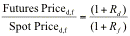
where Futures Priced,f is the number of units of the domestic currency that will be
received for a unit of the foreign currency in a forward contract and Spot Priced,f
is the number of units of the domestic currency that will be received for a
unit of the same foreign currency in a spot contract. For instance, assume that
the one-year interest rate in the United States is 5% and the one-year interest
rate in Germany is 4%. Furthermore, assume that the spot exchange rate is $0.65
per Deutsche Mark. The one-year futures price, based upon interest rate parity,
should be as follows:
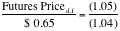
resulting in a futures price of $0.65625 per Deutsche Mark.
Why does this have to be the
futures price? If the futures price were greater than $0.65625, say $0.67, an
investor could take advantage of the mispricing by selling the futures
contract, completely hedging against risk and ending up with a return greater than
the riskfree rate. The actions the investor would need to take are summarized
in Table 11.1, with the cash flows associated with each action in brackets next
to the action.
Table 11.1:
Arbitrage when currency futures contracts are mispriced
|
Forward Rate Mispricing
|
Actions to take today
|
Actions at expiration of futures contract
|
|
If futures price > $0.65625
e.g. $0.67
|
1. Sell a futures contract at $0.67 per Deutsche Mark.
($0.00) $
0.00
2. Borrow the spot price in the U.S. domestic markets @
5%. (+$0.65) +
$ 0.65
3. Convert the dollars into Deutsche Marks at spot price.
(-$0.65/+1 DM) -
$ 0.65/+ 1 DM
4. Invest Deustche Marks in the German market @ 4%. (-1
DM) - 1 DM
|
1. Collect on Deutsche Mark investment. (+1.04 DM) 1.04
DM
2. Convert into dollars at futures price. (-1.04 DM/
+$0.6968) -1.04
DM to + $ 0.6968
3. Repay dollar borrowing with interest. (-$0.6825)
Profit = $0.6968 - $0.6825 = $ 0.0143
|
|
If futures price < $0.65625
e.g. $0.64
|
1. Buy a futures price at $0.64 per Deutsche Mark. ($0.00) $
0.00
2. Borrow the spot rate in the German market @4%. (+1 DM) + 1 DM
3. Convert the Deutsche Marks into Dollars at spot rate.
(-1 DM/+$0.65) - 1 DM/ $ 0.65
4. Invest dollars in the U.S. market @ 5%. (-$0.65) -
$ 0.65
|
1. Collect on Dollar investment. (+$0.6825) $
0.6825
2. Convert into dollars at futures price. (-$0.6825/1.0664
DM) - $ 0.6825 /+1.0664 DM
3. Repay DM borrowing with interest. (1.04 DM)
Profit = 1.0664-1.04 = 0.0264 DM -
1.04 DM
+
0.0264 DM
|
The first arbitrage of Table 11.1 results in a riskless
profit of $0.0143, with no initial investment. The process of arbitrage will
push down futures price towards the equilibrium price.
If
the futures price were lower than $0.65625, the actions would be reversed, with
the same final conclusion. Investors would be able to take no risk, invest no
money and still end up with a positive cash flow at expiration. In the second
arbitrage of Table 34.3, we lay out the actions that would lead to a riskless
profit of .0164 DM.