THEORY BUILDING IN
INDUSTRIAL AND ORGANIZATIONAL PSYCHOLOGY
Jane Webster
and
William H. Starbuck
Pages
93-138 in C. L. Cooper and I. T. Robertson (eds.), International Review of
Industrial and Organizational Psychology 1988; Wiley, 1988.
SUMMARY
I/O psychology has been progressing
slowly. This slowness arises partly from a three-way imbalance: a lack of
substantive consensus, insufficient use of theory to explain observations, and
excessive confidence in induction from empirical evidence. I/O psychologists
could accelerate progress by adopting and enforcing a substantive paradigm.
Staw (1984: 658) observed:
The micro side of
organizational behavior historically has not been strong on theory.
Organizational psychologists have been more concerned ‘with research
methodology, perhaps because of the emphasis upon measurement issues in
personnel selection and evaluation. As an example of this methodological bent,
the I/O Psychology division of the American Psychological Association, when
confronted recently with the task of improving the field’s research, formulated
the problem as one of deficiency in methodology rather than theory
construction.... It is now time to provide equal consideration to theory
formulation.
This chapter explores
the state of theory in I/O psychology and micro-Organizational Behavior (OB).[1]
The chapter argues that these fields have progressed very slowly, and that
progress has occurred so slowly partly because of a three-way imbalance: a lack
of theoretical consensus, inadequate attention to using theory to explain
observations, coupled with excessive confidence in induction from empirical
evidence. As a physicist, J. W. N. Sullivan (1928; quoted by Weber, 1982, p.
54), remarked: ‘It is much easier to make measurements than to know exactly
what you are measuring.’
Well-informed people
hold widely divergent opinions about the centrality and influence of theory.
Consider Dubin’s (1976, p. 23) observation that
managers use theories as moral justifications, that managers may endorse job
enlargement, for example, because it permits more complete delegation of
responsibilities, raises morale and commitment, induces greater effort, and
implies a moral imperative to seek enlarged jobs and increased
responsibilities. Have these consequences anything to do with theory? Job
enlargement is not a theory, but a category of action. Not only do these
actions produce diverse consequences, but the value of any single consequence
is frequently debatable. Is it exploitative to elicit greater effort, because
workers contribute more but receive no more pay? Or is it efficient, because
workers contribute more but receive no more pay? Or is it humane, because
workers enjoy their jobs more? Or is it uplifting, because work is virtuous and
laziness despicable? Nothing compels managers to use job enlargement; they
adopt it voluntarily. Theory only describes the probable consequences if they
do use it. Furthermore, there are numerous theories about work redesigns such
as job enlargement and job enrichment, so managers can choose the theories they
prefer to espouse. Some theories emphasize the consequences of work redesign
for job satisfaction; others highlight its consequences for efficiency, and
still others its effects on accident rates or workers’ health (Campion and Thayer, 1985).
We hold that theories do
make a difference, to non-scientists as well as to scientists, and that
theories often have powerful effects. Theories are not neutral descriptions of
facts. Both prospective and retrospective theories shape facts. Indeed, the
consequences of actions may depend more strongly on the actors’ theories than
on the overt actions. King’s (1974) field experiment illustrates this point. On
the surface, the study aimed at comparing two types of job redesign: a company
enlarged jobs in two plants, and began rotating jobs in two similar plants. But
the study had a 2 x 2 design. Their boss told two of the plant managers that
the redesigns ought to raise productivity but have no effects on industrial relations;
and he told the other two plant managers that the redesigns ought to improve
industrial relations and have no effects on productivity. The observed changes
in productivity and absenteeism matched these predictions: productivity rose
significantly while absenteeism remained stable in those two plants, and
absenteeism dropped while productivity remained constant in the other two
plants. Job rotation and job enlargement, however, yielded the same levels of
productivity and absenteeism. Thus, the differences in actual ways of working
produced no differences in productivity or absenteeism, but the different
rationales did induce different outcomes.
Theories shape facts by
guiding thinking. They tell people what to expect, where to look, what to
ignore, what actions are feasible, what values to hold. These expectations and
beliefs then influence actions and retrospective interpretations, perhaps
unconsciously (Rosenthal, 1966). Kuhn (1970) argued that scientific
collectivities develop consensus around coherent theoretical positions-
paradigms. Because paradigms serve as frameworks for interpreting evidence, for
legitimating findings, and for deciding what studies to conduct, they steer
research into paradigm-confirming channels, and so they reinforce themselves
and remain stable for long periods. For instance, in 1909, Finkelstein reported
in his doctoral dissertation that he had synthesized benzocyclobutene
(Jones, 1966). Finkelstein’s dissertation was rejected for publication because
chemists believed, at that time, such chemicals could not exist, and so his
finding had to be erroneous. Theorists elaborated the reasons for the
impossibility of these chemicals for another 46 years, until Finkelstein’s
thesis was accidentally discovered in 1955.
Although various
observers have argued that the physical sciences have stronger consensus about
paradigms than do the social sciences, the social science findings may be even
more strongly influenced by expectations and beliefs. Because these
expectations and beliefs do not win consensus, they may amplify the
inconsistencies across studies. Among others, Chapman and Chapman (1969),
Mahoney and DeMonbreun (1977) and Snyder (1981) have
presented evidence that people holding prior beliefs emphasize confirmatory
strategies of investigation, they rarely use disconfirmatory strategies, and
they discount disconfirming observations: these confirmatory strategies turn
theories into self-fulfilling prophecies in situations where investigators’
behaviors can elicit diverse responses or where investigators can interpret
their observations in many ways (Tweney et al., 1981). Mahoney (1977)
demonstrated that journal reviewers tend strongly to recommend publication of
manuscripts that confirm their beliefs and to give these manuscripts high
ratings for methodology, whereas reviewers tend strongly to recommend rejection
of manuscripts that contradict their beliefs and to give these manuscripts low
ratings for methodology. Faust (1984) extrapolated these ideas to theory
evaluation and to review articles, such as those in this volume, but he did not
take the obvious next step of gathering data to confirm his hypotheses.
Thus, theories may have
negative consequences. Ineffective theories sustain themselves and tend to
stabilize a science in a state of incompetence, just as effective theories may
suggest insightful experiments that make a science more powerful. Theories
about which scientists disagree foster divergent findings and incomparable
studies that claim to be comparable. So scientists could be better off with no
theories at all than with theories that lead them nowhere or in incompatible
directions. On the other hand, scientists may have to reach consensus on some
base-line theoretical propositions in order to evaluate adequately the effectiveness
of these base-line propositions and the effectiveness of newer theories that
build on these propositions. Consensus on base-line theoretical propositions,
even ones that are somewhat erroneous, may also be an essential prerequisite to
the accumulation of knowledge because such consensus leads scientists to view
their studies in a communal frame of reference (Kuhn, 1970). Thus, it is an
interesting question whether the existing theories or the existing degrees of
theoretical consensus have been aiding or impeding scientific progress in I/O
psychology.
Consequently and
paradoxically, this chapter addresses theory building empirically, and the
chapter’s outline matches the sequence in which we pose questions and seek
answers for them.
First we ask: How much
progress has occurred in I/O psychology? If theories are becoming more and more
effective over time, they should explain higher and higher percentages of
variance. Observing the effect sizes for some major variables, we surmise that
I/O theories have not been improving.
Second, hunting an
explanation for no progress or negative progress, we examine indicators of
paradigm consensus. To our surprise, I/O psychology does not look so different
from chemistry and physics, fields that are perceived as having high paradigm
consensus and as making rapid progress. However, physical science paradigms
embrace both substance and methodology, whereas I/O psychology paradigms
strongly emphasize methodology and pay little attention to substance.
Third, we hypothesize
that I/O psychology’s methodological emphasis is a response to a real problem,
the problem of detecting meaningful research findings against a background of
small, theoretically meaningless, but statistically significant relationships.
Correlations published in the Journal of Applied Psychology seem to
support this conjecture. Thus, I/O psychologists may be de-emphasizing
substance because they do not trust their inferences from empirical evidence.
In the final section, we
propose that I/O psychologists accelerate the field’s progress by adopting and
enforcing a substantive paradigm. We believe that I/O psychologists could
embrace some base-line theoretical propositions that are as sound as Newton’s
laws, and using base-line propositions would project findings into shared
perceptual frameworks that would reinforce the collective nature of research.
PROGRESS IN EXPLAINING VARIANCE
Theories may be evaluated in many ways.
Webb (l961) said good theories exhibit knowledge, skepticism and generalizability. Lave and March (1975) said good theories
are metaphors that embody truth, beauty and justice; whereas unattractive
theories are inaccurate, immoral or unaesthetic. Daft and Wiginton
(1979) said that influential theories provide metaphors, images and concepts that
shape scientists’ definitions of their worlds. McGuire (1983) noted that people
may appraise theories according to internal criteria, such as their logical
consistency, or according to external criteria, such as the statuses of their
authors. Miner (1984) tried to rate theories’ scientific validity and
usefulness in application. Landy and Vasey (1984) pointed out tradeoffs between parsimony and
elegance and between literal and figurative modeling.
Effect sizes measure
theories’ effectiveness in explaining empirical observations or predicting
them. Nelson et al. (1986) found that
psychologists’ confidence in research depends primarily on significance levels
and secondarily on effect sizes. But investigators can directly control
significance levels by making more or fewer observations, so effect sizes
afford more robust measures of effectiveness.
According to the usual
assumptions about empirical research, theoretical progress should produce
rising effect sizes-for example, correlations should get larger and larger over
time. Kaplan (1963: 351-5) identified eight ways in which explanations may be
open to further development; his arguments imply that theories can be improved
by:
1. taking account of more determining
factors,
2. spelling out the conditions under which
theories should be true,
3. making theories more accurate by
refining measures or by specifying more precisely the relations among
variables,
4. decomposing general categories into
more precise subclasses, or aggregating complementary subclasses into general
categories,
5. extending theories to more instances,
6. building up evidence for or against
theories’ assumptions or predictions,
7. embedding theories in theoretical
hierarchies, and
8. augmenting theories with explanations
for other variables or situations.
The first four of these actions should
increase effect sizes if the theories are fundamentally correct, but not if the
theories are incorrect. Unless it is combined with the first four actions,
action (5) might decrease effect sizes even for approximately correct theories.
Action (6) could produce low effect sizes if theories are incorrect.
Social scientists
commonly use coefficients of determination, r2, to measure effect
sizes. Some methodologists have been advocating that the absolute value of r
affords a more dependable metric than r2 in some instances (Ozer,
1985; Nelson et al., 1986). For the
purposes of this chapter, these distinctions make no difference because r2 and the absolute value
of r increase and decrease together. We do, however, want to recognize the
differences between positive and negative relationships, so we use r.
Of the nine effect
measures we use, six are bivariate correlations. One can argue that, to capture
the total import of a stream of research, one has to examine the simultaneous
effects of several independent variables. Various researchers have advocated
multivariate research as a solution to low correlations (Tinsley and Heesacker, 1984; Hackett and Guion,
1985). However, in practice, multivariate research in I/O psychology has not
fulfilled these expectations, and the articles reviewing I/O research have not
noted any dramatic results from the use of multivariate analyses. For instance,
McEvoy and Cascio (1985)
observed that the effect sizes for turnover models have remained small despite
research incorporating many more variables. One reason is that investigators
deal with simultaneous effects in more than one way: they can observe several
independent variables that are varying freely; they can control for moderating
variables statistically; and they can control for contingency variables by
selecting sites or subjects or situations. It is far from obvious that
multivariate correlations obtained in uncontrolled situations should be higher
than bivariate correlations obtained in controlled situations. Indeed, the
rather small gains yielded by multivariate analyses suggest that careful
selection and control of sites or subjects or situations may be much more
important than we have generally recognized.
Scientists’ own
characteristics afford another reason for measuring progress with bivariate
correlations. To be useful, scientific explanations have to be understandable
by scientists; and scientists nearly always describe their findings in
bivariate terms, or occasionally trivariate terms. Even those scientists who
advocate multivariate analyses most fervently fall back upon bivariate and
trivariate interpretations when they try to explain what their analyses really
mean. This brings to mind a practical lesson that Box and Draper (1969)
extracted from their efforts to use experiments to discover more effective ways
to run factories: Box and Draper concluded that practical experiments should
manipulate only two or three variables at a time because the people who
interpret the experimental findings have too much difficulty making sense of
interactions among four or more variables. Speaking directly of the inferences
drawn during scientific research, Faust (1984) too pointed out the difficulties
that scientists have in understanding four-way interactions (Meehl, 1954; Goldberg, 1970). He noted that the great
theoretical contributions to the physical sciences have been distinguished by
their parsimony and simplicity rather than by their articulation of complexity.
Thus, creating theories that psychologists themselves will find satisfying
probably requires the finding of strong relationships among two or three
variables.
To track progress in I/O
theory building, we gathered data on effect sizes for five variables that I/O
psychologists have often studied. Staw (1984)
identified four heavily researched variables: job satisfaction, absenteeism,
turnover and job performance. I/O psychologists also regard leadership as an
important topic: three of the five annual reviews of organizational behavior
have included it (Mitchell, 1979; Schneider, 1985; House and Singh, 1987).
Other evidence supports
the centrality of these five variables for I/O psychologists. De Meuse (1986) made a census of dependent variables in I/O
psychology, and identified job satisfaction as one of the most frequently used
measures; it had been the focus of over 3000 studies by 1976 (Locke, 1976).
Psychologists have correlated job satisfaction with numerous variables: Here,
we examine its correlations with job performance and with absenteeism.
Researchers have made job performance I/O psychology’s most important dependent
variable, and absenteeism has attracted research attention because of its costs
(Hackett and Guion, 1985). We look at correlations of
job satisfaction with absenteeism because researchers have viewed absenteeism
as a consequence of employees’ negative attitudes (Staw,
1984).
Investigators have
produced over 1000 studies on turnover (Steers and Mowday,
1981). Recent research falls into one of two categories: turnover as the
dependent variable when assessing a new work procedure, and correlations
between turnover and stated intentions to quit (Staw,
1984).
Although researchers
have correlated job performance with job satisfaction for over fifty years,
more consistent performance differences have emerged in studies of behavior
modification and goal setting (Staw, 1984). Miner
(1984) surveyed organizational scientists, who nominated behavior modification
and goal setting as the two of the most respected theories in the field.
Although these two theories overlap (Locke, 1977; Miner, 1980), they do have
somewhat different traditions, and so we present them separately here.
Next to job performance,
investigators have studied leadership most often (Mitchell, 1979; De Meuse, 1986). Leadership research may be divided roughly
into two groups: theories about the causes of leaders’ behaviors, and theories
about contingencies influencing the effectiveness of leadership styles.
Research outside these two groups has generated too few studies for us to trace
effect sizes over time (Van Fleet and Yukl, 1986).
Many years ago,
psychologists seeking ways to identify effective leaders focused their research
on inherent traits. This work, however, turned up very weak relationships, and
no set of traits correlated consistently with leaders’ effectiveness. Traits
also offended Americans’ ideology espousing equality of opportunity (Van Fleet
and Yukl, 1986). Criticisms of trait approaches
directed research towards contingency theories (Lord et al., 1986). But these studies too turned up very weak
relationships, so renewed interest in traits has surfaced (Kenny and Zaccaro, 1983; Schneider, 1985). As an example of the trait
theories, we examine the correlations of intelligence with perceptions of
leadership, because these have demonstrated the highest and most consistent
relationships.
It is impossible to
summarize the effect sizes of contingency theories of leadership in general.
First, even though leadership theorists have proposed many contingency
theories, little research has resulted (Schriesheim
and Kerr, 1977), possibly because some of the contingency theories may be too
unclear to suggest definitive empirical studies (Van Fleet and Yukl, 1986). Second, different theories emphasize different
dependent variables (Campbell, 1977; Schriesheim and
Kerr, 1977; Bass, 1981). Therefore, one must focus on a particular contingency
theory. We examine Fiedler’s (1967) theory because Miner (1984) reported that organizational
scientists respect it highly.
Sources
A manual search of thirteen journals[2]
turned up recent review articles concerning the five variables of interest; Borgen et al.
(1985) identified several of these review articles as exemplary works. We took
data from articles that reported both the effect sizes and the publication
dates of individual studies. Since recent review articles did not cover older
studies well, we supplemented these data by examining older reviews, in books
as well as journals. In all, data came from the twelve sources listed in Table
1; these articles reviewed 261 studies.
|
Table 1 – Review
Article Sources |
|
|
Job satisfaction |
Iaffaldano
and Muchinsky (1985) |
|
|
Vroom (1964) |
|
|
Brayfield
and Crockett (1955) |
|
|
|
|
Absenteeism |
Hackett and Guion
(1985) |
|
|
Vroom (1964) |
|
|
Brayfield
and Crockett (1955) |
|
|
|
|
Turnover |
McEvoy
and Cascio (1985) |
|
|
Steel and Ovalle
(1984) |
|
|
|
|
Job Performance |
Hopkins and Sears (1982) |
|
|
Locke et al. (1980) |
|
|
|
|
Leadership |
Lord et al. (1986) |
|
|
Peters et al. (1985) |
|
|
Mann (1959) |
|
|
Stogdill
(1948) |
Measures
Each research study is represented by a
single measure of effect: for a study that measured the concepts in more than one
way, we averaged the reported effect sizes.
To trace changes in
effect sizes over time, we divided time into three equal periods. For instance,
for studies from 1944 to 1983, we compare the effect sizes for 1944-57, 1958-70
and 1971-83.
Results
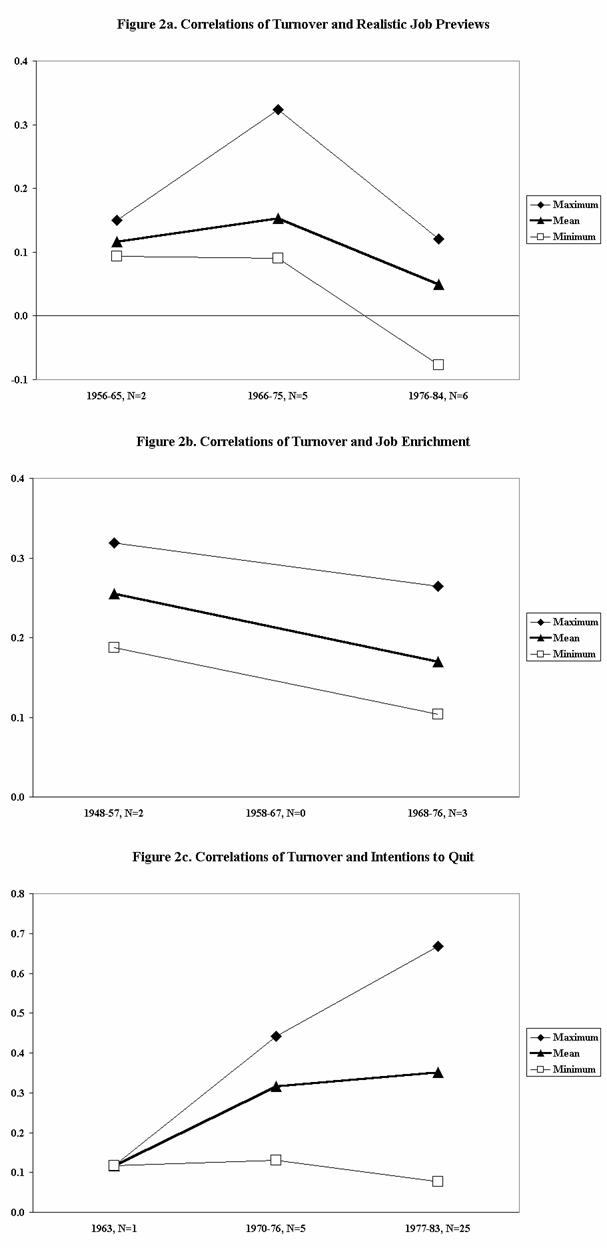
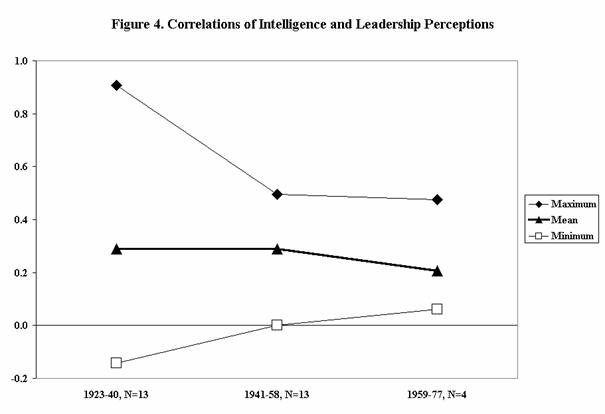
Figures 1-4 present the minimum, maximum
and average effect sizes for the five variables of interest. Three figures
(1(a), 3(b) and 4) seem to show that no progress has occurred over time; and
four figures (1(b), 2(a), 2(b) and 3(a)) seem to indicate that effect sizes
have gradually declined toward zero over time. The largest of these
correlations is only .22 in the most recent time period, so all of these
effects account for less than five per cent of the variance.


Moreover, four of these relationships
(2(a), 2(b), 3(a) and 3(b)) probably incorporate Hawthorne effects: They
measure the effects of interventions. Because all interventions should yield
some effects, the differential impacts of specific interventions would be less
than these effect measures suggest. That is, the effects of behavior
modification, for example, should not be compared with inaction, but compared
with those of an alternative intervention, such as goal setting.
Figure 2(c) is the only
one suggesting significant progress. Almost all of this progress, however,
occurred between the first two time periods: Because only one study was
conducted during the first of these periods, the apparent progress might be no
more than a statement about the characteristics of that single study. This
relationship is also stronger than the others, although not strong enough to
suggest a close causal relationship: The average correlation in the most recent
time period is .40. What this correlation says is that some of the people who
say in private that they intend to quit actually do quit.
Progress with respect to
Fiedler’s contingency theory of leadership is not graphed. Peters et al. (1985) computed the average
correlations (corrected for sampling error) of leadership effectiveness with
the predictions of this theory. The absolute values of the correlations
averaged .38 for the studies from which Fiedler derived this theory
(approximately 1954-65); but for the studies conducted to validate this theory
(approximately 1966-78), the absolute values of the correlations averaged .26.
Thus, these correlations too have declined toward zero over time.
I/O psychologists have
often argued that effects do not have to be absolutely large in order to
produce meaningful economic consequences. (Zedeck and
Cascjo, 1984; Schneider, 1985). For example, goal
setting produced an average performance improvement of 21.6 per cent in the
seventeen studies conducted from 1969 to 1979. If performance has a high
economic value and goal setting costs very little, then goal setting would be
well worth doing on the average. And because the smallest performance
improvement was 2 per cent, the risk that goal setting would actually reduce
performance seems very low (Cascjo, 1984; Schneider,
1985). For example, goal setting produced an average performance improvement of
21.6 per cent in the seventeen studies conducted from 1969 to 1979. If
performance has a high economic value and goal setting costs very little, then
goal setting would be well worth doing on the average. And because the smallest
performance improvement was 2 per cent, the risk that goal setting would
actually reduce performance seems very low.
This chapter, however,
concerns theoretical development; and so the economic benefits of relations
take secondary positions to identifying controllable moderators, to clarifying
causal links, and to increasing effect sizes. In terms of theoretical
development, it is striking that none of these effect sizes rose noticeably
after the first years. This may have happened for any of five reasons, or more
likely a combination of them:
(a)
Researchers may be clinging to incorrect theories despite
disconfirming evidence (Staw, 1976). This would be
more likely to happen where studies’ findings can be interpreted in diverse
ways. Absolutely small correlations nurture such equivocality, by making it
appear that random noise dominates any systematic relationships and that
undiscovered or uninteresting influences exert much more effect than the known
ones.
(b)
Researchers may be continuing to elaborate traditional methods of
information gathering after these stop generating additional knowledge. For
example, researchers developed very good leadership questionnaires during the
early 1950s. Perhaps these early questionnaires picked up all the information
about leadership that can be gathered via questionnaires. Thus, subsequent
questionnaires may not have represented robust improvements; they may merely
have mistaken sampling variations for generalities.
(c)
Most studies may fail to take advantage of the knowledge produced
by the very best studies. As a sole explanation, this would be unlikely even in
a world that does not reward exact replication, because research journals
receive wide distribution and researchers can easily read reports of others’
projects. However, retrospective interpretations of random variations may
obscure real knowledge in clouds of ad hoc rationalizations, so the consumers
of research may have difficulty distinguishing real knowledge from false.
Because we
wanted to examine as many studies as possible and studies of several kinds of
relationships, we did not attempt to evaluate the methodological qualities of
studies. Thus, we are using time as an implicit measure of improvement in
methodology. But time may be a poor indicator of methodological quality if new
studies do not learn much from the best studies. Reviewing studies of the
relationship between formal planning and profitability, Starbuck (1985)
remarked that the lowest correlations came in the studies that assessed
planning and profitability most carefully and that obtained data from the most
representative samples of firms.
(d)
Those studies obtaining the maximum effect sizes may do so for
idiosyncratic or unknown reasons, and thus produce no generalizable
knowledge. Researchers who provide too little information about studied sites,
subjects, or situations make it difficult for others to build upon their
findings (Orwin and Cordray,
1985); several authors have remarked that many studies report too little
information to support meta-analyses (Steel and Ovalle,
1984; Iaffaldano and Muchinsky,
1985; Scott and Taylor, 1985). The tendencies of people, including scientists,
to use confirmatory strategies mean that they attribute as much of the observed
phenomena as possible to the relationships they expect to see (Snyder, 1981;
Faust, 1984; Klayman and Ha, 1987). Very few studies
report correlations above .5, so almost all studies leave much scope for
misattribution and misinterpretation.
(e)
Humans’ characteristics and behaviors may actually change faster
than psychologists’ theories or measures improve. Stagner
(1982) argued that the context of I/O psychology has changed considerably over
the years: the economy has shifted from production to service industries, jobs
have evolved from heavy labor to cognitive functions, employees’ education
levels have risen, and legal requirements have multiplied and changed,
especially with respect to discrimination. For instance, Haire
et al. (1966) found that managers’
years of education correlate with their ideas about proper leadership, and
education alters subordinates’ concepts of proper leadership (Dreeben, 1968; Kunda, 1987). In
the US, median educational levels have risen considerably, from 9.3 years in
1950 to 12.6 years in 1985 (Bureau of the Census, 1987). Haire
et al. also attributed 25 per cent of
the variance in managers’ leadership beliefs to national differences: so, as
people move around, either between countries or within a large country, they
break down the differences between regions and create new beliefs that
intermingle beliefs that used to be distinct. Cummings and Schmidt (1972)
conjectured plausibly that beliefs about proper leadership vary with
industrialization; thus, the ongoing industrialization of the American
south-east and southwest and the concomitant deindustrialization of the
north-east are altering Americans’ responses to leadership questionnaires.
Whatever the reasons,
the theories of I/O psychology explain very small fractions of observed
phenomena, I/O psychology is making little positive progress, and it may
actually be making some negative progress. Are these the kinds of results that
science is supposed to produce?
PARADIGM CONSENSUS
Kuhn (1970) characterized scientific
progress as a sequence of cycles, in which occasional brief spurts of
innovation disrupt long periods of gradual incremental development. During the
periods of incremental development, researchers employ generally accepted
methods to explore the implications of widely accepted theories. The
researchers supposedly see themselves as contributing small but lasting
increments to accumulated stores of well-founded knowledge; they choose their
fields because they accept the existing methods, substantive beliefs and
values, and consequently they find satisfaction in incremental development
within the existing frames of reference. Kuhn used the term paradigm to denote
one of the models that guide such incremental developments. Paradigms, he
(1970, p. 10) said, provide ‘models from which spring particular coherent traditions
of scientific research’.
Thus, Kuhn defined
paradigms, not by their common properties, but by their common effects. His
book actually talks about 22 different kinds of paradigm (Masterman,
1970), which Kuhn placed into two broad categories: (a) a constellation of
beliefs, values and techniques shared by a specific scientific community; and
(b) an example of effective problem-solving that becomes an object of imitation
by a specific scientific community.
I/O psychologists have
traditionally focused on a particular set of variables: the nucleus of this set
would be those examined in the previous section-job satisfaction, absenteeism,
turnover, job performance and leadership. Also, we believe that substantial
majorities of I/O psychologists would agree with some base-line propositions
about human behavior. However, Campbell et
al. (1982) found a lack of consensus among American I/O psychologists
concerning substantive research goals. They asked them to suggest ‘the major
research needs that should occupy us during the next 10-15 years (p. 155): 105
respondents contributed 146 suggestions, of which 106 were unique. Campbell et al. (1982, p. 71) inferred: ‘The
field does not have very well worked out ideas about what it wants to do. There
was relatively little consensus about the relative importance of substantive
issues.’
Shared Beliefs, Values and Techniques
I/O psychologists do seem to have a
paradigm of type (a)-shared beliefs, values, and techniques, but it would seem
to be a methodological paradigm rather than a substantive one. For instance,
Watkins et al.’s (1986) analysis of
the 1984-85 citations in three I/O journals revealed that a methodologist,
Frank L. Schmidt, has been by far the most cited author. In this methodological
orientation, I/O psychology fits a general pattern: numerous authors have
remarked on psychology’s methodological emphasis (Deese,
1972; Koch, 1981; Sanford, 1982). For instance, Brackbill
and Korten (1970, p. 939) observed that psychological
‘reviewers tend to accept studies that are methodologically sound but
uninteresting, while rejecting research problems that are of significance for
science or society but for which faultless methodology can only be
approximated.’ Bakan (1974) called psychology
‘methodolatrous’. Contrasting psychology’s development with that of physics, Kendler (1984, p. 9) argued that ‘Psychological revolutions
have been primarily methodological in nature.’ Shames (1987, p. 264)
characterized psychology as ‘the most fastidiously committed, among the scientific
disciplines, to a socially dominated disciplinary matrix which is almost
exclusively centred on method.’
I/O psychologists not
only emphasize methodology, they exhibit strong consensus about methodology.
Specifically, I/O psychologists speak and act as if they believe they should
use questionnaires, emphasize statistical hypothesis tests, and raise the
validity and reliability of measures. Among others, Campbell (1982, p. 699)
expressed the opinion that 110 psychologists have been relying too much on ‘the
self-report questionnaire, statistical hypothesis testing, and multivariate
analytic methods at the expense of problem generation and sound measurement’.
As Campbell implied, talk about reliability and especially validity tends to be
lip-service: almost always, measurements of reliability are self-reflexive
facades and no direct means even exist to assess validity. I/O psychologists
are so enamored of statistical hypothesis tests that they often make them when
they are inappropriate, for instance when the data are not samples but entire
sub-populations, such as all the employees of one firm, or all of the members
of two departments. Webb et al.
(1966) deplored an overdependence on interviews and questionnaires, but I/O
psychologists use interviews much less often than questionnaires (Stone, 1978).
An emphasis on
methodology also characterizes the social sciences at large. Garvey et al. (1970) discovered that editorial
processes in the social sciences place greater emphasis on statistical procedures
and on methodology in general than do those in the physical sciences; and
Lindsey and Lindsey (1978) factor analysed social
science editors’ criteria for evaluating manuscripts and found that a
quantitative-methodological orientation arose as the first factor. Yet, other
social sciences may place somewhat less emphasis on methodology than does I/O
psychology. For instance, Kerr et al.
(1977) found little evidence that methodological criteria strongly influence
the editorial decisions by management and social science journals. According to
Kerr et al., the most influential
methodological criterion is statistical insignificance, and the editors of
three psychological journals express much stronger negative reactions to
insignificant findings than do editors of other journals.
Mitchell et al. (1985) surveyed 139 members of
the editorial boards of five journals that publish work related to
organizational behavior, and received responses from 99 editors. Table 2
summarizes some of these editors’ responses.[3]
The average editor said that ‘importance’ received more weight than other
criteria; that methodology and logic were given nearly equal weights, and that
presentation carried much less weight. When asked to assign weights among three
aspects of ‘importance’, most editors said that scientific contribution
received much more weight than practical utility or readers’ probable interest
in the topic. Also, they assigned nearly equal weights among three aspects of
methodology, but gave somewhat more weight to design.
Table 2 compares the
editors of two specialized I/O journals-Journal of Applied Psychology (JAP)
and Organizational Behavior and Human Decision Processes (OBHDP)-with
the editors of three more general management journals- Academy of Management
Journal (AMJ), Academy of Management Review (AMR) and Administrative
Science Quarterly (ASQ). Contrary to our expectations, the average editor
of the two I/O journals said that he or she allotted more weight to
‘importance’ and less weight to methodology than did the average editor of the
three management journals. It did not surprise us that the average editor of
the I/O journals gave less weight to the presentation than did the average
editor of the management journals. Among aspects of methodology, the average
I/O editor placed slightly more weight on design and less on measurement than
did the average management editor. When assessing ‘importance’, the average I/O
editor said that he or she gave distinctly less weight to readers’ probable
interest in a topic and more weight to practical utility than did the average
management editor. Thus, the editors of I/O journals may be using practical
utility to make up for I/O psychologists’ lack of consensus concerning
substantive research goals: if readers disagree about what is interesting, it
makes no sense to take account of their preferences (Campbell et al., 1982).
|
Table 2 – Review
Article Sources |
|||
|
|
|
|
|
|
Relative weights among
four general criteria |
|||
|
|
All
five journals |
JAP
and OBHDP |
AMJ,
AMR, and ASQ |
|
‘Importance’ |
35 |
38 |
34 |
|
Methodology |
26 |
25 |
27 |
|
Logic |
24 |
24 |
24 |
|
Presentation |
15 |
13 |
16 |
|
|
|
|
|
|
Relative weights among
three aspects of importance |
|||
|
|
All
five journals |
JAP
and OBHDP |
AMJ,
AMR, and ASQ |
|
Scientific contribution |
53 |
54 |
53 |
|
Practical utility |
28 |
31 |
26 |
|
Readers’ interest in topic |
19 |
14 |
21 |
|
|
|
|
|
|
Relative weights among
three aspects of methodology |
|||
|
|
All
five journals |
JAP
and OBHDP |
AMJ,
AMR, and ASQ |
|
Design |
38 |
39 |
37 |
|
Measurement |
31 |
30 |
32 |
|
Analysis |
31 |
31 |
31 |
|
|
|||
Editors’ stated priority
of ‘importance’ over methodology contrasts with the widespread perception that psychology
journals emphasize methodology at the expense of substantive importance. Does
this contrast imply that the actual behaviors of journal editors diverge from
their espoused values? Not necessarily. If nearly all of the manuscripts
submitted to journals use accepted methods, editors would have little need to
emphasize methodology. And if, like I/O psychologists in general, editors
disagree about the substantive goals of I/O research, editors’ efforts to
emphasize ‘importance’ would work at cross-purposes and have little net effect.
Furthermore, editors would have restricted opportunities to express their
opinions about what constitutes scientific contribution or practical utility if
most of the submitted manuscripts pursue traditional topics and few manuscripts
actually address ‘research problems that are of significance for science or
society’.
Objects of Imitation
I/O psychology may also have a few
methodological and substantive paradigms of type (b) examples that become
objects of imitation. For instance, Griffin (1987, pp. 82-3) observed:
The [Hackman
and Oldham] job characteristics theory was one of the most widely studied and
debated models in the entire field during the late 1970s. Perhaps the reasons
behind its widespread popularity are that it provided an academically sound
model, a packaged and easily used diagnostic instrument, a set of
practitioner-oriented implementation guidelines, and an initial body of
empirical support, all within a relatively narrow span of time. Interpretations
of the empirical research pertaining to the theory have ranged from inferring
positive to mixed to little support for its validity. (References omitted.)
Watkins et al. (1986) too found evidence of
interest in Hackman and Oldham’s (1980)
job-characteristics theory: five of the twelve articles that were most
frequently cited by I/O psychologists during 1984-85 were writings about this
theory, including Roberts and Glick’s (1981) critique of its validity. Although
its validity evokes controversy, Hackman and Oldham’s
theory seems to be the most prominent current model for imitation. As well, the
citation frequencies obtained by Watkins et
al. (1986), together with nominations of important theories collected by
Miner (1984), suggest that two additional theories attract considerable
admiration: Katz and Kahn’s (1978) open-systems theory and Locke’s (1968)
goal-setting theory. It is hard to see what is common among these three
theories that would explain their roles as paradigms; open-systems theory, in
particular, is much less operational than job-characteristics theory, and it is
more a point of view than a set of propositions that could be confirmed or
disconfirmed.
To evaluate more
concretely the paradigm consensus among I/O psychologists, we obtained several indicators
that others have claimed relate to paradigm consensus.
Measures
As indicators of paradigm consensus,
investigators have used: the ages of references, the percentages of references
to the same journal, the numbers of references per article, and the rejection
rates of journals.
Kuhn proposed that
paradigm consensus can be evaluated through literature references. He
hypothesized that during normal-science periods, references focus upon older,
seminal works; and so the numbers and types of references indicate
connectedness to previous research (Moravcsik and Murgesan, 1975). First, in a field with high paradigm
consensus, writers should cite the key works forming the basis for that field
(Small, 1980). Alternatively, a field with a high proportion of recent
references exhibits a high degree of updating, and so has little paradigm
consensus. One measure of this concept is the Citing Half-Life, which shows the
median age of the references in a journal. Second, referencing to the same
journal should reflect an interaction with research in the same domain, so
higher referencing to the same journal should imply higher paradigm consensus.
Third, since references reflect awareness of previous research, a field with
high paradigm consensus should have a high average number of references per
article (Summers, 1979).
Journals constitute the
accepted communication networks for transmitting knowledge in psychology
(Price, 1970; Pinski and Narin,
1979), and high paradigm consensus means agreement about what research deserves
publication. Zuckerman and Merton (1971) said that the humanities demonstrate
their pre-paradigm states through very high rejection rates by journals,
whereas the social sciences exhibit their low paradigm consensus through high
rejection rates, and the physical sciences show their high paradigm consensus
through low rejection rates. That is, paradigm consensus supposedly enables
physical scientists to predict reliably whether their manuscripts are likely to
be accepted for publication, and so they simply do not submit manuscripts that
have little chance of publication.
Results
Based partly on work by Sharplin and Mabry (1985), Salancik
(1986) identified 24 ‘organizational social science journals’. He divided these
into five groups that cite one another frequently; the group that Salancik labeled Applied corresponds closely to I/O
psychology.[4]
Figure 5 compares these groups with respect to citing half-lives, references to
the same journal, and numbers of references per article. The SSCI Journal Citation
Reports (Social Science Citation Index, Garfield, 198 1-84b) provided these
three measures, although a few data were missing. We use four-year averages in
order to smooth the effects of changing editorial policies and of the
publication of seminal works (Blackburn and Mitchell, 1981). Figure 5 also
includes comparable data for three fields that do not qualify as
‘organizational social science’-chemistry, physics, and management information
systems (MIS). [5]
Data concerning chemistry, physics and MIS hold special interest because they
are generally believed to be making rapid progress; MIS may indeed be in a
pre-paradigm state.
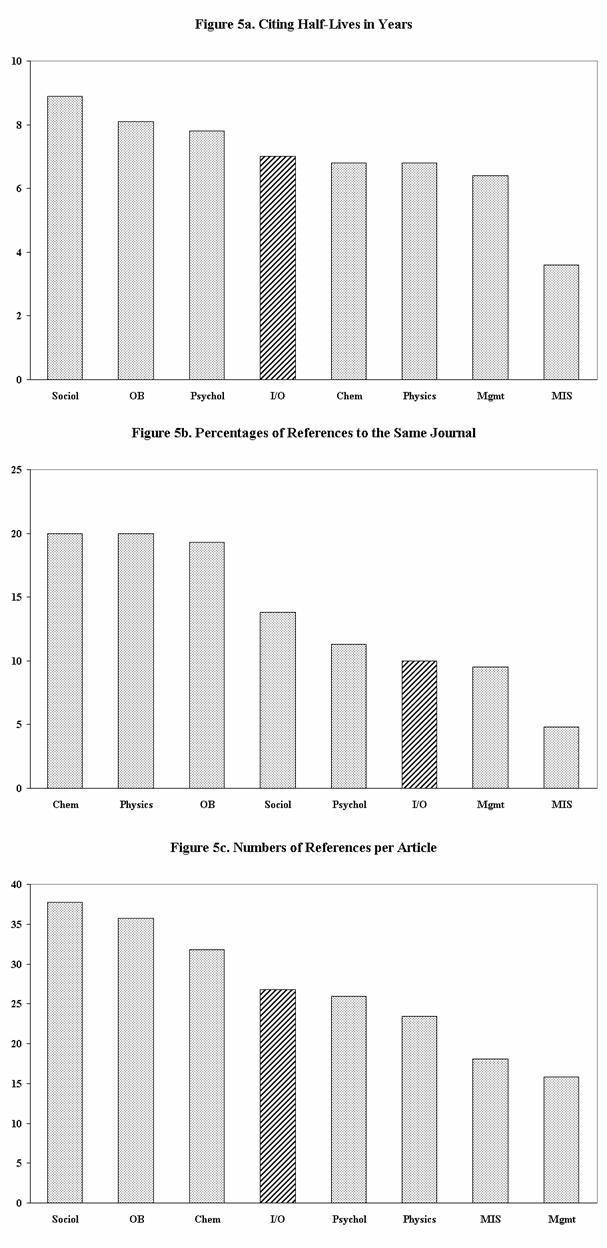
Seven of the eight
groups of journals have average citing half-lives longer than five years, the
figure that Line and Sandison (1974) proposed as
signaling a high degree of updating. Only MIS journals have a citing half-life
below five years; this field is both quite new and changing with extreme
rapidity. I/O psychologists update references at the same pace as chemists and
physicists, and only slightly faster than other psychologists and OB
researchers.
Garfield (1972) found
that referencing to the same journal averages around 20 per cent across diverse
fields, and chemists and physicists match this average. All five groups of
‘organizational social science’ journals average below 20 per cent references
to the same journal, so these social scientists do not focus publications in
specific journals to the same degree as physical scientists, although the OB
researchers come close to the physical-science pattern. The I/O psychologists,
however, average less than 10 per cent references to the same journal, so they
focus publications even less than most social scientists. MIS again has a much
lower percentage than the other fields.
Years ago, Price (1965)
and Line and Sandison (1974) said 15-20 references
per article indicated strong interaction with previous research. Because the
numbers of references have been increasing in all fields (Summers, 1979),
strong interaction probably implies 25-35 references per article today. I/O
psychologists use numbers of references that fall within this range, and that
look much like the numbers for chemists, physicists and other psychologists.
We could not find
rejection rates for management, organizations and sociology journals, but
Jackson (1986) and the American Psychological Association (1986) published
rejection rates for psychology journals during 1985. In that year, I/O
psychology journals rejected 82.5 per cent of the manuscripts, which is near
the 84.3 per cent average for other psychology journals. By contrast, Zuckerman
and Merton (1971) reported that the rejection rates for chemistry and physics
journals were 31 and 24 per cent respectively. Similarly, Garvey et al. (1970) observed higher rejection
rates and higher rates of multiple rejections in the social sciences than in
the physical sciences. However, these differences in rejection rates may
reflect the funding and organization of research more than its quality or
substance: American physical scientists receive much more financial support
than do social scientists, most grants for physical science research go to
rather large teams, and physical scientists normally replicate each others’
findings. Thus, most physical science research is evaluated in the process of
awarding grants as well as in the editorial process, teams evaluate and revise
their research reports internally before submitting them to journals, and
researchers have incentives to replicate their own findings before they publish
them. The conciseness of physical science articles reduces the costs of
publishing them. Also, since the mid-1950s, physical science journals have
asked authors to pay voluntary page charges, and authors have
characteristically drawn upon research grants to pay these charges.
Peters and Ceci (1982) demonstrated for psychology in general that a
lack of substantive consensus shows up in review criteria. They chose twelve
articles that had been published in psychology journals, changed the authors’
names, and resubmitted the articles to the same journals that had published
them: The resubmissions were evaluated by 38 reviewers. Eight per cent of the
reviewers detected that they had received resubmissions, which terminated
review of three of the articles. The remaining nine articles completed the
review process, and eight of these were rejected. The reviewers stated mainly
methodological reasons rather than substantive ones for rejecting articles, but
Mahoney’s (1977) study suggests that reviewers use methodological reasons to
justify rejection of manuscripts that violate the reviewers’ substantive
beliefs.
Figure 6 graphs changes
in four indicators from 1957 to 1984 for the Journal of Applied Psychology and,
where possible, for other I/O psychology journals.[6]
Two of the indicators in Figure 6 have remained quite constant; one indicator
has risen noticeably; and one has dropped noticeably. According to the writers
on paradigm consensus, all four of these indicators should rise
as consensus increases. If these
indicators actually do measure paradigm consensus, I/O psychology has not been
developing distinctly more paradigm consensus over the last three decades.

Overall, the foregoing
indicators imply that I/O psychology looks much like management, sociology, and
other areas of psychology. In two dimensions- citing half-lives and references
per article-I/O psychology also resembles chemistry and physics, fields that
are usually upheld as examples of paradigm consensus (Lodahl
and Gordon, 1972). I/O psychology differs from chemistry and physics in
references to the same journal and in rejection rates, but the latter
difference is partly, perhaps mainly, a result of government policy. Hedges
(1987) found no substantial differences between physics and psychology in the
consistency of results across studies, and Knorr-Cetina’s
(1981) study suggests that research in chemistry incorporates the same kinds of
uncertainties, arbitrary decisions and interpretations, social influences, and
unproductive tangents that mark research in psychology.
Certainly, these
indicators do not reveal dramatic differences between I/O psychology and
chemistry or physics. However, these indicators make no distinctions between
substantive and methodological paradigms. The writings on paradigms cite
examples from the physical sciences that are substantive at least as often as
they are methodological; that is, the examples focus upon Newton’s laws or
phlogiston or evolution, as well as on titration or dropping objects from the
Tower of Pisa. Though far from a representative sample, this suggests that
physical scientists place more emphasis on substantive paradigms than I/O
psychologists do; but since I/O psychology seems to be roughly as paradigmatic
as chemistry and physics, this in turn suggests that I/O psychologists place
more emphasis on methodological paradigms than physical scientists do.
Perhaps I/O
psychologists tend to de-emphasize substantive paradigms and to emphasize
methodological ones because they put strong emphasis on trying to discover
relationships by induction. But can analyses of empirical evidence produce
substantive paradigms where no such paradigms already exist?
INDUCING RELATIONSHIPS FROM OBSERVATIONS
Our colleague Art Brief has been heard to
proclaim, ‘Everything correlates .1 with everything else.’ Suppose, for the
sake of argument, that this were so. Then all observed correlations would
deviate from the null hypothesis of a correlation less than zero, and a sample
of 272 or more would produce statistical significance at the .05 level with a
one-tailed test. If researchers would make sure that their sample sizes exceed
272, all observed correlations would be significantly greater than zero.
Psychologists would be inundated with small, but statistically significant, correlations.
In fact, psychologists
could inundate themselves with small, statistically significant correlations
even if Art Brief is wrong. By making enough observations, researchers can be
certain of rejecting any point null hypothesis that defines an infinitesimal
point on a continuum, such as the, hypothesis that two sample means are exactly
equal, as well as the hypothesis that a correlation is exactly zero. If a point
hypothesis is not immediately rejected, the researcher need only gather more
data. If an observed correlation is .04, a researcher would have to make 2402
observations to achieve significance at the .05 level with a two-tailed test;
and if the observed correlation is .2, the researcher will need just 97
observations.
Induction requires distinguishing
meaningful relationships (signals) against an obscuring background of
confounding relationships (noise). The background of weak and meaningless or
substantively secondary correlations may not have an average value of zero and
may have a variance greater than that assumed by statistical tests. Indeed, we
hypothesize that the distributions of correlation coefficients that researchers
actually encounter diverge quite a bit from the distributions assumed by
statistical tests, and that the background relationships have roughly the same
order of magnitude as the meaningful ones, partly because researchers’
nonrandom behaviors construct meaningless background relationships. These
meaningless relationships make induction untrustworthy.
In many tasks, people
can distinguish weak signals against rather strong background noise. The reason
is that both the signals and the background noise match familiar patterns.
People have trouble making such distinctions where signals and noise look much
alike or where signals and noise have unfamiliar characteristics. Psychological
research has the latter characteristics. The activity is called research
because its outputs are unknown; and the signals and noise look a lot alike in
that both have systematic components and both contain components that vary
erratically. Therefore, researchers rely upon statistical techniques to make
these distinctions. But these techniques assume: (a) that the so-called random
errors really do cancel each other out so that their average values are close
to zero; and (b) that the so-called random errors in different variables are
uncorrelated. These are very strong assumptions because they presume that the
researchers’ hypotheses encompass absolutely all of the systematic effects in
the data, including effects that the researchers have not foreseen or measured.
When these assumptions are not met, the statistical techniques tend to mistake
noise for signal, and to attribute more importance to the researchers’
hypotheses than they deserve. It requires very little in the way of systematic
‘errors’ to distort or confound correlations as small as those I/O
psychologists usually study.
One reason to expect
confounding background relationships is that a few broad characteristics of people
and social systems pervade psychological data. One such characteristic is
intelligence: Intelligence correlates with many other characteristics and
behaviors, such as leadership, job satisfaction, job performance, social class,
income, education and geographic location during childhood. These correlates of
intelligence tend to correlate with each other, independently of any direct
causal relations among them, because of their common relation to intelligence.
Other broad characteristics that correlate with many variables include sex,
age, social class, education, group or organizational size, and geographic
location.
A group of related
organization-theory studies illustrates how broad characteristics may mislead
researchers. In 1965, Woodward hypothesized that organizations employing
different technologies adopt different structures, and she presented some data
supporting this view. There followed many studies that found correlations
between various measures of organization-level technology and measures of
organizational structure. Researchers devoted considerable effort to refining
the measures of technology and structure and to exploring variations on this
general theme. After some fifteen years of research, Gerwin
(1981) pulled together all the diverse findings: Although a variety of
significant correlations had been observed, virtually all of them differed
insignificantly from zero when viewed as partial correlations with
organizational size controlled.
Researchers’ control is
a second reason to expect confounding background relationships. Researchers
often aggregate numerous items into composite variables; and the researchers
themselves decide (possibly indirectly via a technique such as factor analysis)
which items to include in a specific variable and what weights to give to
different items. By including in two composite variables the same items or
items that differ quite superficially from each other, researchers generate
controllable but substantively meaningless correlations between the composites.
Obviously, if two composite variables incorporate many very similar items, the
two composites will be highly correlated. In a very real sense, the
correlations between composite variables lie entirely within the researchers
control; researchers can construct these composites such that they correlate
strongly or weakly, and so the ‘observed’ correlations convey more information
about the researchers’ beliefs than about the situations that the researchers
claim to have observed.
The renowned Aston
studies show how researchers’ decisions may determine their findings (Starbuck,
1981). The Aston researchers made 1000-2000 measurements of each organization,
and then aggregated these into about 50 composite variables. One of the
studies’ main findings was that four of these composite variables-functional
specialization, role specialization, standardization and
formalization-correlate strongly: The first Aston study found correlations
ranging from .57 to .87 among these variables. However, these variables look a lot
alike when one looks into their compositions: Functional specialization and
role specialization were defined so that they had to correlate positively, and
so that a high correlation between them indicated that the researchers observed
organizations having different numbers of specialities. Standardization
measured the presence of these same specialities, but did so by noting the
existence of documents; and formalization too was measured by the presence of
documents, frequently the same documents that determined standardization. Thus,
the strong positive correlations were direct consequences of the researchers’
decisions about how to construct the variables.
Focused sampling is a
third reason to anticipate confounding background relationships. So-called samples
are frequently not random, and many of them are complete sub-populations. If,
for example, a study obtains data from every employee in a single firm, the
number of employees should not be a sample size for the purposes of statistical
tests: For comparisons among these employees, complete sub-populations have
been observed, the allocations of specific employees to these sub-populations
are not random but systematic, and statistical tests are inappropriate. For
extrapolation of findings about these employees to those in other firms, the
sample size is one firm. This firm, however, is unlikely to have been selected
by a random process from a clearly defined sampling frame and it may possess
various distinctive characteristics that make it a poor basis for generalization
- such as its willingness to allow psychologists entry, or its geographic
location, or its unique history.
These are not
unimportant quibbles about the niceties of sampling. Study after study has
turned up evidence that people who live close together, who work together, or
who socialize together tend to have more attitudes, beliefs, and behaviors in
common than do people who are far apart physically and socially. That is,
socialization and interaction create distinctive sub-populations. Findings
about any one of these sub-populations probably do not extrapolate to others
that lie far away or that have quite dissimilar histories or that live during
different ages. It would be surprising if the blue-collar workers in a steel
mill in Pittsburgh were to answer a questionnaire in the same way as the
first-level supervisors in a steel mill in Essen, and even more surprising if
the same answers were to come from executives in an insurance company in
Calcutta. The blue-collar workers in one steel mill in Pittsburgh might not
even answer the questionnaire in the same way as the blue-collar workers in
another steel mill in Pittsburgh if the two mills had distinctly different
histories and work cultures.
Subjective data obtained
from individual respondents at one time and through one method provide a fourth
reason to watch for confounding background relationships. By including items in
a single questionnaire or a single interview, researchers suggest to
respondents that they ought to see relationships among these items; and by
presenting the items in a logical sequence, the researchers suggest how the
items ought to relate. Only an insensitive respondent would ignore such strong
hints. Moreover, respondents have almost certainly made sense of their worlds,
even if they do not understand these worlds in some objective sense. For
instance, Lawrence and Lorsch (1967) asked managers
to describe the structures and environments of their organizations; they then
drew inferences about the relationships of organizations’ structures to their
environments. These inferences might be correct statements about relationships
that one could assess with objective measures; or they might be correct
statements about relationships that managers perceive, but managers’ perceptions
might diverge considerably from objective measures (Starbuck, 1985). Would
anyone be surprised if it turned out that managers perceive what makes sense
because it meshes into their beliefs? In fact, two studies (Tosi
et al., 1973; Downey et al., 1975) have attempted to compare
managers’ perceptions of their environments with other measures of those
environments: both studies found no consistent correlations between the
perceived and objective measures. Furthermore, Downey et al. (1977) found that managers’ perceptions of their firms’
environments correlate more strongly with the managers’ personal
characteristics than with the measurable characteristics of the environments.
As to perceptions of organization structure, Payne and Pugh (1976) compared
people’s perceptions with objective measures: they surmised (a) that the
subjective and objective measures correlate weakly; and (b) that people often
have such different perceptions of their organization that it makes no sense to
talk about shared perceptions.
Foresight is a fifth and
possibly the most important reason to anticipate confounding background
relationships. Researchers are intelligent, observant people who have
considerable life experience and who are achieving success in life. They are
likely to have sound intuitive understanding of people and of social systems;
they are many times more likely to formulate hypotheses that are consistent
with their intuitive understanding than ones that violate it; they are quite
likely to investigate correlations and differences that deviate from zero; and
they are less likely than chance would imply to observe correlations and
differences near zero. This does not mean that researchers can correctly
attribute causation or understand complex interdependencies, for these seem to
be difficult, and researchers make the same kinds of judgement,
interpretation, and attribution errors that other people make (Faust, 1984).
But prediction does not require real understanding. Foresight does suggest that
psychological differences and correlations have statistical distributions very
different from the distributions assumed in hypothesis tests. Hypothesis tests
assume no foresight.
If the differences and
correlations that psychologists test have distributions quite different from
those assumed in hypothesis tests, psychologists are using tests that assign
statistical significance to confounding background relationships. If
psychologists then equate statistical significance with meaningful
relationships, which they often do, they are mistaking confounding background
relationships for theoretically important information. One result is that
psychological research may be creating a cloud of statistically significant
differences and correlations that not only have no real meaning but that impede
scientific progress by obscuring the truly meaningful ones.
Measures
To get an estimate of the population
distribution of correlations that I/O psychologists study, we tabulated every
complete matrix of correlations that appeared in the Journal of Applied Psychology during 1983-86. This amounts to 6574
correlations from 95 articles.
We tabulated only
complete matrices of correlations in order to observe the relations among all
of the variables that I/O psychologists perceive when drawing inductive inferences,
not only those variables that psychologists actually include in hypotheses. Of
course, some studies probably gathered and analysed
data on additional variables beyond those published, and then omitted these
additional variables because they correlated very weakly with the dependent
variables. It seems well established that the variables in hypotheses are
filtered by biases against publishing insignificant results (Sterling, 1959;
Greenwald, 1975; Kerr et al., 1977).
These biases partly explain why some authors revise or create their hypotheses
after they compute correlations, and we know from personal experiences that
editors sometimes improperly ask authors to restate their hypotheses to make
them fit the data. None the less, many correlation matrices include
correlations about which no hypotheses have been stated, and some authors make
it a practice to publish the intercorrelation
matrices for all of the variables they observed, including variables having
expected correlations of zero.
To estimate the
percentage of correlations in hypotheses, we examined a stratified random
sample of 21 articles. We found it quite difficult to decide whether some
relations were or were not included in hypotheses. Nevertheless, it appeared to
us that four of these 21 intercorrelation matrices
included no hypothesized relations, that seven matrices included 29-70 per cent
hypothesized relations, and that ten matrices were made up of more than 80 per
cent hypothesized relations. Based on this sample, we estimate that 64 per cent
of the correlations in our data represented hypotheses.
Results
Figure 7 shows the observed distribution
of correlations. This distribution looks. much like the comparable ones for
Administrative Science Quarterly and the Academy of Management Journal, for
which we also have data, so the general pattern is not peculiar to I/O
psychology.
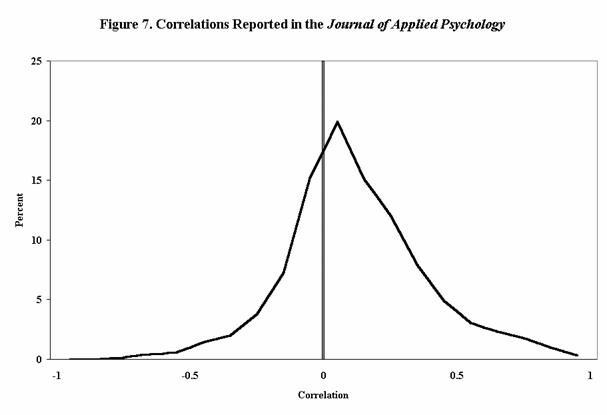
It turns out that Art
Brief was nearly right on average, for the mean correlation is .0895 and the
median correlation is .0956. The distribution seems to reflect a strong bias
against negative correlations: 69 per cent of the correlations are positive and
31 per cent are negative, so the odds are better than 2 to 1 that an observed
correlation will be positive. This strong positive bias provides quite striking
evidence that many researchers prefer positive relationships, possibly because
they find these easier to understand. To express this preference, researchers
must either be inverting scales retrospectively or be anticipating the signs of
hypothesized relationships prospectively, either of which would imply that
these studies should not use statistical tests that assume a mean correlation
of zero.
|
Table 3 – Differences
Associated with Numbers of Observations |
|||
|
|
|
|
|
|
|
N<70 |
70<N<180 |
N>180 |
|
Mean number of observations |
40 |
120 |
542 |
|
Mean correlations |
.140 |
.117 |
.064 |
|
Numbers of correlations |
1195 |
1457 |
3922 |
|
|
|
|
|
|
Percentage of
correlations are: |
|||
|
Positive |
71% |
71% |
67% |
|
Negative |
29% |
29% |
33% |
|
|
|
|
|
|
Percentage of
correlations that are statististically significant
at .05 using two tails: |
|||
|
Positive correlations |
34% |
64% |
72% |
|
Negative correlations |
18% |
41% |
56% |
|
|
|||
Studies with large numbers
of observations exhibit slightly less positive bias. Table 3 compares studies
having less than 70 observations, those with 70 to 180 observations, and those
with more than 180 observations. Studies with over 180 observations report 67
per cent positive correlations and 33 per cent negative ones, making the odds
of a positive correlation almost exactly 2 to 1. The mean correlation found in
studies with over 180 observations is .064, whereas the mean correlation in
studies with fewer than 70 observations in .140.
Figure 8 compares the
observed distributions of correlations with the distributions assumed by a
typical hypothesis test. The test distributions in Figure 8 assume random
samples equal to the mean numbers of observations for each category. Compared
to the observed distributions, the test distributions assume much higher
percentages of correlations near zero, so roughly 65 per cent of the reported
correlations are statistically significant at the 5 per cent level. The
percentages of statistically significant correlations change considerably with
numbers of observations because of the different positive biases and because of
different test distributions. For studies with more than 180 observations, 72
per cent of the positive correlations and 56 per cent of the negative
correlations are statistically significant; whereas for studies with less than
70 observations, 34 per cent of the positive correlations and only 18 per cent
of the negative correlations are statistically significant (Table 3). Thus,
positive correlations are noticeably more likely than negative ones to be
judged statistically significant.

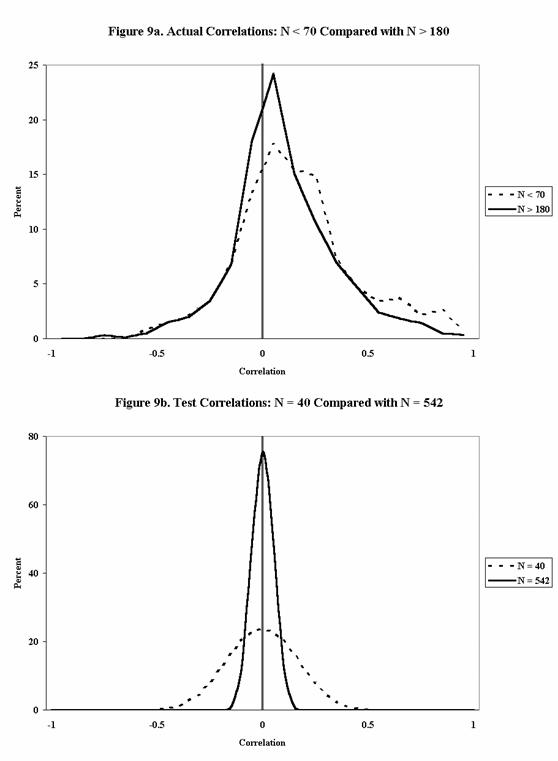
Figure 9a shows that
large-N studies and small-N studies obtain rather similar distributions of correlations.
The small-N studies do produce more correlations above + .5, and the large-N
studies report more correlations between - .2 and + .2. Both differences fit
the rationale that researchers make more observations when they are observing
correlations near zero. Some researchers undoubtedly anticipate the magnitudes
of hypothesized relationships and set out to make numbers of observations that
should produce statistical significance (Cohen, 1977); other researchers keep
adding observations until they achieve statistical significance for some
relationships; and still other researchers stop making observations when they
obtain large positive correlations. Again, graphs for Administrative Science
Quarterly and the Academy of Management Journal strongly resemble
these for the Journal of Applied Psychology.
Figure 9b graphs the
test distributions corresponding to Figure 9a. These graphs provide a reminder
that large-N studies and small-N studies differ more in the criteria used to
evaluate statistical significance than in the data they produce, and Figures 9a
and b imply that an emphasis on statistical significance amounts to an emphasis
on absolutely small correlations.
The pervasive
correlations among variables make induction undependable: starting with almost
any variable, an I/O psychologist finds it extremely easy to discover a second
variable that correlates with the first at least .1 in absolute value. In fact,
if the psychologist were to choose the second variable utterly at random, the
psychologist’s odds would be 2 to 1 of coming up with such a variable on the
first try, and the odds would be 24 to 1 of discovering such a variable within
three tries. This is a cross-sectional parallel to a finding by Ames and Reiter
(1961) relating to the analyses of historical economic statistics: Starting
with one time series and choosing a second series at random, an economist would
need only three trials on average to discover a correlation of .71 or more;
even if the economist would correct each series for linear trend, finding a
correlation of .71 or more would require only five trials on average.
Induction becomes even
less dependable if a psychologist uses hypothesis tests to decide what
correlations deserve attention, and especially so if the psychologist tries to
make enough observations to guarantee statistical significance. If the
psychologist also defines or redefines variables so as to make positive
correlations more likely than negative correlations, hypothesis tests based on
the null hypothesis of zero correlation become deceptive rituals.
Suppose that roughly 10
per cent of all observable relations could be theoretically meaningful and that
the remaining 90 per cent either have no meanings or can be deduced as implications
of the key 10 per cent. But we do not now know which relations constitute the
key 10 per cent, and so our research resembles a search through a haystack in
which we are trying to separate needles from more numerous straws. Now suppose
that we adopt a search method that makes every straw look like a needle and
that turns up thousands of apparent needles annually; 90 per cent of these
apparent needles are actually straws, but we have no way of knowing which ones.
Next, we fabricate a theory that ‘explains’ these apparent needles. Some of the
propositions in our theory are likely to be correct, merely by chance; but
many, many more propositions are incorrect or misleading in that they describe
straws. Even if this theory were to account rationally for all of the needles
that we have supposedly discovered in the past, which is extremely unlikely,
the theory has very little chance of making highly accurate predictions about
the consequences of our actions unless the theory itself acts as a powerful self-fulfilling
prophecy (Eden and Ravid, 1982). Our theory would
make some correct predictions, of course; with so many correlated variables,
even a completely false theory would have a reasonable chance of generating
predictions that come true, so we dare not even take correct predictions as
dependable evidence of our theory’s correctness (Deese,
1972, pp.61-7).
I/O psychologists with
applied orientations might protest that they primarily need to make correct
predictions and that doing this does not require a correct and parsimonious
theory. Two responses are in order. First, this chapter concerns theory
building, not practical utility. Second, the predictive accuracies of I/O
relationships, which are not very high, may already be as high as they can be
made solely on the basis of blind statistical methods. Making major
improvements in predictive accuracies probably requires actual theoretical
insights that will not come through purely statistical methods.
Undependable induction
may be a cause of I/O psychology’s methodological emphasis as well as a
consequence of it. Facing a world of unstable ‘facts’ and weak relationships,
we have reason to distrust substantive propositions and to view methods as
sounder, more deserving of admiration. We can control our methods better than
substance, so emphasizing methods reduces our risks; and because we evaluate
our methods ritualistically, we find it much easier to meet methodological
standards than to demonstrate the theoretical significance of our findings.
Indeed, if our world changes rapidly, ‘facts’ are ephemeral and theoretical
significance becomes very elusive.
Because we doubt that
methodological improvements are what I/O psychology needs most, we do this with
reluctance, but we cannot resist pointing out same of the methodological
opportunities that exist:
(a)
Statistical significance is a very dangerous criterion. It
probably causes more harm than good, by inducing researchers who have few
observations to discount strong relationships and encouraging those who have many
observations to highlight weak relationships. Moreover, a researcher can be
certain of rejecting any point null hypothesis, and point null hypotheses
usually look quite implausible if one treats them as genuine descriptions of
phenomena (Gilpin and Diamond, 1984; Shames, 1987). Deese
(1972, pp. 56-9), among others, has advocated that researchers replace
hypothesis tests with statements about confidence limits. But confidence limits
too exaggerate the significance of numbers of observations. In I/O psychology,
and in social science research more generally, the numbers of observations are
rarely equivalent to the sample sizes assumed in statistical theories, both
because truly random sampling is rare and because statistical theories assume
that sample sizes are basically the only observable characteristics by which to
judge data’s dependability, generality, or representativeness.
Real life offers researchers many characteristics by which to evaluate data,
and carefully chosen observations may be more informative than random samples.
Thus, researchers could improve their analyses by using statistical procedures
that allow them to assign different weights to observations reflecting their
dependability, generality or representativeness; more
dependable or more representative observations would receive more weight. As
much as from the weights’ arithmetic effects, the improvements in induction
would come from researchers’ efforts to analyse
data’s dependability or representativeness and from
the researchers’ efforts to communicate rationales for these weights.
Researchers could also improve their analyses by paying more attention to
percentage differences between categories: Are males 1 per cent different from
females, or 30 per cent? And yet more improvement could come from less use of
averages to represent heterogeneous groups and more use of distributions
(Brandt, 1982). What fraction of males are 30 per cent different from what
fraction of females? Speaking of measures of organizational climate, Payne and
Pugh (1976) remarked that respondents’ opinions generally vary so greatly that
it makes no sense to use averages to characterize groups or organizations.
(b)
Statistical analyses would have greater credibility and greater
theoretical significance if researchers would base their analyses on naive
hypotheses or realistic hypotheses instead of null hypotheses (Fombrun and Starbuck, 1987). Virtually the entire apparatus
of classical statistics was created when high-speed computers did not yet exist
and statisticians had to manipulate distributions algebraically. Thus,
statisticians built an analytic rationale around distributions that are
algebraically pliant even though these distributions make incredible
assumptions such as point null hypotheses. With modern computers, however,
researchers can generate statistical distributions that reflect either
realistic assumptions or naive ones, even if these distributions cannot be
manipulated algebraically. For example, computer simulations could generate the
distributions of observed correlations in samples of size N from a hypothetical
bivariate Normal population with a correlation of .1. To assess the
plausibility of alternative theories where several influences interact, some
biologists (Connor and Simberloff, 1986) have begun
to compare data with computer-generated multinomial distributions that
incorporate combinations of several probable influences; such distributions
reduce the need for simplifying assumptions such as normality and linearity,
and they make it more practical to examine entire distributions of data.
A key value judgement, however, is how challenging should a researcher
make the naive or credible hypothesis? How high should the jumper place the
crossbar? In science, the crossbar’s height has implications for the research
community as a whole as well as for an individual researcher: Low crossbars
make it easier to claim that the researcher has learned something of
significance, but they also lead to building scientific theories on random
errors.
(c)
Even traditional hypothesis tests and confidence limits could
support better induction than they do, but no statistical procedure can
surmount inappropriate assumptions, biased samples, overgeneralization, or
misrepresentation. Researchers should either eschew the appearance of
statistical methods or try to approximate the assumptions underlying these
methods.
(d)
Researchers should often attempt to replicate others’ studies,
basing these replications solely on the published reports. Frequent replication
would encourage researchers to describe their work completely and to
characterize its generality modestly. Replication failures and successes would
clarify the reasons for exceptional findings, and thus provide grounds on which
to design better studies and to discard inexplicably deviant ones.
(e)
I/0 psychology has been bounded by two data-acquisition methods:
questionnaires and interviews. Although cheap and easy, these methods emphasize
subjective perceptions that people recognize and understand well enough to
express verbally. These are a part of life. But verbal behavior is bounded by
socialization and social constraints that make I/O psychology prone to observe
clichés and stereotypes, and it is altogether too easy to find observable
behaviors that people do not recognize that they exhibit or that they describe
in misleading terms. Thus, researchers should remain skeptical about the
validity of subjective data, and they should supplement questionnaires and
interviews with their personal observations of behavior, with documents such,
as letters, memoranda and grievances, and with quantitative data such as costs,
turnover statistics, and production volumes (Campbell and Fiske,
1959; Phillips, 1971; Denzin, 1978). Jick (1979) has discussed the advantages and problems of
reconciling different kinds of data. However, the greatest payoffs may come
from discovering that different kinds of data simply cannot be reconciled.
(f)
New sciences tend to begin timidly by gathering data through
passive observation and then constructing retrospective explanations for these
data (Starbuck, 1976). Unfortunately, most spontaneous events are
uninteresting; the more interesting objects of study are unusual, complex,
dynamic and reactive; and postdiction makes weak
discriminations between alternative theories. Consequently, as sciences gain
confidence, they gradually move from the passive, postdictive
mode toward a more active and predictive mode: They make more and more efforts
to anticipate future events and to manipulate them. Interventions enable
scientists to create interesting situations and dynamic reactions. Predictions
tend to highlight differences between alternative theories, and trying to make
predictions come true may be the only practical way to find out what would
happen if. Giving theories visible consequences puts scientists under pressure
to attempt innovations (Gordon and Marquis, 1966; Starbuck and Nystrom, 1981).
Thus, potential
advantages inhere in I/O psychology’s applied orientation and in the numerous
I/O psychologists holding non-academic jobs. Compared to academic areas of
psychology and to most social sciences, I/O psychology could be more
innovative, quicker to discard ineffective theories, more interested in dynamic
theories, and more strongly oriented toward prediction and intervention. I/O
psychology probably does pay more attention than most social sciences to
prediction and intervention, but prediction seems to be associated mainly with
personnel selection, interventions have focused on goal-setting and behavior
modification, and it is doubtful that I/O psychology is exploiting its other
potential advantages. We examined several studies of goal-setting and behavior
modification published during 1986, and we turned up only static
before-and-after comparisons and no analyses that were truly dynamic.
SUMMARY
We started by asking: How much has I/O
psychology progressed? Partly because a number of I/O psychologists have been
expressing dissatisfaction with the field’s progress and asking for more
innovation (Hackman, 1982; Nord,
1982), we had an initial impression that progress has been quite slow since the
early 1950s. We had also seen a sequence of business-strategy studies that had
achieved negative progress, in the sense that relationships became less and
less clear as the studies accumulated, and we wondered whether this might have
happened in some areas of I/O psychology. We appraised progress by observing
the historical changes in effect sizes for some of I/O’s major variables. If
theories are becoming more and more effective, they should explain higher and
higher percentages of variance over time. We found that I/O theories have not
been improving by this measure. For the reasons just stated, this did not
surprise us, but we were surprised to find such small percentages of variance
explained and such consistent changes in variance explained.
Seeking an explanation
for no progress or negative progress, we turned to the literature on paradigm
development. These writings led us to hypothesize that I/O psychology might be
inconsistent with itself: various reviews have suggested that I/O psychologists
disagree with each other about the substance of theories. Perhaps I/O
psychologists have low paradigm consensus but employ quantitative, large-sample
research methods that presume high paradigm consensus. So we assembled various
indicators of paradigm consensus. According to these indicators, I/O psychology
looks much like Organizational Behavior and psychology in general. This is no
surprise, of course. I/O psychology also looks different from Management
Information Systems (MIS), which appears to be a field that both lacks paradigm
consensus and makes rapid progress. But, to our astonishment, I/O psychology
does not look so very different from chemistry and physics, two fields that are
widely perceived as having high paradigm consensus and as making rapid
progress. I/O psychology may, however, differ significantly from the physical
sciences in the content of paradigms. Physical science paradigms evidently
embrace both substance and methodology, whereas I/O psychology paradigms
strongly emphasize methodology and pay little attention to substance. I/O
psychologists act as if they do not agree with each other concerning the
substance of human behavior, although we believe that this lack of substantive
Consensus is unnecessary and probably superficial.
Why might the paradigms
of I/O psychologists deemphasize substance? We hypothesized that this
orientation is probably an intelligent response to a real problem. This real
problem, we conjectured, is that I/O psychologists find it difficult to detect
meaningful research findings against a background of small, theoretically
meaningless, but statistically significant relationships. Thus, I/O
psychologists dare not trust their inferences from empirical evidence. To
assess the plausibility of this conjecture, we tabulated all of the correlation
matrices reported in the Journal of
Applied Psychology over four years. We found that two-thirds of the
reported correlations are statistically significant at the 5 per cent level,
and a strong bias makes positive correlations more likely to be reported and to
be judged statistically significant than negative ones.
Thus, I/O psychology
faces a Catch-22. A distrust of undependable substantive findings may be
leading I/O psychologists to emphasize methodology. This strategy, however,
assumes that induction works, whereas it is induction that is producing the
undependable substantive findings.
CONSTRUCTING A SUBSTANTIVE PARADIGM
Our survey of effect sizes seems to say that
I/O theories are not very effective and they are not improving significantly
over time. We psychologists seem to have achieved very little agreement among
ourselves concerning the substantive products of our research; and it is easy
to see why this might be the case, for almost everything in our worlds appears
to be somewhat related to everything else, and we use criteria that say almost
every relationship is important.
We could make this
situation a springboard for despair. People are simple creatures seeking to
comprehend worlds more complex than themselves. Scientists attempt to construct
rational explanations; but rationality is a human characteristic, not an
intrinsic characteristic of nature, so scientists have no guarantee that
science will prove adequate to the demands they place on it. Psychological
research itself details the cognitive limitations that confine and warp human
perceptions (Faust, 1984). The complexity of people’s worlds may also be a
human characteristic, for people who think they comprehend some aspects of
their worlds tend to react by complicating their worlds until they no longer
understand them. Thus, social scientists have reason to doubt the adequacy of
rational explanations to encompass most phenomena (Starbuck, 1988). Within our
limitations, we psychologists may find it impossible to achieve complete
explanations without reducing actions and measures to trivial tautologies. For
example, we can decide that we will only teach in school what we can measure
with an aptitude test, or that we will select and promote leaders solely on the
basis of leadership questionnaires.
We need not despair,
however. Studies of progress in the physical sciences emphasize the strong
effects of social construction (Sullivan, 1928; Knorr-Cetina,
1981; Latour, 1987). Although it is true that
physical scientists discard theories that do not work, the scientists
themselves exercise a good deal of choice about what aspects of phenomena they
try to explain and how they measure theories’ efficacies. Newton’s laws are one
of the best known substantive paradigms. Physicists came to accept these laws
because they enabled better predictions concerning certain phenomena, but the
laws say nothing whatever about some properties of physical systems, and the
laws fail to explain some of the phenomena that physicists expected them to
explain, such as light or sub-atomic interactions. In no sense are Newton’s
laws absolute truths. Rather they are statements that physicists use as base
lines for explanation: physicists attempt to build explanations upon Newton’s
laws first. If these explanations work, the physicists are satisfied, and their
confidence in Newton’s laws has been reaffirmed. If these base-line
explanations do not work, physicists try to explain the deviations from
Newton’s laws. Are there, for instance, exogenous influences that had not
previously been noticed? Finally, if some inexplicable deviations from Newton’s
laws recur systematically, but only in this extreme circumstance, physicists
contemplate alternative theories.
The contrast to I/O
psychology is striking. . . and suggestive. The difference between physics and
psychology may be more in the minds of physicists and psychologists than in the
phenomena they study (Landy and Vasey,
1984). After arguing that psychological facts are approximately as stable over
time as physical ones, Hedges (1987, pp. 453-4) observed:
New physical theories
are not sought on every occasion in which there is a modest failure of
experimental consistency. Instead, reasons for the inconsistency are likely to
be sought in the methodology of the research studies. At least tentative
confidence in theory stabilizes the situation so that a rather extended series
of inconsistent results would be required to force a major reconceptualization.
In social sciences, theory does not often play this stabilizing role.
Campbell (1982, p. 697)
characterized the theories of I/O psychology as ‘collections of statements that
are so general that asserting them to be true conveys very little information.’
But, of course, the same could be said of the major propositions of the
physical sciences such as Newton’s laws: any truly general proposition can
convey no information about where it applies because it applies everywhere (Smedslund, 1984). General theoretical propositions are
necessarily heuristic guidelines rather than formulae with obvious applications
in specific instances, and it is up to scientists to apply these heuristics in
specific instances. But general theoretical propositions are more than
heuristics because they serve social functions as well.
Scientific progress is a
perception by scientists, and theories need not be completely correct in order
to support scientific progress. As much as correctness, theories need the
backing of consensus and consistency. When scientists agree among themselves to
explain phenomena in terms of base-line theories, they project their findings
into shared perceptual frameworks that reinforce the collective nature of
research by facilitating communication and comparison and by defining what is
important or irrelevant. Indeed, in so far as science is a collective
enterprise, abstractions do not become theoretical propositions until they win
widespread social support. A lack of substantive consensus is equivalent to a
lack of theory, and scientists must agree to share a theory in order to build
on each others’ work. Making progress depends upon scientists’ agreeing to make
progress.
The absence of a strong
substantive paradigm may be more a cause of slow progress than a consequence of
it, and I/O psychologists could dramatically accelerate the field’s progress by
adopting and enforcing a substantive paradigm. Of course, conformity to a
seriously erroneous paradigm might delay progress until dissatisfaction builds
up to a high state and one of Kuhn’s revolutions takes place; but so little
progress is occurring at present that the prospect of non-progress hardly seems
threatening.
Moreover, I/O psychology
could embrace some theoretical propositions that are roughly as sound as
Newton’s laws. At least, these propositions are dependable enough to serve as
base lines: they describe many phenomena, and deviations from them point to
contingencies. For example, we believe that almost all I/O psychologists could
accept the following propositions as base lines:
Pervasive
Characteristics. Almost all characteristics of individual people correlate with
age, education, intelligence, sex, and social class; and almost all
characteristics of groups and organizations correlate with age, size, and
wealth. (Implication: every study should measure these variables and take them
into account.)
Cognitive
Consonance.
Simultaneously evoked cognitions (attitudes, beliefs, perceptions and values)
tend to become logically consistent (Festinger, 1957;
Heider, 1958; Abelson et al., 1968). Corollary 1:
Retrospection makes what has happened appear highly probable (Fischhoff, 1980). Corollary 2: Social status, competence,
control, and organizational attitudes tend toward congruence (Sampson, 1969;
Payne and Pugh, 1976). Corollary 3: Dissonant cognitions elicit subjective
sensations such as feelings of inequity, and strong dissonance may trigger
behaviors such as change initiatives or reduced participation (Walster et al.,
1973). Corollary 4: Simultaneously evoked cognitions tend to polarize into one
of two opposing clusters (Cartwright and
Harary, 1956). Corollary 5: People and social systems
tend to resist change (Marx, 1859; Lewin, 1943).
Social
Propositions:
Activities,
interactions, and sentiments reinforce each other (Homans,
1950). Corollary 1: People come to resemble their neighbors (Coleman et al., 1966; Industrial Democracy in
Europe International Research Group, 1981). Corollary 2: Collectivities develop
distinctive norms and shared beliefs (Roethlisberger
and Dickson, 1939; Seashore, 1954; Beyer, 1981). (These propositions too can be
viewed as corollaries of cognitive consonance.)
Idea
evaluation inhibits idea generation (Maier, 1963).
Participation
in the implementation of new ideas makes them more acceptable (Lewin, 1943;Kelley and Thibaut,
1954). Corollary 1: Participation in goal setting fosters the acceptance of
goals (Maier, 1963; Locke, 1968; Vroom and Yetton,
1973; Latham and Yukl, 1975). Corollary 2: Participation
in the design of changes reduces resistance to change (Coch
and French, 1948; Marrow et al.,
1967; Lawler and Hackman, 1969). Corollary 3:
Opportunities to voice dissent make exit less likely (Hirschman, 1970).
Reinforcement
Propositions:
Rewards make
behaviors more likely, punishments make behaviors less likely (Thorndike, 1911;
Skinner, 1953). (This is a tautology, of course [Smedshxnd,
1984], but so is Newton’s F = ma. A proposition need not convey information in
order to facilitate consensus.)
The more
immediate a reinforcement the stronger is its impact (Hull, 1943).
Continuous
reinforcements produce faster learning that is more quickly unlearned, whereas
intermittent reinforcements produce slower learning that is more slowly
unlearned (Hull, 1943; Estes, 1957).
Other propositions
doubtless could be added to the list, but these illustrate what we mean. We
would be exceedingly happy to have some august body take responsibility for
formulating dogma.
I/O psychologists are
quite unlikely to adopt and use a set of base-line propositions voluntarily.
Many I/O psychologists hold vested interests in specific propositions that do
not qualify for base-line status or that would become redundant. I/O
psychologists are not accustomed to projecting everything they do onto a shared
framework, so they would have to learn new ways of thinking and speaking. Some
I/O psychologists have expressed doubts about the validity of theoretical
propositions in the field. Thus, we surmise that constructing a consensus requires
explicit actions by the key journals that act as professional gatekeepers.
Specifically, to promote progress in I/O psychology, the key journals could
adhere to three policies:
1.
Journals should refuse to publish studies that purport to
contradict the base-line propositions.[7]
Since the propositions are known laws of nature, valid evidence cannot
contradict them. Apparent discrepancies from these laws point to exogenous
influences, to interactions among influences, or to observational errors.
2.
Journals should refuse to publish studies that do no more than
reaffirm the base-line propositions. Known laws of nature need no more
documentation. However, there may be need to explain the implications of these
laws in circumstances where those implications are not self-evident.
3.
Journals should insist that all published studies refer to any of
the baseline propositions that are relevant. There is no need for new
theoretical propositions where the existing laws are already adequate, so any
phenomena that can be explained in terms of these laws must be so explained.
Will base-line
propositions such as those we have listed prove to be adequate psychological
laws in the long run? No, unquestionably not. First, because we are simple
creatures trying to comprehend complex worlds, it behooves us to expect our
theories to prove somewhat wrong; and because we are hopeful creatures, we
intend to do better. Secondly, in order to integrate multiple propositions, I/O
psychology will have to move from qualitative propositions to quantitative
ones. Attempts to apply base-line propositions would likely produce demands for
standardized measures, and then more specific propositions. How rapidly do
cognitions become consistent, and how can one judge whether they have attained
consistency? Thirdly, processes that tend to alter some characteristics of a
social System also tend to evoke antithetical processes that affect these
characteristics oppositely (Fombrun and Starbuck,
1987). Stability creates pressures for change, consensus arouses dissent,
constraint stirs up rebellion, conformity brings out independence, and
conviction evokes skepticism. Thus, the very existence of a scientific paradigm
would call forth efforts to overthrow that paradigm.
But we believe I/O
psychology should try using a consistent paradigm for a few decades before
overthrowing it. Moreover, history suggests that I/O psychologists do not
actually overthrow theoretical propositions. Instead, they react to
unsatisfactory propositions by integrating them with their antitheses.
For example, during the
early part of the twentieth century, many writers and managers held that
successful organizations require firm leaders and obedient subordinates
(Starbuck and Nystrom, 1981, pp. xvii-xviii).
Leadership was viewed as a stable characteristic of individuals: some fortunate
people have leadership traits, and other unlucky souls do not. This orthodoxy
attracted challenges during the 1920s and 1930s: Weber (1947) noted that some
organizations depersonalize leadership and that subordinates sometimes judge
leaders illegitimate. The Hawthorne studies argued that friendly supervision
increases subordinates’ productivity (Roethlisberger
and Dickson, 1939; Mayo, 1946). Barnard (1938) asserted that authority
originates in subordinates rather than superiors. By the early 1950s, various
syntheses were being proposed. Bales (1953), Cartwright and Zander
(1953), and Gibb (1954) analysed leadership as an
activity shared among group members. Coch and French
(1948) and Lewin (1953) spoke of democratic
leadership, and Bales (1953) distinguished leaders’ social roles from their
task roles. Cattell and Stice
(1954) and Stogdill (1948) considered the distinctive
personality attributes of different kinds of leaders. By the late 1950s, the
Ohio State studies had factored leadership into two dimensions: initiating
structure and consideration (Fleishman et
al., 1955; Stogdill and Coons, 1957). Initiating
structure corresponds closely to the leadership concepts of 1910, and
consideration corresponds to the challenges to those concepts. Thus, views that
had originally been seen as antithetical had eventually been synthesized into
independent dimensions of multiple, complex phenomena.
REFERENCES
Abelson, R. P., Aronson, E., McGuire,
W. J., Newcomb, T. M., Rosenberg, M. J. and Tannenbaum,
P. H. (1968) Theories of Cognitive Consistency. Chicago: Rand-McNally.
American Psychological Association (1968) Summary report of journal operations:
1967, American Psychologist, 23, 872.
American
Psychological Association (1978) Summary report of journal operations for 1977,
American Psychologist, 33, 608.
American
Psychological Association (1982) Summary report of journal operations: 1981, American Psychologist, 37, 709.
American
Psychological Association (1983) Summary report of journal operations: 1982, American Psychologist, 38, 739.
American
Psychological Association (1984) Summary report of journal operations, American Psychologist, 39, 689.
American
Psychological Association (1985) Summary report of journal operations, American Psychologist, 40, 707.
American
Psychological Association (1986) Summary report of journal operations: 1985, American Psychologist, 41, 701.
Ames, E. and
Reiter, S. (1961) Distributions of correlation coefficients in economic time
series. Journal of the American Statistical Association, 56, 637-656.
Bakan, D. (1974) On
Method: Toward a Reconstruction of Psychological Investigation. San
Francisco: Jossey-Bass.
Bales, R. F.
(1953) The equilibrium problem in small groups. In T. Parsons, R. F. Bales and
E. A. Shils (eds.) Working Papers in the Theory of
Action. Glencoe, Ill.: Free Press, 111-161.
Barnard, C.
I. (1938) The Functions of the Executive. Cambridge, Mass.: Harvard
University Press.
Bass, B. M.
(1981) Stogdill’s Handbook of Leadership. New York:
The Free Press.
Beyer, J M.
(1978) Editorial policies and practices among leading journals in four
scientific fields. The Sociological Quarterly, 19, 68-88.
Beyer, J. M.
(1981) Ideologies, values, and decision-making in organizations. In P. C. Nystrom and W. H. Starbuck (eds) Handbook
of Organizational Design. Oxford:Oxford
University Press, 166-202.
Blackburn,
R. S. and Mitchell, M.(1981) Citation analysis in the organizational sciences. Journal
of Applied Psychology, 66, 337-342.
Borgen, F. H., Layton, W. L., Veenhuizen, D. L. and Johnson, D. J. (1985) Vocational
behavior and career development, 1984: A review. Journal of Vocational
Behavior, 27, 2 18-269.
Box, G. E.
P. and Draper, N. R. (1969) Evolutionary Operation. New York: John
Wiley. Brackbill, Y. and Korten,
F. (1970) Journal reviewing practices: Authors’ and APA members’ suggestions
for revision. American Psychologist,
25, 937-940.
Brandt, L.
W. (1982) Psychologists Caught: A psycho-logic of psychology. Toronto:
University of Toronto Press.
Brayfield, A. H. and Crockett, W.
H. (1955) Employee attitudes and employee performance. Psychological
Bulletin, 52, 396-424.
Bureau of
the Census(1987) Statistical Abstract of the United States 1987.
Washington, DC: US Department of Commerce.
Campbell, D.
T. and Fiske, D. W. (1959) Convergent and discriminant validation by the multitrait-multimethod
matrix. Psychological Bulletin, 56, 8 1-105.
Campbell, J.
P. (1977) The cutting edge of leadership: An overview. In J. G. Hunt and L. L.
Larson (eds) Leadership: The cutting edge.
Carbondale, Ill.: Southern Illinois University Press.
Campbell, J.
P. (1982) Editorial: Some remarks from the outgoing editor. Journal of
Applied Psychology, 67, 691-700.
Campbell, J.
P., Daft, R. L. and Hulin, C. L. (1982) What to
Study: Generating and developing research questions. New York: Sage.
Campion, M. A. and Thayer, P.
W. (1985) Development and field evaluation of an interdisciplinary measure of
job design. Journal of Applied Psychology,
62, 29-43.
Cartwright,
D. and Harary, F. (1956) Structural balance: A
generalization of Heider’s theory. Psychological
Review, 63, 277-293.
Cartwright,
D. and Zander, A. (1953) Leadership: Introduction. In
D. Cartwright and A. Zander (eds)
Group Dynamics. Evanston, Ill.: Row, Peterson, 535-550.
Cattell, R. B. and Stice, G. F. (1954) Four formulae for selecting leaders on
the basis of personality. Human Relations, 7, 493-507.
Chapman, L.
J. and Chapman, J. P. (1969) Illusory correlation as an obstacle to the use of
valid psychodiagnostic signs. Journal of Abnormal
Psychology, 74, 27 1-280.
Coch, L. and French, J. R.
P. Jr (1948) Overcoming resistance to change. Human
Relations, 1, 512-532.
Cohen, J.
(1977) Statistical Power Analysis for the Behavioral Sciences. New York:
Academic Press.
Coleman, J.
S., Katz, E. and Menzel, H. (1966) Medical
Innovation. Indianapolis: BobbsMerrill.
Connor, E.
F. and Simberloff, D. (1986) Competition, scientific
method, and null models in ecology. American Scientist, 74,
155-162.
Cummings, L.
L. and Schmidt, S. M. (1972) Managerial attitudes of Greeks: The roles of
culture and industrialization. Administrative Science Quarterly, 17,
265-272.
Daft, R. L.
and Wiginton, J. (1979) Language and organization. Academy
of Management Review, 4, 179-191.
De Meuse, K. P. (1986) A compendium of frequently used
measures in industrial/organizational psychology. The
Industrial-Organizational Psychologist, 23 (2), 53-59.
Deese, J. (1972) Psychology
as Science and Art. New York: Harcourt.
Denzin, N. K. (1978) The
Research Act. New York: McGraw-Hill.
Downey, H.
K., Hellriegel, G. and Slocum, J. W., Jr (1975) Environmental uncertainty: The construct and its
application. Administrative Science Quarterly, 20, 613-629.
Downey, H.
K., Hellriegel, G. and Slocum, J. W., Jr (1977) Individual characteristics as sources of
perceived uncertainty. Human Relations, 30, 161-174. Dreeben, R. (1968) On What is Learned in School. Reading,
Mass.: Addison-Wesley.
Dubin, R. (1976) Theory building
in applied areas. In M. D. Dunnette (ed.), Handbook
of Industrial and Organizational Psychology. Chicago: Rand-McNally, 17-39.
Eden, D. and
Ravid, G. (1982) Pygmalion versus self-expectancy:
Effects of instructor-and self-expectancy on trainee performance. Organizational
Behavior and Human Performance, 30, 351-364.
Estes, W. K.
(1957) Theory of learning with constant, variable, or contingent probabilities
of reinforcement. Psychometrika, 22,
113-132.
Faust, D.
(1984) The Limits of Scientific Reasoning. Minneapolis, MN: University
of Minnesota Press.
Festinger, L. (1957) A Theory
of Cognitive Dissonance. Evanston, Ill.: Row, Peterson.
Fiedler, F.
E. (1967) A Theory of Leadership Effectiveness. New York: McGraw-Hill.
Fischhoff, B. (1980) For those
condemned to study the past: Reflections on historical judgment. In R. A. Shweder and D. W. Fiste (eds) New Directions for Methodology of Behavioral
Science. San Francisco: Jossey-Bass, 79-93.
Fleishman,
E. A., Harris, E. F. and Burtt, H. E. (1955) Leadership
and Supervision in Industry. Columbus, Ohio: Ohio State University, Bureau
of Educational Research.
Fombrun, C. J. and Starbuck, W.
H. (1987) Variations in the Evolution of Organizational Ecology. Working
paper, New York University.
Garfield, E.
(1972) Citation analysis as a tool in journal evaluation. Science, 178,
471-479.
Garfield, E.
(198 1-84a) SSCI Journal Citation Reports. Philadelphia, Penn.:
Institute for Scientific Information.
Garfield, E.
(1981-84b) SSCI Journal Citation Reports. Philadelphia, Penn.: Institute
for Scientific Information.
Garvey, W.
D., Lin, N. and Nelson, C. E. (1970) Some comparisons of communication
activities in the physical and social sciences. In C. E. Nelson and D. K.
Pollock (eds) Communication among Scientists and Engineers.
Lexington, Mass.: Heath Lexington, 61-84.
Gerwin, D. (198
l)Relationships between structure and technology. In P. C. Nystrom
and W.H. Starbuck (eds) Handbook of Organizational
Design. New York: Oxford University Press, 3-38.
Gibb, C. A.
(1954) Leadership. In G. Lindzey (ed.), Handbook
of Social Psychology. Cambridge, Mass.: Addison-Wesley.
Gilpin, M.
E. and Diamond, J. M. (1984) Are serious co-occurrences on islands non-random,
and are null hypotheses useful in community ecology? In D. R. Strong and others
(eds) Ecological Communities: Conceptual issues
and the evidence. Princeton, N.J.:Princeton
University Press, 297-315.
Goldberg, L.
R. (1970) Man versus model of man: A rationaie, plus
some evidence, for a method of improving on clinical inferences. Psychological
Bulletin, 73, 422-432.
Gordon, G.
and Marquis, S. (1966) Freedom, visibility of consequences, and scientific
innovation. American Journal of Sociology, 72, 195-202.
Greenwald,
A. G. (1975) Consequences of prejudice against the null hypothesis. Psychological Bulletin, 82, 1-20.
Griffin, R.
W. (1987) Toward an integrated theory of task design. In L. L. Cummings and B.
M. Staw (eds) Research
in Organizational Behavior (pp. 79-120). Greenwich, Conn.: JAI Press.
Hackett, R.
D. and Guion, R. M. (1985) A reevaluation of the
absenteeism - job satisfaction relationship. Organizational Behavior and
Human Decision Processes, 35, 340-381.
Hackman, J. R. (1982) Preface.
In Campbell, J. T., Daft, R. L. and Hulin, C. L. (eds) What to Study: Generating and developing research
questions. New York: Sage.
Hackman, J. R. and Oldham, G.
R. (1980) Work Redesign. Reading, Mass.: Addison-Wesley.
Haire, M., Ghiselli, E. E. and Porter, L. W. (1966) Managerial
Thinking. New York: John Wiley.
Hedges, L.
V. (1987) How hard is hard science, how soft is soft science? American Psychologist, 42,
443-455.
Heider, F. (1958) The
Psychology of Interpersonal Relations. New York: John Wiley.
Hirschman,
A. 0. (1970) Exit, Voice, and Loyalty. Cambridge, Mass.: Harvard
University Press.
Homans, G. C. (1950) The
Human Group. New York: Harcourt, Brace.
Hopkins, B.
L. and Sears, J. (1982) Managing behavior for productivity. In L. W. Frederiksen (ed.) Handbook of Organizational Behavior
Management. New York: John Wiley, 393-425.
House, R. J.
and Singh, J. V. (1987) Organizational behavior: Some new directions for I/O
psychology. Annual Review of Psychology, 38.
Hull, C. L.
(1943) Principles of Behavior. New York: D. Appleton Century.
Iaffaldano, M. T. and Muchinsky, P. M. (1985) Job satisfaction and job
performance: A meta-analysis. Psychological
Bulletin, 97, 251-273.
Industrial
Democracy in Europe International Research Group (1981) Industrial Democracy
in Europe. Oxford: Oxford University Press.
Ives, B. and
Hamilton, S. (1982) Knowledge utilization among MIS researchers. MIS
Quarterly, 6 (4), 61-77.
Jackson, S.
E. (1986) Workshop: Results from a survey of editors. Paper presented at the
Washington, DC meeting of the APA Annual Convention.
Jick, T. J. (1979) Mixing
qualitative and quantitative methods: Triangulation in action. Administrative
Science Quarterly, 24, 602-611.
Jones, D. E.
H. (1966) On being blinded with science - being a ruthless enquiry into
scientific methods, complete with 29 genuine references and a learned footnote.
New Scientist, 24 November, 465-467.
Kaplan, A.
(1963) The Conduct of Inquiry: Methodology for behavioral science. San
Francisco: Chandler.
Katz, D. and
Kahn, R. L. (1978) The Social Psychology of Organizations. New York: John
Wiley.
Kelley, H.
H. and Thibaut, 3. W. (1954) Experimental studies of
group problem solving and process. In G. Lindzey
(ed.), Handbook of Social Psychology. Cambridge, Mass.: Addison-Wesley,
735-786.
Kendler, H. H. (1984)
Evolutions or revolutions? In K. M. J. Lagerspetz and
P. Niemi
(eds) Psychology in the 1990's. Amsterdam:
North-Holland.
Kenny, D. A.
and Zaccaro, S. J. (1983) An estimate of variance due
to traits in leadership. Journal of
Applied Psychology, 68, 678-685.
Kerr, S.,
Tolliver, J. and Petree, D. (1977) Manuscript characteristics
which influence acceptance for management and social science journals. Academy
of Management Journal, 20, 132-141.
King, A. S.
(1974) Expectation effects in organizational change; Administrative Science
Quarterly, 19, 221-230.
Klayman, J. and Ha, Y.-W.
(1987) Confirmation, disconfirmation, and information in hypothesis testing. Psychological
Review, 94, 211-228.
Knorr-Cetina, K. D. (1981) The
Manufacture of Knowledge: An essay on the constructivist and contextual nature
of science. Oxford: Pergamon.
Koch, S.
(1981) The nature and limits of psychological knowledge. American Psychologist, 36, 257-269.
Kuhn, T. S.
(1970) The Structure of Scientific Revolutions. Chicago: The University of
Chicago Press.
Kunda, G. (1987) Engineering
Culture: Culture and control in a high-tech organization. PhD thesis,
Alfred P. Sloan School of Management, MIT.
Landy, F. J. and Vasey, J. (1984) Theory and logic in human resources
research. In K. M. Rowland and G. R. Ferris (eds) Research
in Personnel and Human Resources Management. Greenwich, Conn.: JAI Press,
1-34.
Latham, G.
P. and Yukl, G. A. (1975) A review of research on the
application of goal setting in organizations. Academy of Management Journal,
18, 824-845.
Latour, B. (1987) Science
in Action. Cambridge, Mass.: Harvard University Press.
Lave, C. and
March, 3. (1975) An Introduction to Models in the Social Sciences. New York:Harper and Row.
Lawler, E.
E. III and Hackman, 3. (1969) Impact of employee
participation in the development of pay incentive plans: A field experiment. Journal
ofApplied Psychology, 53, 467-471.
Lawrence, P.
R. and Lorsch, J. W. (1967) Organization and
Environment. Boston, Mass.: Harvard Business School.
Lewin, K. (1943) Forces
behind food habits and methods of change. National Research Council,
Bulletin, 108, 35-65.
Lewin, K. (1953) Studies in
group decision. In D. Cartwright and A. Zander (eds) Group Dynamics. Evanston, Ill.: Row, Peterson,
287-301.
Lindsey, D.
and Lindsey, T. (1978) The outlook of journal editors and referees on the
normative criteria of scientific craftsmanship. Quality and Quantity, 12,
45-62.
Line, M. B.
and Sandison, A. (1974) ‘Obsolescence’ and changes in
the use of literature with time. Journal of Documentation, 30,
283-350.
Locke, E. A.
(1968) Toward a theory of task motivation and incentives. Organizational
Behavior and Human Performance, 3, 157-189.
Locke, E.
(1976) The nature and causes of job satisfaction. In M. D. Dunnette
(ed.), Handbook of Industrial and Organizational Psychology. New York:
John Wiley, 1297-1349.
Locke, E. A.
(1977) The myths of behavior mod in organizations. Academy ofManagement Review, 4, 543-553.
Locke, E.
A., Feren, D. B., McCaleb,
V. M., Shaw, K. N. and Denny, A. T. (1980) The relative effectiveness of four
methods of motivating employee performance. In K. D. Duncan, M. M. Gruneberg and D. Wallis (eds) Changes
in Working Life. New York: John Wiley, 363-388.
Lodahl, J. B. and Gordon, G.
(1972) The structure of scientific fields and the functioning of university graduate
departments. American Sociological Review, 37, 57-72.
Lord, R. G.,
De Vader, C. L. and Alliger, G. M. (1986) A ineta-analysis of the relation between personality traits
and leadership perceptions: An application of validity generalization procedures.
Journal of Applied Psychology, 71,
402-410.
Mahoney, M.
J. (1977) Publication prejudices: An experimental study of confirmatory bias in
the peer review system. Cognitive Therapy and Research, 1,
161-175.
Mahoney, M.
J. and DeMonbreun, B. G. (1977) Psychology of the
scientist: An analysis of problem-solving bias. Cognitive Therapy and
Research, 1, 229-238.
Maier, N. R.
F. (1963) Problem-solving Discussions and Conferences: Leadership methods
and skills. New York: McGraw-Hill.
Mann, R. D. (1959)
A review of the relationships between personality and performance in small
groups. Psychological Bulletin, 56,
241-270.
Marrow, A.
J., Bowers, D. G. and Seashore, S. E. (1967) Management by Participation.
New York: Harper and Row.
Marx, K.
(18S9) A Contribution to the Critique of Political Economy. Chicago:
Kerr.
Masterman, M. (1970) The nature
of a paradigm. In I. Lakatos and A. Musgrave (eds) Criticism and the Growth of Knowledge. London:
Cambridge University Press.
Mayo, E.
(1946) The Human Problems of an Industrial Civilization. Boston, Mass.:
Harvard University Press, Graduate School of Business Administration.
McEvoy, G. M. and Cascio, W. F. (1985) Strategies for reducing employee
turnover: A meta-analysis. Journal of
Applied Psychology, 70, 342-353.
McGuire, W.
J. (1983) A contextualist theory of knowledge: Its
implications for innovation and reform in psychological research. In L.
Berkowitz (ed.), Advances in Experimental Social Psychology. Orlando:
Academic Press, 1-47.
Meehl, P. E. (1954) Clinical
versus Statistical Prediction: A theoretical analysis and review of the
evidence. Minneapolis, Minn.: University of Minnesota Press.
Miner, J. B.
(1980) Theories of Organizational Behavior. Hinsdale, Ill.: Dryden.
Miner, J. B.
(1984) The validity and usefulness of theories in an emerging organizational
science. Academy of Management Review, 9, 296-306.
Mitchell, T.
R. (1979) Organizational behavior. Annual Review of Psychology, 30,
243-281.
Mitchell, T.
R., Beach, L. R. and Smith, K. 0. (1985) Some data on publishing from the
authors’ and reviewers’ perspectives. In L. L. Cummings and P. J. Frost (eds) Publishing in the Organizational Sciences.
Homewood, Ill.: Richard D. Irwin, 248-264.
Moravcsik, M. J. and Murgesan, P. (1975) Some results on the function and
quality of citations. Social Studies of Science, 5, 86-92.
Nelson, N.,
Rosenthal, R. and Rosnow, R. L. (1986) Interpretation
of significance levels and effect sizes by psychological researchers. American Psychologist, 41,
1299-1301.
Nord, W. R. (1982)
Continuity and change in Industrial/Organizational psychology: Learning from
previous mistakes. Professional Psychology, 13, 942-952.
Orwin, R. G. and Cordray, D. S. (1985) Effects of deficient reporting on meta-analysis:
A conceptual framework and reanalysis. Psychological
Bulletin, 97, 134-147.
Ozer, D. J. (1985)
Correlation and the coefficient of determination. Psychological Bulletin, 97, 307-315.
Payne, R. L.
and Pugh, D. S. (1976) Organizational structure and climate. In M. D. Dunnette (ed.) Handbook of Industrial and Organizational
Psychology. Chicago: RandMcNally, 1125-1173.
Peters, D.
P. and Ceci, S. J. (1982) Peer-review practices of
psychological journals: The fate of published articles, submitted again. The
Behavioural and Brain Sciences, 5,
187-195.
Peters, L.
H., Hartke, D. D. and Pohlmann,
J. T. (1985) Fiedler’s contingency theory of leadership: An application of the
meta-analysis procedures of Schmidt and Hunter. Psychological Bulletin, 97, 274-285.
Phillips, D.
L. (1971) Knowledge from What?: Theories and methods in social research.
Chicago: Rand-McNally.
Pinski, G. and Narin, F. (1979) Structure of the psychological literature.
Journal of the American Society for Information Science, 30, 16
1-168.
Price, D. J.
de S. (1965) Networks of scientific papers. Science, 149,
510-515.
Price, D. J.
de S. (1970) Citation measures of hard science, soft science, technology, and nonscience. In C. E. Nelson and D. K. Pollock (eds) Communication among Scientists and Engineers.
Lexington, Mass.: Heath Lexington, 3-22.
Roberts, K.
H. and Glick, W. (1981) The job characteristics approach to task design: A
critical review. Journal of Applied
Psychology, 66, 193-217.
Roethlisberger, F. J. and Dickson, W.
J. (1939) Management and the Worker. Cambridge, Mass.: Harvard
University Press.
Rosenthal,
R. (1966) Experimenter Effects in Behavioral Research. New York: AppletonCentury-Crofts.
Salancik, G. R. (1986) An index
of subgroup influence in dependency networks. Administrative Science
Quarterly, 31, 194-211.
Sampson, E.
E. (1969) Studies in status congruence. In L. Berkowitz (ed.), Advances in
Experimental Social Psychology. New York: Academic Press, 225-270.
Sanford, N.
(1982) Social psychology: Its place in personology. American Psychologist, 37,
896-903.
Schneider,
B. (1985) Organizational behavior. Annual Review of Psychology, 36,
573-611.
Schriesheim, C. A. and Kerr, S.
(1977) Theories and measures of leadership: A critical appraisal of current and
future directions. In J. G. Hunt and L. L. Larson (eds)
Leadership: The cutting edge. Carbondale, Ill.: Southern Illinois
University Press, 9-45.
Scott, K. D.
and Taylor, G. S. (1985) An examination of conflicting findings on the
relationship between job satisfaction and absenteeism: A meta-analysis. Academy
of Management Journal, 28, 599-612.
Seashore, S.
E. (1954) Group Cohesiveness in the Industrial Work Group. Ann Arbor,
Mich.: Institute for Social Research.
Shames, M.
L. (1987) Methodocentricity, theoretical sterility,
and the socio-behavioral sciences. In W. J. Baker, M. E. Hyland, H. Van Rappard, and A. W. Staats (eds) Current Issues in Theoretical Psychology.
Amsterdam: North-Holland.
Sharplin, A. D. and Mabry, R. H.
(1985) The relative importance of journals used in management research: An
alternative ranking. Human Relations, 38, 139-149.
Skinner, B.
F. (1953) Science and Human Behavior. New York: Macmillan.
Small, H.
(1980) Co-citation context analysis and the structure of paradigms. Journal
of Documentation, 36, 183-196.
Smedslund, J. (1984) What is
necessarily true in psychology? In J.R. Royce and L. P. Mos
(eds) Annals of Theoretical Psychology. New
York: Plenum Press, 24 1-272.
Snyder, M.
(1981) Seek, and ye shall find: Testing hypotheses about other people. In E. T.
Higgins, C. P. Herman and M. P. Zanna (eds) Social Cognition. The Ontario Symposium. Hilisdale, N.J.: Lawrence Erlbaum, 277-303.
Stagner, R. (1982) Past and
Future of Industrial/Organizational Psychology. Professional Psychology,
13, 892-902.
Starbuck, W.
H. (1976) Organizations and their environments. In M. D. Dunnette
(ed.) Handbook of Industrial and Organizational Psychology. Chicago:
Rand-McNally, 1069-1123.
Starbuck, W.
H. (1981) A trip to view the elephants and rattlesnakes in the garden of Aston.
In A. H. Van de Ven and W. F. Joyce (eds) Perspectives on Organization Design and Behavior.
New York: Wiley-Interscience, 167-198.
Starbuck, W.
H. (1985) Acting first and thinking later: Theory versus reality in strategic
change. In J. M. Pennings and Associates, Organizational
Strategy Decision and Change. San Francisco: Jossey-Bass,
336-372.
Starbuck, W.
H. (1988) Surmounting our human limitations. In R. Quinn and K. Cameron (eds) Paradox and Transformation: Toward a theoty of change in organization and management.
Cambridge, Mass.: Ballinger.
Starbuck, W.
H. and Nystrom, P. C. (1981) Designing and
understanding organizations. In P. C. Nystrom and W.
H. Starbuck, (eds) Handbook of Organizational
Design. Oxford: Oxford University Press, ix-xxii.
Staw, B. M. (1976) Knee deep
in the Big Muddy: A study of escalating commitment to a chosen course of
action. Organizational Behavior and Human Performance, 16, 27-44.
Staw, B. M. (1984)
Organizational behavior: A review and reformulation of the field’s outcome
variables. Annual Review of Psychology, 35, 627-666.
Steel, R. P.
and Ovalle, N. K. 11(1984) A review and meta-analysis
of research on the relationship between behavioral intentions and employee
turnover. Journal ofApplied Psychology, 69,
673-686.
Steers, R.
M. and Mowday, R. T. (1981) Employee turnover and
post-decision accomodation process. In B. M. Staw and L. L. Cummings (eds) Research
in Organizational Behavior. Greenwich, CN: JAI Press, 235-282.
Sterling, T.
D. (1959) Publication decisions and their possible effects on inferences drawn
from tests of significance - or vice versa. Journal of the American
Statistical Association, 54, 30-34.
Stogdill, R. M. (1948) Personal’
factors associated with leadership: A survey of the literature. The Journal
of Psychology, 25, 35-71.
Stogdill, R. M. and Coons, A. E.
(1957) Leader Behavior. Columbus, Ohio: Ohio State University, Bureau of
Business Research.
Stone, E. F.
(1978) Research Methods in Organizational Behavior. Glenview, Ill.:
Scott, Foresman.
Sullivan, J.
W. N. (1928) The Bases of Modern Science. London: Benn.
Summers, E.
G. (1979) Information characteristics of the ‘Journal of Reading’ (1957- 1977).
Journal of Reading, 23, 39-49.
Thorndike,
E. L. (1911) Animal Intelligence. New York: Macmillan.
Tinsley, H.
E. A. and Heesacker, M. (1984) Vocational behavior
and career development, 1983: A review. Journal of Vocational Behavior, 25,
139-190.
Tosi, H., Aldag, R. and Storey, R. (1973) On the measurement of the
environment: An assessment of the Lawrence and Lorsch
environmental uncertainty subscale. Administrative Science Quarterly, 18,
27-36.
Tweney, R. D., Doherty, M. E.
and Mynatt, C. R. (1981) On Scientific Thinking.
New York: Columbia University Press.
Van Fleet,
D. D. and Yukl, G. A. (1986) A century of leadership
research. In D. A. Wren and J. A. Pearce (eds) Papers
Dedicated to the Development of Modern Management. Academy of Management,
12-23.
Vroom, V. H.
(1964) Work and Motivation. New York: John Wiley.
Vroom, V. H.
and Yetton, P. W. (1973) Leadership and
Decision-making. Pittsburgh: University of Pittsburgh Press.
Walster, E., Berscheid, E. and Waister, G. W.
(1973) New directions in equity research. Journal of Personality and Social
Psychology, 25, 15 1-176.
Watkins, C.
E., Jr., Bradford, B. D., Mitchell, B., Christiansen, T. J., Marsh, G., Blumentritt, J. and Pierce, C. (1986) Major contributors
and major contributions to the industrial/organizational literature. The
Industrial-Organizational Psychologist, 24 (1), 10-12.
Webb, E. J.,
Campbell, D. T., Schwartz, R. D. and Sechrest, L.
(1966) Unobtrusive Measures. Skokie, Ill.: Rand McNally.
‘Webb, W. B.
(1961) The choice of the problem. American
Psychologist, 16, 223-227. Weber, R. L. (1982) More Random Walks in
Science. London: The Institute of Physics.
Weber, M.
(1947) The Theory of Social and Economic Organization. London:
Collier-Macmillan.
Woodward, J.
(1965) Industrial Organization: Theory and practice. London: Oxford
University Press.
Xhignesse, L. V. and Osgood, C.
E. (1967) Bibliographical citation characteristics of the psychological journal
network in 1950 and 1960. American
Psychologist, 22, 778-791.
Zedeck, S. and Cascio, W. F. (1984) Psychological issues in personnel
decisions. Annual Review of Psychology, 35, 461-518.
Zuckerman, H.
and Merton, R. K. (1971) Patterns of evaluation in science: Institutionalisation,
structure and functions of the referee system. Minerva, IX,
66-100.