
BHAGWATI ON TRADE
Fast track to nowhere
In our issue of September 27th Fred Bergsten argued that America’s Congress should grant Bill Clinton “fast-track” trade negotiating authority without further delay. In this reply, Jagdish Bhagwati says that fast-track is not the issue. What matters is the end to which it will be put—and the administration’s goals in trade policy are suspect, to say the least
BILL CLINTON is almost certainly going to talk Congress into giving him the fast-track trade-negotiating authority he seeks. When it comes to striking political deals to get his way, the president’s record speaks for itself. But the current synthetic controversy over fast-track is actually beside the point. The real question in trade policy lies elsewhere, drowned out by the political noise from Capitol Hill and the White House. What trade specialists in Washington—Fred Bergsten among them—should really be asking is this: do the president’s trade goals make sense?
The administration’s various actions and policy pronouncements—notably, its capitulation over the Helms-Burton act and its misguided efforts to insert a social clause into the World Trade Organisation (WTO)—raise grave doubts. Mr Bergsten offers the cliché that the United States is the “only plausible leader”, and therefore an ideal architect, of the emerging world trading system. As somebody who believes passionately in the case for liberal trade, I am far less sanguine.
The administration says it wants fast-track authority in order to pursue “regional and global trade negotiations”. The truth is that the president seeks it for regional agreements only. To be more precise, he wants to add Chile to the North American Free-Trade Agreement (NAFTA) and to move further towards creating a Free-Trade Agreement of the Americas (FTAA).
The president believes (and Charlene Barshefsky, the United States trade representative, has told Congress) that without fast-track he is “empty-handed” in trade talks with the Latin American countries. At stake, he says, are America’s export markets to the south. The administration also notes that the European Union has lately been flirting with the idea of its own free-trade agreement with Mercosur, and that other preferential trade arrangements are in the pipeline. Don’t tie my hands at such a time, says Mr Clinton.
This would be all right if there were any prospect that Mr Clinton might lead bold new multilateral efforts to liberalise trade. If such efforts are under way or even under consideration, it is the administration’s best-kept secret. Recent multilateral agreements on information technology and telecommunications, and the deal on financial services which the EU rescued and which may soon be brought to a conclusion, seem to suggest that multilateralism is alive and well. But it cannot seriously be argued that these agreements required fast-track, with its all-or-nothing vote. They are export-oriented “win-win” agreements in areas where America’s competitive strength is not in doubt. Opposition to them was never likely to have been strong enough to trouble the White House.
If the president were indeed keen to embrace another round of multilateral trade negotiations, that would be a different matter. Many outside the administration have called for just such an initiative. But the president’s advisers caution against it. These people are almost entirely of two kinds: litigators conditioned to see trade as a zero-sum game, or spin-doctors who cannot lift their eyes from their latest poll findings. They have told the president to steer clear of a new multilateral initiative—despite the fact that Mr Clinton was in fact the first G7 leader to moot the idea immediately after the end of the Uruguay Round.
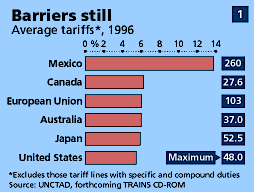
Mr Clinton has shied away even from the distant vision of a liberal trading world—or from any corresponding trade-policy goal, such as to dismantle all border barriers to trade by, say, 2010. Admittedly, considering the extent of trade protection in agriculture and the many high tariffs that remain even in the OECD countries today, that would take some doing (see chart 1). But the subject is no longer even discussed. The president’s handlers dismiss calls for such initiatives as unimportant, impractical, untimely, even ludicrous. So much for American leadership on the multilateral front.
 |
|
|
|
|
|
So we return to the short-run agenda that actually animates the administration: the FTAA. On this, I count myself among the many “purists” whom Mr Bergsten deplores: I consider striving for an FTAA a great mistake. The reason is simple. Proliferating “free-trade areas” have become a pox on the world trading system. It is a mark of Washington’s blurred vision and failure of leadership that, departing from a half-century of steadfast adherence to non-discriminatory multilateralism in trade, the administration has sought to build discriminatory free-trade areas instead.
The rationale advanced for this strategy in the early 1980s was that the turnpike of multilateral negotiations was unfinished and might long remain so. In the meantime, governments wishing to make progress towards liberal trade had to resort to the dirt road of regional free-trade areas. But that was before the great success of the Uruguay Round. The WTO created during the course of that round is the turnpike that America and the other rich countries always said they wanted. Why not use it?
The administration’s answer to that is to fudge the distinction between genuine, multilateral, non-discriminatory free trade and the inherently discriminatory free-trade agreements. Recalling Orwell’s strictures on euphemisms in politics, let us call a spade a spade and henceforth talk not of free-trade agreements (FTAs) but of preferential trade agreements (PTAs). This may be helpful to lazy politicians, devoted to soundbites, who can absorb no more than two words at a time and therefore construe “free-trade area” as free trade.
Mr Bergsten in fact fudges just as much as the politicians. In espousing “open regionalism”—meaning that new members will always be welcomed in—he fails to acknowledge that this is a protracted and tricky process, and in particular subject to votes in legislatures. The difficulty of adding Chile to NAFTA is a case in point. In practice, then, open regionalism is likely to prove a detour rather than a staging post on the path to liberal trade. I recall a meeting in Tokyo some years ago, when a Brazilian diplomat announced proudly that Mercosur practised open regionalism. This prompted a mischievous official from Hong Kong to walk up to the stage and say: “Here is Hong Kong’s application. When can we start?”. No answer as yet.
This error of expecting more from PTAs than they can plausibly deliver has an ironic aspect. Mr Bergsten compliments the United States for its perspicacity in forging PTAs that can be opened wider in due course—emphasising America’s leadership, to be contrasted with the less public-spirited attitudes of the “inward-looking” EU. Yet to date the EU has actually signed PTAs with as many as 18 countries, many more than the United States has. If PTAs are a sign of trade-policy virtue, the EU, not the United States, sets the global standard. But that is nothing to boast about: in my view the EU is simply the greater culprit in the game of trade discrimination.
PTAs are an inferior policy to the multilateral freeing of trade not only because they deny trading opportunities to outsiders. They may well be worse for members too. This is because they can cause “trade diversion”. Instead of importing goods from the countries that can supply most cheaply, the members of a PTA may choose to buy from fellow members. Thus, rather than merely creating trade where there was none before—which improves economic welfare—a PTA may redirect it from efficient sources to inefficient ones.
The distinction between trade creation and trade diversion was first drawn in 1950 by Jacob Viner, who was one of the great economists. Most other economists have since regarded it as essential in thinking clearly about whether regional trade-deals advance or retard economic well-being. Administration spokesmen such as Larry Summers (treasury deputy secretary and a distinguished economist in his own right) may say diversion is a “laughable” worry in practice, but it is now beginning to emerge in several empirical studies as a major concern.
For instance, Alexander Yeats, an economist at the World Bank, has found evidence of significant trade diversion due to Mercosur. Perhaps Americans can be forgiven for failing to notice what is going on in South America. But it is disappointing that commentators in the United States, where one expects a comparatively high level of economic literacy in public discourse, recently discussed the effects of NAFTA without mentioning the fact that Mexico too has almost certainly suffered from trade diversion to American sources.
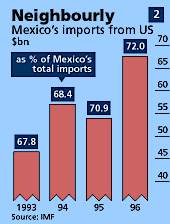
Exports from the United States to Mexico increased by 45% between 1993 and 1996, and America’s share in Mexican imports went up from 68% to 72% (see chart 2). At the same time, Mexico’s tariffs on American goods were cut by an average of 7.1 percentage points. This resulted in “a ten percentage-point average tariff advantage over foreign suppliers”, according to a study commissioned by the administration and carried out by Data Resources Inc. This result was fatuously greeted as a proof of NAFTA’s success. It suggests the very opposite. A provisional estimate by Arvind Panagariya of Maryland University suggests that Mexico’s recent losses from trade diversion due to NAFTA could be as high as $3 billion a year.
 |
|
|
|
|
|
A plague of PTAs
When President Clinton argued that NAFTA would help American firms to compete better with their (excluded) Japanese competitors, he was explicitly appealing to the trade-diverting aspects of the agreement—that is, to the welfare-reducing aspects. True, he was also exploiting the Japanophobia that his first term had fanned. In the main, however, he was simply deploying the most powerful special-interest incentive to choose PTAs over non-discriminatory trade liberalisation.
Presented with these arguments, the administration’s proponents of PTAs fall back on the defence that they “lock in reforms” in countries such as Mexico. Robert Rubin, the treasury secretary, argued recently that, thanks to NAFTA, Mexico had reacted to the peso crisis by foregoing the use of tariff increases, unlike in previous crises.
In fact, Mexico put more than 500 of its tariffs up. Mr Rubin was right only about tariffs within NAFTA. (Many WTO tariff-ceilings, known as “bindings”, were higher than the existing tariffs, thus allowing the tariffs to be raised legally under the terms of earlier trade agreements. In many cases this room for manoeuvre may well have been secured precisely because NAFTA put a lid on raising trade barriers against its members.) In other words, Mexico increased its relative protection against non-members of NAFTA, inviting more trade diversion. Interestingly, however, many countries that are not part of significant PTAs, such as Thailand, have lately faced financial difficulties without raising their tariffs. So much for locking in liberal trade.
Nor is the argument that your reforms become “credible” if you join a PTA very compelling. The widely-noted reforms of New Zealand and Chile, for example, were credible without membership in a PTA. In fact, these countries undertook their major trade and other reforms unilaterally. And their policymakers and many economists I have talked to dismiss PTAs as a distraction from, and a drag upon, the domestic momentum towards reducing trade barriers unilaterally down to negligible levels.
However, the biggest problem that Mr Bergsten sidesteps and which increasingly bothers scholars of international trade is the “systemic” effect of proliferating PTAs. A few PTAs are just bad; in larger numbers, their bad effects multiply. Seen through Mr Bergsten’s rose-tinted glasses, the trade effects of a multitude of PTAs can be gauged simply by adding up, as it were, the series of partial liberalisations. A world with lots of PTAs, he supposes, has lower trade barriers and hence is moving towards global free trade. This is false economics: you cannot simply add these tariff reductions together. In principle, a preferential reduction of barriers can increase total protection in the world, in an economically meaningful sense, because of trade diversion.
On top of this, as PTAs spread, the world trading system comes to look like a spaghetti-bowl of ever more complicated trade barriers, each depending on the supposed “nationality” of products. As soon as trade barriers are differentiated by country, and the principle of non-discrimination is not fully adhered to, imported products must be assigned to a country to determine which duties and quotas apply.
The difficulty is acute for PTAs where members have different external tariffs. The United States made an issue of Hondas produced in Canada, claiming that they were not Canadian enough in content to qualify for the lower NAFTA tariffs. But the problem arises also in customs unions with common tariffs—as when the French did not want to extend European Union trade benefits to Japanese transplant cars made in Britain. The rules on content and “transformation” that are commonly used to determine origin are inherently arbitrary, of course. They never made much sense; they make even less today, when production is massively globalised.
The absurdity of basing discriminatory trade policies on determinations of the origin of products was well illustrated by a previous U.S. trade representative, Carla Hills. She told Japan that cars produced by transplant factories in America were Japanese; exports of such cars back to Japan should not therefore count towards the import targets that America sought from Japan. Simultaneously, she told Europeans that the very same cars should be considered American—that is, they should not be subject to EU quotas for Japanese cars.
Note too that within each PTA different rules of origin often apply to different products, and that different PTAs apply different tariff-reduction schedules for different products. All in all, it is easy to see why a chaotic and discriminatory regime for global-trade is developing, with a multitude of tariffs and quotas applying to particular products, all depending on administratively defined and inherently arbitrary definitions of the product’s “nationality”.
In the 1930s trade preferences and discrimination proliferated worldwide because of protectionism. Today we see them breaking out all over again—because of “free-trade areas”. It is time to recall John Maynard Keynes’s words in the House of Lords in the debates on GATT:
|
|
|
The separate blocs and all the friction and loss of friendship they must bring with them are expedients to which one may be driven in a hostile world where trade has ceased over wide areas to be co-operative and peaceful and where are forgotten the healthy rules of mutual advantage and equal treatment. But it is surely crazy to prefer that. |
On to the Clinton Round?
Of these grand PTA schemes only the FTAA remains on the agenda. If the United States were to abandon it, this would put the last nail in the coffin of “large-scale regionalism”. The energies of trade-policy makers around the world could once more be brought to bear on the multilateral regime and the WTO. Supporters of liberal trade in South America would rejoice, I am sure. Many are keen to return their countries to unilateral non-discriminatory trade liberalisation, and would like nothing better than to see the United States take the lead along that road at Geneva. South America’s apparent enthusiasm for the FTAA is misleading. It is chiefly a response to Washington’s own obsession with the subject. In this hemisphere, it often pays, one way or another, to feign enthusiasm for Washington’s projects.
True, Mr Clinton is out on a limb—committed to bringing Chile into NAFTA and then to building the FTAA, despite the growing doubts over PTAs among those concerned with the architecture of the world trading system. But if he is to exercise true leadership, and to justify Mr Bergsten’s hitherto unwarranted praise of his role in trade policy, it is time to think again. Mr Clinton could and should return the United States to multilateralism, while continuing to pursue “regionalism” through a non-PTA mechanism, exactly as APEC has done so far.
Is that really so difficult, so implausible? Pursuing free trade in a non-discriminatory fashion in the WTO, while developing regionalism (in human rights, defence, security, democracy and so on) through APEC-style initiatives and institutions, ought to appeal to this president—just as it did to a distinguished predecessor. John F. Kennedy, Mr Clinton’s role model, adopted just this strategy. He followed multilateralism in trade, and even had a round of multilateral trade negotiations at the GATT named after him.
Mr President, history beckons. Why fiddle with an FTAA when the Clinton Round is there for the making?
Jagdish Bhagwati is the Arthur Lehman Professor of Economics and Political Science at Columbia University in New York, and one of the world’s leading authorities on international trade. He was the economic-policy adviser to the director-general of the GATT in 1991-93.
© Copyright 1997 The Economist Newspaper Limited. All Rights Reserved