 |
 |
 |
 |
 |
 |
 |
|
|
|
|
|
|
|

The emails for this class will be collected on this page, arranged chronologically. Since I send quite a few, you can target it on a specific month by going here:
| Date | Email content |
||||||||||||||||
| 1/13/25 | Welcome back! As I checked through the roster, I noticed a lot of familiar names from corporate finance, and you know that the email deluge that awaits you.I am sure that you are finding that break is passing by way too fast, but the semester will soon be upon us and I want to welcome you to the Valuation class. One of the best things about teaching this class is that valuation is always timely (and always fun...) Just as examples: is the chance to cash in on Nvidia passed you by? How much did the Barbie Buzz add to Birkenstock’s value? Is Juan Soto really worth $765 million to the Mets or is Steve Cohen bonkers? How much is Greenland worth? You will find the answers to these and other questions on my blog:
1. Preclass work: I know that some of you are worried about the class but relax! If you can add, subtract, divide and multiply, you are pretty much home free… Seriously, all I need of you is a familiarity with basic finance, accounting and statistics. If you feel shaky, you may want to check out the online classes that I have on accounting and financing basics:
2. For this class: If you want to get a jump on the class, you can go to the class web page:
As the schedule stands right now, we will meet on Mondays and Wednesdays from 1.30 pm - 2.50 pm in KMEC 2-60, starting on January 27. I would love to see all of you in class for every session, but if you have to miss a class or two, because the classes will be recorded and available on three platforms:
When you get a chance, check it out.
3. Syllabus & Calendar: The syllabus for the class is available on the website for the class and is also linked here:
and there is a google calendar for the class that you can get to by clicking on
For those of you already setting up your calendars, it lists when the quizzes will be held and when projects come due.
5. Lecture notes: The first set of lecture notes for the class is ready. You can either print off the slides, or save them online. .
Please download and print only this packet on discounted cashflow valuation. The other two packets (yes, there are three…) will be ready soon.
6. Books for the class: First things first. You don’t need a book to get through the class, and if you are budget-constrained, don’t buy any book. If you decide to buy a book, the best book for the class is the Investment Valuation book - and the fourth edition just came out. To be honest, the book is obscenely over priced, and if you can find a cheaper third edition, it will do. You can get it at Amazon or wait and get it at the book store... If you are the law-abiding type, you can buy "Damodaran on Valuation" - make sure that you are getting the second edition. Or, as a third choice, you can try The Dark Side of Valuation, again the second edition, if you are interested in hard to value companies.. Or if you are budget and time constrained, try "The Little Book of Valuation". Finally, if you really want to take a leap, try my newest book, Narrative and Numbers at
You can get away without any of these books, since much of what is in these books is in the public domain. You will find the webpages for all of the books at http://www.stern.nyu.edu/~adamodar/New_Home_Page/public.htm. If you want a comparison of the books, try this link: http://people.stern.nyu.edu/adamodar/New_Home_Page/valbookcomp.html
7. Valuation apps: One final note. I worked with Anant Sundaram (at Dartmouth) isn developing a valuation app for the iPad or iPhone that you can download on the iTunes store: http://itunes.apple.com/us/app/uvalue/id440046276?mt=8
It comes with a money back guarantee... Sorry, no Android version yet…
I am looking forward to seeing you in two weeks in class.
|
||||||||||||||||
| 1/20/25 | It’s been a week since my last email, and while not a whole lot has happened, I thought I should check in ahead of next week’s class. First, if this is the first email you are reading, then you should catch up with the earlier one, which are available at the link below:
If you are wondering about the logistics (exams, projects etc.), we will start the first class with the syllabus, which will also lay out the themes for the class:
As you go through the syllabus, you will notice mention of a project and you can find the details of that project here:
Once we are through the syllabus in session 1, we will turn to an introductory packet (of about 20 pages). The link to that package is below:
Please have this ready for the first session. The rest of the class will be covered in the lecture note packets, and I sent you the link to the first one last week (but here it is again):
Having drowned you with all of that stuff, let me hit with you some pre-class reading (and I don’t think it is too painful). I don’t do much academic research and am supremely uninterested in writing for an echo chamber. Much of what I have written that is original or different has be initially (at least) on my blog. I spend the first few weeks of each year, talking about the data that I update on my website:
The first two updates re on my blog. Please browse through them, because they are relevant for class:
The first class will be a week from today (Monday, January 27, from 1.30 pm - 2.50 pm, NY time) in KMEC 2-60, and I cannot tell how happy I am to be teaching in a room other than Paulson. Please do come, if you can. If you are unable to, either because of logistical or health reasons, the class will be carried on Zoom. The Zoom link for all of the classes (all 28 sessions) is below:
Join Zoom Meeting: https://nyu.zoom.us/j/92632007432 |
||||||||||||||||
| 1/26/25 | It’s been about a week since my last email, and while not a whole lot has happened, I thought I should check in ahead of the first session of the class tomorrow. First, if this is the first email you are reading, then you should catch up with the earlier one, which are available at the link below:
If you are wondering about the logistics (exams, projects etc.), we will start the first class with the syllabus, which will also lay out the themes for the class:
As you go through the syllabus, you will notice mention of a project and you can find the details of that project here:
Once we are through the syllabus in session 1, we will turn to an introductory packet (of about 20 pages). The link to that package is below:
Please have this ready for the first session. The rest of the class will be covered in the lecture note packets, and I sent you the link to the first one last week (but here it is again):
Having drowned you with all of that stuff, let me hit with you some pre-class reading (and I don’t think it is too painful). I don’t do much academic research and am supremely uninterested in writing for an echo chamber. Much of what I have written that is original or different has be initially (at least) on my blog. I spend the first few weeks of each year, talking about the data that I update on my website:
The first thee updates re on my blog. Please browse through them, because they are relevant for class:
The first class will be tomorrow (Monday, January 27), from 1.30 pm - 2.50 pm, NY time) in KMEC 2-60. Please do come, if you can. If you are unable to, either because of logistical or health reasons, the class will be carried on Zoom.
Join Zoom Meeting: https://nyu.zoom.us/j/92632007432 |
||||||||||||||||
| 1/27/25 | We are officially rolling. If you enrolled in the class in the last couple of days, you did miss the first two emails but they are already in the email chronicle, in case you are interested:
Email chronicles: http://www.stern.nyu.edu/~adamodar/New_Home_Page/eqemail.html
This chronicle will be updated at the end of each week to include all emails sent up until then. If you were able to make it today’s class, thank you, and the slides that we used for the class should be at the links below:
Introduction to Valuation (Slides for Wednesday’s class): https://pages.stern.nyu.edu/~adamodar/pdfiles/eqnotes/ValIntroSpr25.pdf
I mentioned the project for the class, but only in very general terms. You can find the specifics at the link below:
A quick note about today's class. During the session, I told you that that this was a class about valuation in all of its many forms – different approaches (intrinsic, relative & contingent claim), different forums (for acquisitions, value enhancement, investing) and across different types of businesses (private & public, small and large, developed & emerging market). After spending some time laying out the script for the class (quizzes, exams, weekly tortures), I suggested that you start thinking about forming a group and picking companies. To get the process rolling, here is what I have done
1. Group: Please do find a group to nurture your valuation creativity, and a company to value soon. If you are ostracized, or feel alone, I will create an orphan list and make sure that you are adopted.
2. Company Choice: Once you pick a company, collect information on the company. I would start off on the company's own website and download the annual report for the most recent year (probably 2019) and then visit the SEC website (http://www.sec.gov) (for US listings) and download 10Q filings. (You can pick any publicly traded company anywhere in the world to value. The non-US company that you value can have ADRs (but does not have to have ADRs) listed in the US but you still have to value it in the local currency and local market. You can even analyze a private company, if you can take responsibility for collecting the information.)
3. Webcast of today’s class: The web casts for the first class are up and running in all of their variations (Zoom recording, downloadable video, downloadable audio and YouTube). You can access them by going to: 4. Lecture Note Packets: Please download the first lecture note packet, when you get a chance. You can either download it as a powerpoint file (though powerpoint bloats file size or as a pdf file)
Powerpoint slides: ://pages.stern.nyu.edu/~adamodar/pptfiles/val3E/valpacket1spr25.pptx (This is a big file, and to add to its pain, Microsoft PC powerpoint does not play well with Microsoft Mac powerpoint. So, you may get scary looking messages such as the file needs to be repaired and updated. Just say yes to both. It seems to be unscathed)
5. Post class test: To review what we did in class today, I prepared a very simple post-class test. I have attached it, with the solution. Give it your best shot.
Sorry (not really, but I think you are supposed to act sorry when you send long emails) about the length of this email, but there will be more to come (I promise!).
|
||||||||||||||||
| 1/28/25 | It is time for the valuation of the week, and I had initially planned on making it Nvidia. But after an eventful weekend, I will have to revisit my story and valuation for Nvidia, and I promise it is coming in a future week, sooner rather than later. Instead, I am going to do a valuation that may allow you to answer the question I asked most in market interviews: Is the market in a bubble? Is it overvalued? Given there is so froth in this response, I value the S&P 500 index at regular intervals, and at the start of 2025, after two very strong years for US equities, I valued the S&P 500 index and wrote about in my second data update post for 2025:
I am not going to claim that it is scintillating reading, but I don’t think it is that boring, and I would like you to start with that. In the post, I also share the spreadsheet that contains my valuation:
Please download that spreadsheet, and here is what I would like you to do. In the spreadsheet, there are four levers that drive the index value:
If your response is that you really don’t have a point of view, leave the number as is. When you are done, go to this Google shared spreadsheet, and enter your numbers.
https://docs.google.com/spreadsheets/d/1ICGB1xcqQHYsiltPq7c2MNbRkuoJlpadpWoaVWdJoiE/edit?usp=sharing
The last column of the spreadsheet will compute how under or over valued you find the market, and the table to the right will give you the crowd judgment. Clearly, with 500 people in the two valuation classes (undergraduate and MBA), that willl be a big crowd, if you chose to partake, but I have also made this spreadsheet open to the public, and the tribe may multiply. It should take just a few minutes of your time, and I think it will be worth it. |
||||||||||||||||
| 1/29/25 | Today's class started with a test on whether you can detect the direction bias will take, based on who or why a valuation is done. The solutions are posted online on the webcast page for the class. Bringing in the effects of uncertainty and complexity, I argued that these three (bias, uncertainty and complexity) forces are the biggest challenges to good valuation. In fact, they represent the Bermuda Triangle of Valuation, a place where good sense goes to disappear. If you have the time to watch a much, much longer version of this topic, try this:
We then moved on to talk about the three basic approaches to valuation: discounted cash flow valuation, where you estimate the intrinsic value of an asset, relative valuation, where you value an asset based on the pricing of similar assets and option pricing valuation, where you apply option pricing to value businesses. With each approach, we talked about the types of assets that are best priced with that approach and what you need to bring as an analyst/investor to the table. For instance, in our discussion of DCF valuation and how to make it work for you, I suggested that there were two requirements: a long time horizon and the capacity to act as the catalyst for market correction. We will be starting on the first lecture note packet on Monday. So, please have it downloaded and ready to go. |
||||||||||||||||
| 1/30/25 | Each week, I will use the Thursday email to prod, nag and bug you about the project. So, without further ado, here is where you should be this first week:
In doing all of this, you will need data and Stern subscribes to one of the two industry standards: S&P Capital IQ (the other is Factset). As MBAs, you should have access to Capital IQ on the Stern Dashboard, but you need to ask for access, I have attached a pdf file that shows you how.
This is the seventh or eighth email for the class. If you have not been receiving these emails (which means that you are reading this in the chronicles), it is worth noting that I don’t keep an email list for the class. I use the Google groups that Stern creates. In theory, students registered for the class should be on Albert (the NYU official registration/grading site), Brightspace and Google Groups, and the three should be synced, but this is a university. What should be true in theory is not always the case in practice. I can do very little to alter the Google groups. If you are finding yourself locked out of the email list, start with IT, and if they won’t help, I will figure out a way to add you in. If you are a non-Stern student, and have an email address that does not end in@stern.nyu.edu, note that you were assigned a stern email address when you joined this class, and you should be able to find that address. Here is what I got from IT when I asked:
Since you are teaching a Stern course, all your students, exchange and non-Stern, are provided with a Stern account and Gmail.
You can have them all head over to 'start.stern.nyu.edu' to activate their account.
Attachment: Capital IQ Access |
||||||||||||||||
| 1/31/25 | I described valuation as a craft, where just when you think you have got things nailed down, the market throws you a surprise. This week’s big story has been DeepSeek, and while its initial impact has been on market prices, the bigger question is how it will change not just the AI business, but other businesses that interact with it. With the caveat (and I mentioned this to my corporate finance class as well) that I know far less about computed chips than I do potato chips, I decided to put down my novice thoughts about how I see DeepSeek playing out in markets. What started as a short note expanded on my flight from New York to San Diego into a longer note (the nice thing about writing in planes is that you have no distractions, and UnitedWiFi is so crappy that paying money for it is a waste). The post just went up a few minutes ago, typos and all (I would love to claim that I leave the typos in to show that it was not written by my bot)
As I said, I don’t have the answers, but this is my take, and I would love to hear yours. (The post includes an advance look at your valuation of the week, which will be Nvidia)
A few quick notes. The first is that I did put up an in a tools webcast today. It is a very basic webcast on how to read a 10K, using P&G as my example. The links are below:
Downloadable video: http://www.stern.nyu.edu/~adamodar/podcasts/Webcasts/Reading10Knew.mp4
P&G Valuation (excel spreadsheet): http://www.stern.nyu.edu/~adamodar/pdfiles/eqnotes/PG/P&Gvaluationfixed.xls
It is a very old webcast,and I need to do a newer version, but I am way too lazy.
Second, for those of you who have already valued the S&P 500 (the first valuation of the week), thank you! For those of you who have been putting it off, there is still time to add your input to the crowd:
https://docs.google.com/spreadsheets/d/1ICGB1xcqQHYsiltPq7c2MNbRkuoJlpadpWoaVWdJoiE/edit?usp=sharing
If you scroll to the right, and towards the top, you will see the average and median values that the crowd has estimated. When you value a company or a market index, it is good to disagree with other people’s stories, as long as you are willing to replace them with your own. My Tesla post in January 2023 evoked a lot of responses and I wrote a post about disagreements that make sense and disagreements that violate first principles:
For those of you who are late to this party, we have run out of beer and chips, but you can read all of the emails that I have sent so far in the class:
Finally, I know that some of you are having trouble finding groups for the project work, there does seem to be a critical mass (four people) on the groupless sheet (https://docs.google.com/spreadsheets/d/1ilonvo5nKx8MFLpRw_PuwFdzGzrr-S5jvldVMkUAz4Q/edit?usp=sharing) Why not create a group of your own?
|
||||||||||||||||
| 2/1/25 | Hi,
I hope that you are enjoying your first weekend back at school. I will intrude with a couple of notes.
1. Teaching Fellows/Review sessions: Just a reminder about the TAs for this class. There are two:
5. Lecture note packet 1: Finally, we will be starting with the first lecture note packet in class on Monday. Please have it with you for class. The pdf version can be found here:
Have a great weekend!
Attachment: Issue 1 (February 1) |
||||||||||||||||
| 2/2/25 | No email. (I blame United's crappy wifi) | ||||||||||||||||
| 2/3/25 | Today's class started with a look at a major investment banking valuation of a target company in an acquisition and why having a big name on a valuation does not always mean that a valuation follows first principles, with the first principle being consistency, where your cash flows match up to your discount rates. We began our intrinsic value discussion by talking about the weapons of mass distraction. If you want to read the blog post I have on the topic, try this link:
https://aswathdamodaran.blogspot.com/2014/03/if-it-is-strategic-growth-investment-in.html This post is dated, and the India story seems to have displaced the China story, and Sustainability, AI and the Metaverse have entered the conversation. The more things change, the more they stay the same!
After setting the table for the key inputs that drive value - cash flows, growth, risk, we looked at the different ways of approaching valuation (Dividend Discount model, FCFE model, firm valuation) and the roots that they share, and how they result in different estimation processes. Next session, we will continue with a discussion of risk free rate, a foundational number that will drive the rest of our calculations. I have attached a post class test for today, with the solution. |
||||||||||||||||
| 2/4/25 | In this week’s valuation of the week, I am focusing on Nvidia, a company that I have the most selfish of reasons to value, which is that I have owned shares in it since 2018, and have been a beneficiary of the AI boom. I would start with this post from 2023, just as the AI boom was taking form, where I grappled with the AI market, as seen then.
I would then move on to my 2024 post on the Nvidia valuation, where I try to value the AI story, and explain why, even though I found Nvidia to be overvalued,, after a bad earnings report:
You can follow this up with the post that I did on DeepSeek at the end of last week, where I look at how DeepSeek changes the AI story, and by extension the valuation of Nvidia:
In the context of that post, I revalued Nvidia, and my updated valuation of the company is at the link below:
Here is what I want you to focus on. There are many pieces to the Nvidia story, but I would like you to look at four of them:
1. AI chip market size: In my January 2025 valuation, I reassessed my total market size for AI chips to be $300 billion (down from $500 billion), because of how I see DeepSeek affecting the end game for AI. You are welcome to disagree, from believing that DeepSeek will devastate the AI market profitability (which will make the market for AI chips even smaller), that it will have no effect (leave the market at $500 billion) or even that it makes the market bigger (with a market size greater than $500 billion)
2. Nvidia Market Share of Chip Market: Nvidia currently has an 80% market share of the market, and over time, while competition will increase, it will remain a dominant player (with a 60% market share). You may believe that this assumption is too optimistic (giving them a share less than 60%) or too pessimistic (share >60%)
3. Nvidia’s operating margin: Nvidia has nosebleed profit margin - close to 80% gross margins and 70% operating margins. I have assumed that there are three forces that will bring margins down - increased competition, attempts by TSMC to claim a larger share o the spoils and pushback from its four biggest customers (all big tech companies), but that the target margin will stay at 60%, since it is a design company.
4. Nvidia’s cost of capital: I use Nvidia’s characteristics on risk, debt mix and operating risk to arrive at a starting cost of capital of 11.79%, which I scaled down over time to a median cost of capital for US companies, You may be more optimistic than me about operating risk, and given them the median cost of capital (close to 8.5%) today.
Change what you feel comfortable changing, using my spreadsheet, and then report your estimated value in the Google shared spreadsheet below:
https://docs.google.com/spreadsheets/d/1KgHLfJ-fkGMIA05UOQemoSAhZyD3MwhDfDQDFeQgMlY/edit?usp=sharing
That’s about it. |
||||||||||||||||
| 2/5/25 | We started the class with a discussion of structuring a DCF and the different groupings of risk, and why some types of risk matter more than others, before moving on torisk free rates, exploring why risk free rates vary across currencies and what to do about really low or negative risk free rates. The blog post below captures my thoughts on negative risk free rates:
If you want to see my updated perspective on risk free rates, try my blog post from this year, built around the inflation question is here:
I know that the notion that the Fed sets interest rates runs deep, and that you will be able find ways of explaining away contrary evidence, if you feel strongly enough, but I would encourage you to keep an open mind on this question,. Way too much money and resources have been wasted because of the Fed obsession over the last decade to not fight back. Finally, I am included the latest sovereign ratings from Moody;’s and the sovereign CDS spreads
|
||||||||||||||||
| 2/6/25 | By now, you should have a company picked, and if so, you can start thinking about at least the first two pieces of your discount rate calculation, a risk free rate and an equity risk premium.
Finally, if you are still groupless, reach out to me, I am putting a call out for groups that want one or two more people in the group. That’s about it for the moment. Enjoy the weekend,
Attachment: Not needed (fixed in notes) |
||||||||||||||||
| 2/7/25 | It is Friday, andI have put up the webcast for risk free rates on the webpage for the class.
Risk free Rates
Webcast: https://youtu.be/imfy-O9QuVc
Additional material:
These sovereign CDS spreads and ratings are stale, and if you want updated versions, you can find them linked below (they were also attached to your Wednesday email)
Sovereign Ratings: https://pages.stern.nyu.edu/~adamodar/pc/datasets/sovrrating2025.xlsx
Sovereign CDS Spreads: https://pages.stern.nyu.edu/~adamodar/pc/datasets/sovrCDS2024.xlsx
It will of course make more sense, if you have picked a company and have a currency to work with, but that is a nag for a different days II hope that you get a chance to watch the webcast! Finally, I forgot to send you the first weekly challenge on Wednesday. It is the weekly challenge that tests you on valuation consistency, and it is entirely optional. If you choose to do it, the solution will be available online and you can check it. There is no need to submit it back to me.
Attachment: Weekly challenge #1 |
||||||||||||||||
| 2/8/25 | 1. It is time for some news (not really), but this is the second newsletter for the class.
2. Company choice & groups: I was checking the valuation master sheet:
https://docs.google.com/spreadsheets/d/11M36DZLLT4NRdYI-K5wlniQA5HYn5scbxp_uWkikY9E/edit?usp=sharing
I notice that we are moving in the right direction, but it you have not picked a company, please do. If you have already and have just not entered the company name (not symbol), please do that.
3. My data update posts: I have a verbosity problem, and my data update are long and often boring (not my intent, but it happens..) I did post my sixth data update for 2025, and if you want to get a quick review of both my corporate finance and valuation classes, the posts contain that review, with update data. My sixth update is particularly relevant to what we will be talking about in the class for the next two weeks, and if you can find the time (especially if Superbowl ads are boring) to read it, it would help:
Attachment: Issue 2 (February 8) |
||||||||||||||||
| 2/9/25 | I hope that you are getting ready for a Super Bowl party, but as you watch the game, you may want to think about valuation questions. For instance, how much would you pay, if you were a network, for the rights to carry the Super Bowl in perpetuity? (Think of the questions you have to address to do this valuation, starting with whether the football can outlast its CTE challenge and continuing on to whether technology will allow watchers to completely bypass ads…) And if you are a company built around subscribers, say Amazon Prime or Netflix, would you outbid the ad-driven networks because you will use the Super Bowl to sign up new subscribers? Now that I have sowed those seeds that may prevent you from watch Patrick Mahomes throw the ball with his left hand while lying on his back (how does he do that?), two quick loose ends to tie up.
Attachments: |
||||||||||||||||
| 2/10/25 | In the session today, we started by doing a brief test on equity risk premiums. We then completed our discussion of risk free rates, and how the power of central banks comes from the perception that they have power, before embarking on an assessment of historical equity risk premiums, and why they are not good predictors of future equity risk premiums, before embarking on a discussion of country risk and how to deal with it, and measure it. If you are still confused about the different approaches to computing country risk premium, I hope this picture helps: (Sorry.. The picture would not come through)
|
||||||||||||||||
| 2/11/25 | For this week, I thought I would switch gears and value a very different company from the last few. I look at Aramco, a company that became the most valuable public company (in terms of market cap) over night, when it had its IPO in 2019. The place to start this valuation is with the Aramco IPO, a document written by bankers for bankers, and hence thoroughly boring:
You can follow up with two posts that I wrote at the time of the IPO:
Those posts include my valuation of Aramco, putting its value at about $1.6 trillion, roughly where it went public.
Clearly, much water has passed under this bridge in the last two years, and I have the updated numbers for Aramco through 2025 at the link below;
I have updated my Aramco valuation to reflect these updated numbers.:
As you look at the what if questions, I would like you to focus on just two variables (my advice is you leave the rest alone):
These inputs can change to reflect what you think will happen to fossil fuels or the earth. If you believe that fossil fuel usage can be cut sharply, you can set the growth rate to a negative number and the number of years to less than 50. In short, this is about as pure a play as you can get on fossil fuels as you can get.
In short, this is a valuation where the differences we have are really about country/political risk and fossil fuels, not the company. if you feel up to it, please do go enter your updated valuations for Aramco, with the updated market cap of just over two trillion into the Google shared spreadsheet:
https://docs.google.com/spreadsheets/d/18izNwqeYOEzTUs8KlO6nXqdYpkp8LDiXRecOLNqNExw/edit?usp=sharing
Good luck and have fun!
|
||||||||||||||||
| 2/12/25 | In today’s class, we started by firs trying up how to estimate the equity risk premium for a company, arguing for measuring exposure based on where a company operates, not where it is incorporated. I did mention the paper that I wrote on the trip to Brazil 20 years on measuring lambda. If you are interested, the link is here:
We then looked at implied equity risk premiums, why they move over time and how they are related to the prices of risk in other risky asset classes (bond and real estate).
One final note. There is no class next Monday. Also, today is Wednesday and I have the weekly challenge for this week attached, and if you found the discussion of implied equity risk premiums and their relationships with other macro numbers interesting, you may find this challenge worthwhile.
I know I ask a lot of you in this class, and I also understand that you have lives to live and other demands on your time. To help you navigate the time demands of this class, I thought I would lay out priorities for you that reflect your time constraints (if you are in my corporate finance class as well, this will look similar):
Busy, Multiple constraints on time including health, family etc.
Time available: <3 hours a week
1. Do post-class tests (10-15 minutes for each class)
2. Review lecture notes for the session (20-30 minutes for each class)
3. Bare minimum on project company valuation (30 minutes/week) & full-fledged catching up (2 hours every three weeks)
4. In quiz week, work through at least three or four past quizzes (2018-2022) (3 hours every three or four weeks)
Busy, Significant constraints on time
Time available: 3-6 hours a week
1. Do post-class tests (10-15 minutes for each class)
2. Review lecture notes for the session (20-30 minutes for each class)
3. Watch Valuation Tools video each week (30 minutes/week)
4. Get numbers crunched on project company (1 hour/week)
5. In quiz week, work through at least six to eight past quizzes (2015-2022) (5 hours every three or four weeks)
Busy, but class is key priority
Time available: 6-10 hours a week
1. Do post-class tests (10-15 minutes for each class)
2. Review lecture notes for the session (20-30 minutes for each class)
3. Watch Valuation Tools video each week (30 minutes/week)
4. Get numbers crunched on project company & start narrative (1.5 hour/week)
5. Read and try the weekly challenge, with a time limit (30 minutes/week)
6. Give the valuation of the week a quick try (30 minutes/week)
7. Review practice problems for each section and try two or three in each section (30 minutes/week)
8. In quiz week, work through at least eight to ten past quizzes (2013-2022) (6 hours every three or four weeks)
Obsessed with this class
Time available: As many hours as needed
1. Do post-class tests (10-15 minutes for each class)
2. Review lecture notes for the session (20-30 minutes for each class)
3. Watch Valuation Tools video each week (30 minutes/week)
4. Get numbers crunched on project company & start narrative + help other group members (2.5 hour/week)
5. 5. Read and try the weekly challenge, without a time limit (1 hour/week)
6. Give the valuation of the week a solid try (1 hour/week)
7. Review practice problems for each section and try four or five in each section (1 hour/week)
8. In quiz week, work through all past quizzes (1997-2022) (8 hours every three or four weeks)
9. Read stories in financial press, and craft your corporate finance response to each story (continuous)
Until next Wednesday!
Attachments: Post class test and solution, Implied premium challenge, data |
||||||||||||||||
| 2/13/25 | First things first. By now, I hope that you are in a group and have picked a company. If so, please complete the process by going to the master spreadsheet for the class and input your company name:
https://docs.google.com/spreadsheets/d/11M36DZLLT4NRdYI-K5wlniQA5HYn5scbxp_uWkikY9E/edit?usp=sharing
If you have not, please don’t be surprised if I reach out to you and ask you what’s going on.
At this stage in the class, you should be able to complete three basic tasks related to discount rates, estimating risk free rates, equity risk premiums and betas. Along the way, you have to get comfortable with how to estimate implied equity risk premiums, and to further you on that path, I will be posting valuation tools webcasts on estimating implied equity risk premiums and company exposure to equity risk. I know that the numbers will start mounting up and that some of you are building or are planning to build your own spreadsheets. For your sake and mine, I would push you not to build your own spreadsheet and use mine instead (or do both, to see if you get similar numbers):
It is not because I have good spreadsheet skills. Far from it, since I have never used an Excel macro and use only bare bones functions. It is because this spreadsheet has
I created a video guide last year, on how to use the spreadsheet, and it is at the link below:
I am sorry if my voice sounds ragged, but I had just got off a long flight and my throat has been scratchy for a couple of days.
This spreadsheet is also versatile and will work for any non-financial service company, small or large, US or emerging markets, young growth or in decline. I have used it to value companies that range the spectrum from Uber in 2013, when it was a young start up, to Bed, Bath and Beyond last year. You are welcome to add detail to the spreadsheet, as long as you don’t break it. Thus, for Peloton, you can break revenues down into equipment and subscriptions, and for NVIdia into Ai chips and the rest of the chip business. if you feel that there are different stories for each one that you want to tell. Just add tow rows on to of the valuation output page, and make them the revenues from each segment. In fact, the minute you start using it, it is your model, not mine, and you are welcome to claim ownership of it, if that makes you happy. Finally, my push to get you to use my spreadsheet is also purely selfish . This spreadsheet is easy for me to check, since I know exactly where to look to see how your assumptions are playing out and the mistakes that you might have made at the input stage.
If you have a financial service company (bank, investment bank, insurance company), the spreadsheet above will not work well. Instead, try this spreadsheet:
It is a dividend discount model, but one with enough flex built into it that you can use it to value a growing bank that may not currently be paying dividends. A little later in the class, I will offer you a variant of a free cash flow equity model built just for banks, but for the moment, the dividend discount model will do.
Finally, if you have dropped the class and are still getting emails, I am truly sorry but the fault lies elsewhere. I use the Google group alias emails that the school maintains for each class, and while in theory it should be syncing with the registration page (Albert), it often does not. If you are truly bothered by it, please talk to IT, but you know how conversations with IT usually go, right?
|
||||||||||||||||
| 2/14/25 | This week in class, we moved from risk free rates to looking at equity risk premiums and beta. This week, I have added two tools webcasts.
1. Implied Equity Risk Premiums
Webcast: https://www.stern.nyu.edu/~adamodar/podcasts/Webcasts/ImpliedERP.mp4
The supporting materials are below: Presentation: https://www.stern.nyu.edu/~adamodar/pdfiles/eqnotes/webcasts/ERP/ImpliedERP.ppt Implied ERP spreadsheet (from February 2013): https://www.stern.nyu.edu/~adamodar/pc/implprem/ERPFeb13.xls S&P on buybacks (from earlier this year): https://www.stern.nyu.edu/~adamodar/pdfiles/eqnotes/webcasts/ERP/SP500buyback.pdf S&P 500 Earnings: https://www.stern.nyu.edu/~adamodar/pdfiles/eqnotes/webcasts/ERP/SP500eps.xls If you are intrigued or curious or even just bored, I have attached the most recent implied ERP calculation from the start of February 2024, and you can try updating it for where the index and rates are now.
2. Company Equity Risk Premium
If you remember, we started this discussion in class by looking at how to measure company risk exposure to country risk, using Embraer, Ambev and Coca Cola, using revenue weights, and then looking at Royal Dutch, where we used oil production weights. In this week’s valuation tool’s webcast, I look at estimating a company’s risk exposure to country risk.
Supporting data: https://www.stern.nyu.edu/~adamodar/pc/datasets/ERP&GDP.xls
Of course, the table you see in this webcast with GDP and ERP is an old one, and you can get the updated version here:
Give it a look, when you get a chance.
Finally, I know that the quiz is not until March 3rd, but just in case you get the urge to start working on these quizzes (you should be able to do problems 1 and 2 on most of the recent quizzes), I have a webcast that I have put together where I take you through the material that will be covered on the quiz. It is about 35 minutes long and it may help you get ready for the quiz (or not)…
The past quizzes are at the links below:
Practice quizzes: http://www.stern.nyu.edu/~adamodar/pdfiles/eqexams/quiz1.pdf
Practice quiz solutions: http://www.stern.nyu.edu/~adamodar/pdfiles/eqexams/quiz1sol.xlsx
If the links don’t work, try a different browser. |
||||||||||||||||
| 2/15/25 | Last week, we continued on our discussion of discount rates by looking at how best to estimate the equity risk premium. This coming week, we have only one session on Wednesday and we will look at how best to estimate beta and the cost of capital. Attachments: Issue 3 (February 15) |
||||||||||||||||
| 2/15/25 | As you can see from the heading, this is an email to all my classes, and it is about how to collect data, without getting overwhelmed by it. In particular, I want to focus on, and provide some help on data from three sources: the company itself (annual reports, financial filings), Capital IQ (a database of all publicly traded companies, with immense amounts of accounting and market data on each) and the physical Bloomberg terminals that are in the business school:
1. The Company: About 75% of the information, perhaps more, still come from annual reports and financial filings made by the company and the best source for this information is in the original documents (rather than on online sources, no matter how sophisticated). I usually start by finding the company’s webpage, going to the investor section and finding the most recent annual and quarterly report, as well as the analogous financial filings (10K and 10Q for US companies). Download them in pdf format, because you can then use the search box to search for the data you need in the pdf. (Warning: Do not read the annual report, until you are ready in terms of what data you want from the report)
2. Capital IQ: I have sent you many reminders that you have access to S&P Capital IQ. It is one of the premier global corporate datasets, and given how expensive it is to access, we are lucky to have access at Stern.
If you have not already done so, access Cap IQ, find your company, and it is pretty self-explanatory. I just download into excel the income statement, the balance sheets, the cash flow statement and the segment data, and I replace the default time period (which is the last few years with the maximum period, which can 30 years or more for some companies). You now have all of the historical data that you will need for your company. While you are in Capital IQ, you can also check out the industry grouping that your company is in, screen for other companies like it (by industry group, geography, market cap etc.) and download the data you might need on those companies (I would start with betas, market capitalizations, total debt and cash, but you may need to come back to this list again later in the class). I put together a YouTube video on how to do this, if you are interested:
3. Bloomberg terminal: Find the Bloomberg terminals in the building; for MBAs, there are four on the fourth floor of KMEC, and for undergraduates, there are four in Tisch 316 (accessed through 305). Since these are scarce, and hogging the machines is not a good idea, I thought I would create a guide specifying not only what you need to print off for your company, as well as where to find data on those print outs. I used BP as my company, and the print out should reflect what the pages should look like now for your company:
You will note that there are only six Bloomberg groupings you should print out, ten pages, in all.
HDS: Just the first page
BETA: One page
DES: Five pages
DDIS: One page
CRPR: One page
FA: One page
If you play this right, it should take you 10-15 minutes for your company, and you should do it as soon as you can. I know that this is my second email to you today, but to compensate, I will skip emailing you tomorrow and day after. See.. I am a compassionate person. Attachments: Capital IQ Access, Bloomberg Guide |
||||||||||||||||
| 2/18/25 | As some of you may have undoubtedly read in the news or heard, Starbucks is going through a tough time on multiple dimensions:
1. Corporate Governance/Management: Starbucks is struggling with its corporate governance, cycling through CEOs, with Howard Schultz lurking in the background.
2. Business Model: The story that has brought Starbucks as far as it has seems to have broken down, and there is no easy way back.
3. Politics: For fair or unfair reasons, Starbucks seems to have been caught in the headlights of the politics of the Middle East.
Not surprisingly, the market has turned on the stock, with the stock price about where it was four years ago, though it has recovered from its lows in September 2024.
And to top it all off, the Chestnut Praline latte is no longer in season.
The big question, for Starbucks as a business and for investors in the company, is whether the story is broken and Starbucks is entering into decline, or whether this is a temporary problem that can be fixed by adding new offerings, changing store setup or entering new geographies. I may be wrong, but I think that the Starbucks story is broken, as Howard Schultz’s original story of a cafe culture with customized offerings has run its course, stymied by saturation in its core market (US) and by intense completion in its second largest market (China), and a COVID shift in customer behavior to online ordering that is wreaking havoc on baristas and the cafe model. (Next time, you go into a Starbucks, especially during rush hour, check out how many people are waiting to pick up online orders and how few are actually staying in the store. I wrote about this and two other companies (Walgreens and Intel) that are also facing the aging cliff.
I have updated the valuation that you will see in that post to reflect two additional quarters of data that I have for the company:
Updated 2025 financials for Starbucks: https://pages.stern.nyu.edu/~adamodar/pc/blog/Starbucksfinancials2025.xls
Updated 2025 valuation for Starbucks: https://pages.stern.nyu.edu/~adamodar/pc/blog/Starbucks2025.xlsx
If you have been intimidated by the companies that we have valued so far because you cannot quite grasp a market (the first valuation of the S&P 500), are not tech savvy (Nvidia) and are not an oil person (Aramco), Starbucks is a good company to started on your voyage of understanding the connection between story and numbers, and one that you can relate to personally. If you try your hand at the Starbucks valuation (using my spreadsheet to construct your valuation, please enter your estimate of value for the company into the shared Google spreadsheet below:
|
||||||||||||||||
| 2/19/25 | companies and how to deal with hybrid securities.. If you are interested in getting updated default spreads (on the cheap or free), try this site:
Click on PBR and that link will give you end spreads, they do update the numbers monthly, but seem to do an awfully poor job of making the spreadsheet findable. You can also try the St. Louis FRED and find updated on seven major ratings classes (AAA, AA, A, BBB, BB, B, C and lower) updated daily. Neat, right? You can get the spreads from Bloomberg as well, using the FIW function, and tweaking the choices to show all corporate spreads.
We then started on our discussion of free cashflows, with an examination of the differences between free cash flows to equity and free cash flow to the firm. If you are still confused, I do have a post on free cash flows that I did a couple of years ago that might help:
On the quiz front, please remember that all past quizzes and solutions can be accessed here (please switch browsers if you have trouble with the downloads):
Practice quizzes: http://www.stern.nyu.edu/~adamodar/pdfiles/eqexams/quiz1.pdf
Practice quiz solutions: http://www.stern.nyu.edu/~adamodar/pdfiles/eqexams/quiz1sol.xlsx
The review session links are below:
As you get ready for the quiz, I am sure you will have questions, and if you do, please reach out to me or to the TAs. I will have extra office hours next week, and on the Sunday before the quiz. |
||||||||||||||||
| 2/20/25 | I am going to skip the nagging next week, since you have a quiz a week from Monday (March 3), and your time will be better spent preparing for it. Again, remember that understanding something in the abstract in the classroom is very different from being able to do the same thing in practice. Thus, there is no substitute for working through past quizzes, getting stuck (as you will sooner or later), figuring out how to get unstuck and solving problems. Watch the quiz review along the way and don’t forget to test your self too. Here is a rough guideline on how to approach the past quizzes:
There was a problem with the links to the quizzes I sent you in the last email. Here are the correct versions:
Practice quizzes: https://pages.stern.nyu.edu/~adamodar/pdfiles/eqexams/quiz1.pdf
Practice quiz solutions: http://www.stern.nyu.edu/~adamodar/pdfiles/eqexams/quiz1sol.xlsx
The review session links are below:
My advice on the quizzes is that you start with the most recent quizzes and work backwards, and with time constraints in mind, here is what I would recommendL
On the earlier quizzes, you will notice that I don’t provide an ERP in problems, and that 5.5% shows up in the answer. That is because I expected people to look up the ERP in their lecture notes, and it was roughly 5.5% then, but I have learned my lesson the hard way and provide the ERP in the problem in recent year. Also, some of the earlier quizzes have questions on growth and that will not be part of your first quiz. So, pick your battles wisely and don’t freak out. Incidentally, if you have any trouble with downloads from my webpage, switch browsers and see if it does the trick. |
||||||||||||||||
| 2/21/25 | I know that you have big and fun plans for the weekend (like getting ready for the quiz) and it is my job to ruin them. If you feel the urge to catch up on your project, I am going to give you the capacity to do so by watching the following webcasts:
1. Implied Equity Risk Premiums
Webcast: https://www.stern.nyu.edu/~adamodar/podcasts/Webcasts/ImpliedERP.mp4
The supporting materials are below: Presentation: https://www.stern.nyu.edu/~adamodar/pdfiles/eqnotes/webcasts/ERP/ImpliedERP.ppt Implied ERP spreadsheet (from February 2013): https://www.stern.nyu.edu/~adamodar/pc/implprem/ERPFeb13.xls S&P on buybacks (from earlier this year): https://www.stern.nyu.edu/~adamodar/pdfiles/eqnotes/webcasts/ERP/SP500buyback.pdf S&P 500 Earnings: https://www.stern.nyu.edu/~adamodar/pdfiles/eqnotes/webcasts/ERP/SP500eps.xls If you are intrigued or curious or even just bored, I have attached the most recent implied ERP calculation from the start of February 2025, and you can try updating it for where the index and rates are now.
2. Company Equity Risk Premium
If you remember, we started this discussion in class by looking at how to measure company risk exposure to country risk, using Embraer, Ambev and Coca Cola, using revenue weights, and then looking at Royal Dutch, where we used oil production weights. In this week’s valuation tool’s webcast, I look at estimating a company’s risk exposure to country risk.
Supporting data: https://www.stern.nyu.edu/~adamodar/pc/datasets/ERP&GDP.xls
Of course, the table you see in this webcast with GDP and ERP is an old one, and you can get the updated version here:
Give it a look, when you get a chance.
3. Bottom up betas
I use United Technologies to illustrate the process and I go through how to pull up companies from Capital IQ. Even if you don't get a chance to watch it after the quiz, it may perhaps be useful later on. Here are the links:
United Technologies 10K: http://www.stern.nyu.edu/~adamodar/pdfiles/cfovhds/webcasts/Bottomupbeta/UT10K.pdf
Spreadsheet to help compute bottom up beta: http://www.stern.nyu.edu/~adamodar/pdfiles/cfovhds/webcasts/Bottomupbeta/bottomupbeta.xls
The last spreadsheet has built into it the industry averages that I have computed for different sectors in the US in 2015. You can get the updated version from 2024 here:
It uses the US industry average, but you can replace them with the global, European, Japanese, Chinese, Indian and Emerging Market beta averages, which are all are on my webpage. Attachments: February 2025 ERP |
||||||||||||||||
| 2/22/25 | Not much news to report this week, since we had only one session, but the class is moving into the hectic zone, when quizzes and your DCFs will come due soon. Newsletter for the week attached. Attachments: Issue 4 (February 22) |
||||||||||||||||
| 2/23/25 | This week in class, we will move at speed, first coasting through what’s left in hurdle rates (cost of debt and capital) and then turning to earnings and cash flows. That subject will start with an examining of earnings (updating, normalizing, clearing up and it will test the weakest links in your accounting knowledge. If you want to get a jump on that material, try this post I have on cash flows (at Microsoft):
In Wednesday’s class, we will move on to tax rates and what should be in cap ex.
During the course of the week, I hope you have a chance to start preparing for the first quiz. I won’t send you the links to the past quizzes and review sessions again (since I have sent them to you a few times already), but I will have extended office hours this week:
In the meantime, please, please do pick a company and get started valuing the company with my spreadsheets:
For non-financial service firms: https://pages.stern.nyu.edu/~adamodar/pc/fcffsimpleginzu.xlsx
For financial service firms: https://pages.stern.nyu.edu/~adamodar/pc/divginzu.xlsx
Until tomorrow!
|
||||||||||||||||
| 2/24/25 | We started today’s class with an assessment of the cost of debt and capital, looking at how best to estimate the former and what weights to use in computing the latter. We continued with a big picture assessment of what goes into free cash flows, and I mentioned a post I had on Microsoft’s FCFF and FCFE:
We ended the class by noting that leases are debt, and while accountants should always treated them as such, they came to their senses in 2019. More to come on Wednesday/
For those of you who are playing catch up on past post class tests and solutions, and on the weekly challenges, you can find them on the webcast page for the class:
In fact, if there is one page you track for this class, this one should be it.
|
||||||||||||||||
| 2/25/25 | First things first! The quiz is next Monday in the first 30 minutes of class, and there will be class afterwards. If you signed up with the Moses Center for extra time and/or accommodations, you will be taking your exam at the Moses Center. They have the exam already, and you should be all set. On a different note, today is the day that you get the valuation of the week. Rather than hit with you another company valuation, I thought I would try something lighter.So, let’s have some fun. I have always been a Star Wars fan, and like other fans, I was a little worried when Disney bought Lucas Films (and with it the rights to the Star Wars franchise) for $4 billion a few years ago. Disney was explicit about its plans at the time, and said that it planned to produce three major Star Wars movies, continuing the story, and three side stories (like Rogue One) filling in history. I went to see Force One in December 2015 and wrote this post on my blog about what I thought the value of Star Wars was at the time;
I assigned a value of almost $10 billion to the franchise, with a big chunk coming from the side products (toys, software, apps) coming from the franchise. You can download the spreadsheet that contains the valuation here:
When I wrote the post, Force Awakens had been out in theaters only a few days and I estimated box office revenue of $2 billion for the movie. Rogue One, of course, had not been released yet and I estimated revenues of $1 billion. Force Awakens is now one for the history books, with global revenues of just over $2 billion and Rogue One crossed the $1 billion threshold.
Updated box office for Force Awakens: http://www.boxofficemojo.com/movies/?id=starwars7.htm
Updated box office for Rogue One: http://www.the-numbers.com/movie/Rogue-One-A-Star-Wars-Story#tab=summary
In addition, the eighth Star Wars movie has come and gone, with the Last Jedi, as has the next add on movie on Hans Solo:
Updated box office for The Last Jedi: https://www.boxofficemojo.com/movies/?id=starwars8.htm
Updated box office for Solo: https://www.boxofficemojo.com/movies/?id=untitledhansolostarwarsanthologyfilm.htm
The final movie in this trilogy, The Rise of Skywalker came out in 2019. You can get the updated box office numbers for all of these movies here:
In addition, it looks like Star Wars is going to be central to Disney Plus making inroads into the streaming business. The Mandalorian was the most-watched series three years ago on Disney Streaming and has been followed by other series, well watched but very expensive to make. That adds a value stream that did not exist a few years ago. Armed with this additional information, try to reestimate the value of the Star Wars franchise. It may be only tweaks but give it your best shot. And since this is a Star Wars post, might as well end with some good advice from Yoda: Have fun, you must!
|
||||||||||||||||
| 2/26/25 | We continued our discussion of earnings and cash flows, starting with an examination of why accountants treat some capital expenses (like R&D) as operating expenses, and what we can do to correct that error We then dealt with some final issues on earnings, including the tax rate to use in computing after-tax cash flows and dealing with money losing companies. In the process, we did look at what to do about accounting fraud, and while the answer is not much, there may be a role for forensic accounting. To be honest, most forensic accounting books are designed for valuation morticians, but here are a couple that you may find useful:
I know that I did not send a weekly challenge last week, but I have added one to this email and it may be worth your time trying it, especially if you are still grappling with capitalizing leases and R&D. We then moved on to examine broad questions about what to include in capital expenditures and working capital. Next session, we will start with a quiz in the first 30 minutes of class, before putting closure on cash flows and starting up on growth rates. Attachments: Post class test and solution |
||||||||||||||||
| 2/27/25 | I seldom get a chance to nag on two fronts at the same time, but this email may do it. We are done with the cost of capital calculation in class, and it is an important part of both your project and the upcoming quiz. While nothing in the calculation is complex, there are so many moving parts, that it is easy to lose sight of the end game. So, if you are preparing for the quiz or working on your project, here are some quick review points:
In doing all of this, the overriding rule in discounted cash flow valuation is to remember to match up your discount rate to your cash flows - in terms of currency, claim holders (cost of equity for cashflows to equity and cost of capital for cash flows to the firm), risk and nominal/real.
As you work through past quizzes, please do try not to check the solutions too soon. Part of what I hope you get out of the practice quizzes is coping mechanisms that you can use when you get stuck, to work through the problem on your own. I am in Portugal for the next couple of days, but will make it back to New York by mid afternoon on Sunday to have office hours from 5 pm - 7 pm that day on zoom. https://nyu.zoom.us/j/99520086506 |
||||||||||||||||
| 2/28/25 | I am probably pushing my luck, since I have taken up so much of your time this week, with preparing for the quiz. If you feel the urge to catch up on your project, I am going to give you the capacity to do so by posting three in-practice webcasts:
1. Trailing 12 month data: If you feel the urge to catch up on your project, I am going to give you the capacity to do so by getting trailing 12-month data on your company:
Webcast: https://youtu.be/3xKK2Baiso0
The most productive use of the webcast is to download the most recent annual and quarterly reports for your company and work with your company’s numbers. You may get lucky, if your company has a calendar year-end and has just reported its fourth quarter 2021 numbers, in which case your most recent 12 months and the most recent fiscal year will match. If you do have access to S&P Capital IQ (gentle nudge to get that access as soon as you can), you can get trailing 12 month numbers. The other plus of Capital IQ is that you can get historical data for your company in any currency you want.
2. Converting leases to debt: I have also posted a second webcast on converting leases to debt which takes you through the process of which numbers to use in this conversion and how to deal with loose ends (like the lump sum that is often given for past 5 years).
3. Converting R&D to capital expenditures: We have net covered how to capitalizet R&D expenses in class yet, but you can get a jump on the process with this webcast. I use Microsoft from a year gone by to illustrate this concept:
How to capitalize R&D: https://www.stern.nyu.edu/~adamodar/podcasts/Webcasts/R&D.mp4
Microsoft 10K 2011: https://www.stern.nyu.edu/~adamodar/pdfiles/eqnotes/webcasts/R&D/Microsoftlastyear10K.docx
Microsoft 10K 2012: https://www.stern.nyu.edu/~adamodar/pdfiles/eqnotes/webcasts/R&D/Microsoft10K.docx
If you get a chance, please watch one or both of these webcasts.
|
||||||||||||||||
| 3/1/25 | First things first. As you know, the first quiz is on Monday in the first 30 minutes of class, from 1.30 pm - 2 pm. There will be class after the quiz. Also, there will be a zoom session on Sunday from 5 pm - 7 pm, and the zoom link is below:
Join URL: https://nyu.zoom.us/j/99520086506 Attachment: Issue 5 (March 1) |
||||||||||||||||
| 3/2/25 | I know that there is some confusion about the quiz ttomorrow and I take the brunt of the responsibility for this development, as some of the rules on the webpage for the class reflect times past, not that long ago, when people bought or printed physical copies of the lecture notes and used abacuses to do calculations. So, at the risk of creating more confusion, here are the final rules (and since I have pope-like status on this front, these override all existing rules and can be amended and altered only by me):
1. Quiz Logistics: The quiz will be in-person in the first 30 minutes of class (1.30 - 2 pm) tomorrow, in 2-60 for everyone in the class. If you have signed up with the Moses Center for additional time or other accommodations, please go to the Moses Center to take your quiz. There will be class after the quiz. So, if you finish early, you can take a quick break but come back for the rest of the class. I will try to make it riveting!
2. Quiz Coverage The quiz will cover everything through cash flows (intro packet + Packet 1 through page 160), but will not include growth. Note that some of the earlier quizzes do have questions about growth that you can ignore for this quiz,
3. Quiz rules: It is open book, open notes, but remember that with only 30 minutes to do the quiz, you cannot afford to be looking for equations or answers to questions in the notes during the quiz. Since many of you have your slides on tablets or on a PC, you can use either device to look at your notes, but you cannot use Excel, Numbers or any other laptop tool in your work. Please bring your calculators (physical or digital) to the quiz with you, and if you have your calculator on your device, you can use it, but just as a calculator.
4. Quiz work: The quiz will be four pages long, with one question on each page, and space below to answer the question. Show your work in that section, rather than on scrap paper,, since I will be grading the quizzes (don’t harass the teaching fellows, since they bear no responsibility) and I give partial credit. Since I want to give you credit for things you know, showing your work in a neat and orderly manner.
5. Missing the Quiz: If you will be missing the quiz, let me know ahead of the quiz. While you may not receive an acknowledgement, I will check after the quiz to make sure that I have heard from you ahead of the quiz, if you missed the quiz. If you do miss the quiz, the 10% will get reallocated over the rest of the exams in the class. So, if you miss quiz 1, your second and third quiz will be worth 12% apiece, and your final will be worth 36%. You will also lose the option of having your worst quiz score replaced by the average.
Finally, if you are having trouble opening the past quiz links, try a different browser. A final reminder that the zoom session will be at 5 pm today, and I will record it. |
||||||||||||||||
| 3/3/25 | Thank you for staying on after the quiz was done. In the quiz-shortened session, we started our discussion of growth rates by first looking at historical growth rates, and how they vary across metrics (revenues, operating income, net income etc.() and why arithmetic and geometric averages can be very different. I also mentioned I.M.D. Little and his thesis title, “Higgledy Piggledy Growth”, which he managed to publish in a journal:
We then looked at why equity research promises so much and delivers so little, and in that context, I thought you might find it interesting to see the analysts who showed on the Institutional Investors’ All America Team last year:
We then moved into discussion of fundamental growth rates, starting with earnings per share, and then moving on to non-cash net income. While we Weill continue with that discussion next class, the basic theme will remain the same, which is that sustainable or long term growth is the product of how much you reinvest and how well you reinvest, a lesson worth returning to over and over again.
|
||||||||||||||||
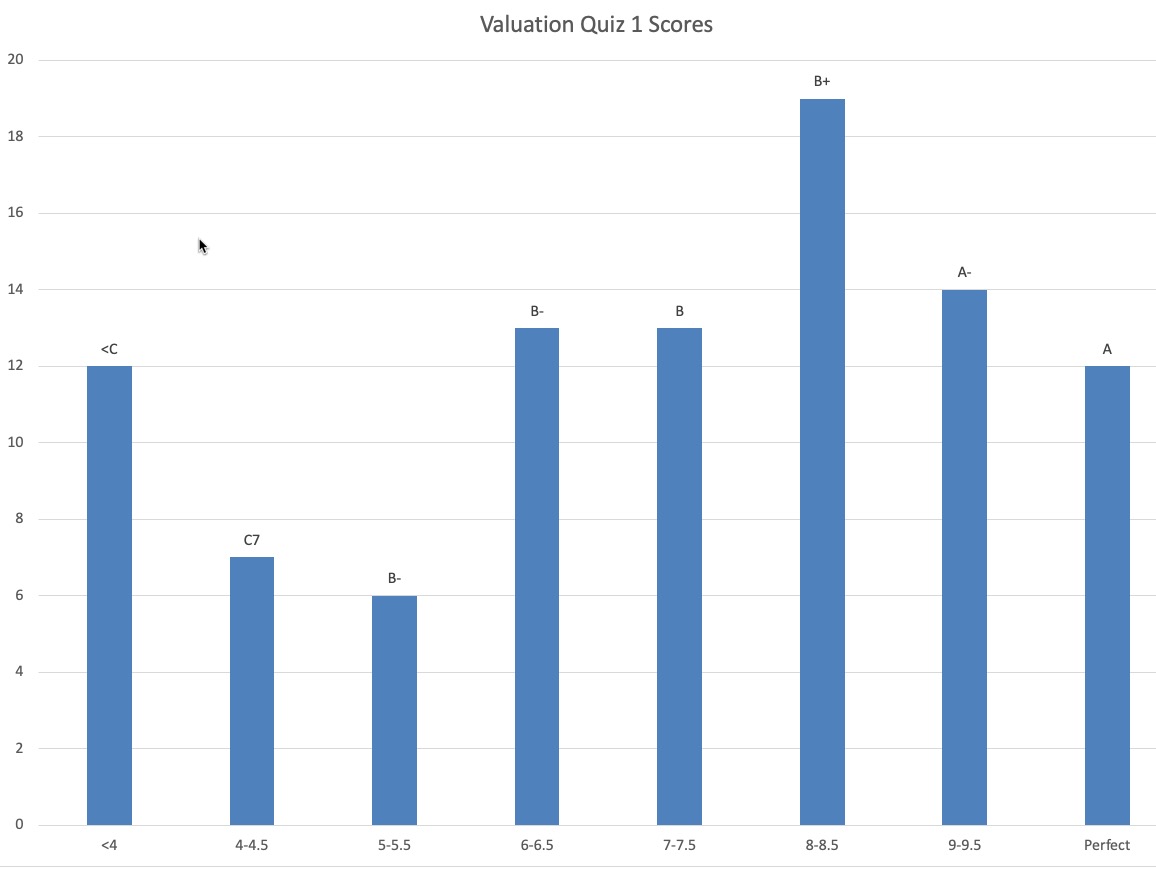
| 3/4/25 | The quizzes have been graded and are ready to pick up. Here are the details on how you can pick them up and check your score:
If you are unable to pick up your quiz, your score should be accessible on Brightspace as well. U
Attachments: Quiz 1, solution and grade distribution |
||||||||||||||||
| 3/5/25 | In today’s class, we spent some time on the key value drivers - revenue growth, operating margins and sales to capital, before tying up loose ends on terminal value, with the dangers of waiting too long to put your company into stable growth and the importance of long term excess returns in determining terminal value. If yo do get a chance read the posts that I have on terminal value that you can find below:
Try this week’s weekly challenge, if you want to strengthen your terminal value mechanics. In the last part of the class, w looked at building a DCF model, and how your choices of which cash flows to discount, the discount rate to use and the growth rates/patterns for a business have to be tailored to the firms.
|
||||||||||||||||
| 3/6/25 | I hope that you are also moving forward on your project. As I mentioned at the start of the class, I will be glad to give you feedback (without a grade) on the intrinsic (DCF) value for your company, if you can get your DCF spreadsheet to me by April 4. While I will not be able to tell you whether your valuation is right or wrong, I can at least tell you whether there are inconsistencies. If you are ready to turn in your DCF for review, please make sure that you send the spreadsheet as an attachment in an email to me, and use “My Perfect DCF” in the subject. (Please, please do not try to change this subject to something else (like my imperfect DCF), since computers don’t do well with nuance).
If you are just starting, I thought I would give you a boost. First, I will not be giving any credit for excel spreadsheet building skills. In fact, I would rather than you focus on valuation and less on spreadsheet building. If you are valuing a non financial service company, the only spreadsheet you will nee is the following;
The spreadsheet comes with add-ons that you may or may not need. Thus, there is a lease conversion worksheet, but if your company follows IFRS or GAAP can capitalizes leases, you can turn it off. There is an option worksheet that converts employee options into a value and recomputes value per share. It also has all of the industry averages (US and global) in it, as worksheets. Use what you want, turn off whatever you do not. To help you in using the spreadsheet, I have this video guide that I recorded on how to use the spreadsheet.
If you are valuing a bank, you can try the dividend discount model that I have online:
This one does not come with a YouTube video (and I may do one soon), but it is far simper. These valuations will give you at least a baseline value, and you can revisit it once we talk about valuing banks in class. If you really, really want to build your own spreadsheet, you can do so, but remember my admonition about less is more and please do not (under any conditions) use a spreadsheet you picked up at an investment bank, since fundamental flaws will be baked into it. |
||||||||||||||||
| 3/7/25 | I have two valuation webcasts for this week.
One relates to accounting returns on capital and how best to estimate them for your company, using Walmart as my example:
Webcast: https://youtu.be/An2SduBDYQE
Walmart 10K (2013): https://www.stern.nyu.edu/~adamodar/pdfiles/cfovhds/webcasts/ROIC/walmart10K.pdf Walmart 10K (2012): https://www.stern.nyu.edu/~adamodar/pdfiles/cfovhds/webcasts/ROIC/walmart10Klastyear.pdf Spreadsheet: https://www.stern.nyu.edu/~adamodar/pdfiles/cfovhds/webcasts/ROIC/walmartreturncalculator.xls An updated version of the return calculator is attached.
Also, as you well know, or will find out soon enough, much of your value per share for your company will come from the terminal value, and I have a webcast on checking terminal value that I hope that you get a chance to look at.
Also, if you are using Capital IQ for the project, and are having trouble, I did get an email on changes access to the database, which I am reproducing below:
I am reaching out from the NYU Libraries E-Resources unit regarding access to Capital IQ. A few students who were having trouble with this resource mentioned they are taking one of your classes. Access instructions for Capital IQ have changed and we wanted to make sure you are aware of the new requirements: https://guides.nyu.edu/az/databases?q=capital%20iq
Namely, users should start with the Database A-Z link listed instead of registering on the platform directly since authentication is now through single sign-on. Additional requirements are listed in the More Info section of the A-Z entry. Please let us know if you have any questions about this - thank you!
|
||||||||||||||||
| 3/8/25 | The newsletter for this week is attached. At this stage of the class, I hope that you have not just picked a company but are working on your intrinsic valuation.
Attachments: Issue 6 (March 8) |
||||||||||||||||
| 3/9/25 | This week, we will look at the loose ends in valuation, starting with cash and cross holdings and then moving on to stock-based compensation and how it affects the intrinsic value that you attach to companies. If you are interested in getting a jump on the latter, you can try this blog post I have on the topic:
Enjoy the last hour of your Sunday, |
||||||||||||||||
| 3/10/25 | During today's session we finished started on the loose ends in valuation, with cash and cross holdings first, and then moving on to other assets. The simple rule to follow is to make sure that you neither double count nor entirely miss assets owned by a firm. We then moved on to look how complexity plays out in valuation, before ending with questions of what to include in debt, with different rules on debt in your cost of capital calculation and debt that you net out from firm value to get to equity value.
The DCF is due three weeks from this Friday (April 4), for feedback, if you want it. If you can get it in earlier, all the better. A few notes on the submission:
1. Individual, not group: This portion of the submission can be done individually and should be done individually rather than as a group, The feedback is specifically for you. As I mentioned in my emails from last week, Please try to use this spreadsheet, since it will make it easier for me to stay with your story and give you meaningful feedback:
If you have a financial service company, try this one instead:
2. Submission content: An Excel spreadsheet will do, with your story in the story worksheet (that is part of the spreadsheet) and any specific assumptions
3. Submission subject: Use “My Perfect DCF” in your subject. (Please don’t deviate from the script. It is to make sure that it gets into the right smart mailbox, and computers have no sense of humor)
Remember that this DCF is for feedback, not a grade, but work on it as if were your final valuation. That way, the feedback will be more focused and perhaps more useful.
To put a bow on this part of the class, I have a blog post that you may find enjoyable about dysfunctional DCFs.
I hope that none of your DCFs fall on this list.
|
||||||||||||||||
| 3/11/25 | Hi,
I know that you are woking on your valuation and have little time to spend on a different valuation. That said, I am usingUber as my example to illustrate the connection between stories and numbers in class, and I thought it would make sense to go back to my original post on valuing Uber:
After pushback from Bill Gurley (please read his takedown of my total market assessment), I came back with a post on how to incorporate feedback into the valuation:
At the end of 2014, I created a crowd valuation of Uber, where I let readers pick their own stories for Uber and valued each story:
I valued Uber almost every year in the following years, and when it went public in 2019, I value Uber ahead of its IPO:
The IPO did not go well, and in March 2020, I bought Uber, when it hit a low of $14/share in the midst of COVID, and I have held it since. The stock recovered in the second half of 2020, and it has tested me in the years since, but it’s been on a run in the recent past, and it now trades at over $80. Put simply, it seems to have finally found a business model (15 years after founding.. And tens of billions of dollars in capital later) that works.
Rather than give you my updated valuation, I am going to give you the updated financials for Uber at the link below:
You can update my 2019 valuation to reflect the updated information and then enter the Google shared spreadsheet:
https://docs.google.com/spreadsheets/d/1gv6Ebxroxt7VQEYRAvIprh6uWv2JDDq990Bv44XN52o/edit?usp=sharing
As you may have read, Bill Ackman is now an Uber investor, and value investors seem to be looking at the company as a prospect. Not sure whether that is good or bad news!
|
||||||||||||||||
| 3/12/25 | In today’s class, we started by looking at stock-based compensation, and why it is an expense that should be treated as one, notwithstanding arguments about it being non-cash. We then started on story telling in valuation, and the process, using Uber in June 2014 as an example. If you want a longer version of my stories to numbers session, you may prefer this Google talk version that I did a few years ago on the same topic:
It is longer and in a little more detail.
In this week’s challenge, I look at stock-based compensation:
Do take a look because it will clear up some questions you have about the mechanics.
|
||||||||||||||||
| 3/13/25 | I know that your project DCFs are not due until April 4, but if you decide to work on your DCF and even turn it in early, here is some general guidance. I will try to get them back to you as soon as I can, and if your submission is not exactly at the deadline, you will get your feedback much more quickly. (If I get all 400 valuations at 5 pm on April 4, it will be first in first out… And that may cause some waiting…)
Don’t put too much pressure on yourself. This is only for feedback. Try your best.
If you are ready to relax and watch some media, I have a couple of great shows for you.
If you prefer reading,
I had blog posts on all three companies in real time:
|
||||||||||||||||
| 3/14/25 | As we get ready for the last week before spring break, I have a valuation tools webcast on valuing employee options and a preview for the quiz. Before you freak out about the latter, it is not until April 7, but just in case...
1. Valuation Tools Webcast: If you are confused about employee options and how they affect value, you may also want to watch this webcast that I put together on doing this in practice. I used Cisco, a monster option granter, to illustrate the mechanics. You can find the links below:
Webcast: https://youtu.be/-sGw4oLPTsM
Cisco 10K: https://www.stern.nyu.edu/~adamodar/pdfiles/eqnotes/webcasts/EmployeeOptions/cisco10K.pdf
Spreadsheet for options: https://www.stern.nyu.edu/~adamodar/pdfiles/eqnotes/webcasts/EmployeeOptions/ciscooptions.xls
I hope you get a chance to watch the webcast and that you find it useful.
2. Quiz 2 Preview: The quiz is not until April 7, a week after you get back from break, but if you want to get an early start, I thought I would send you something to get ready:
Presentation: http://people.stern.nyu.edu/adamodar/pdfiles/eqnotes/valquiz2review.pdf
Webcast: http://www.stern.nyu.edu/~adamodar/podcasts/Webcasts/valquiz2review.mp4 You can also find all past quizzes with the solutions in the following links: All past quiz 2s: http://www.stern.nyu.edu/~adamodar/pdfiles/eqexams/quiz2.pdf Quiz 2 solutions: http://www.stern.nyu.edu/~adamodar/pdfiles/eqexams/quiz2sol.xlsx We have covered almost everything that will be on the quiz.
|
||||||||||||||||
| 3/16/25 | I got you to open the email with the subject, right? Whenever I find myself knocked off balance by things happening around me, I try to regain my serenity (or my happy place, as Winnie the Pooh would put it) by doing two things: (1) step back, elevate and look at the big picture and (2) go back to basics. That is what I have tried to do in this post on Trump, tariffs and Tesla, three hot button topics that are almost guaranteed to pull you into a political debate (that can turn toxic very quickly):
I did try to stay above the political fray, though I may not have succeeded. I hope that you find it interesting (or at least not boring). I have also attached the newsletter for the week.
Attachments: Issue 7 (March 15) |
||||||||||||||||
| 3/17/25 | We started class today by finishing up the discussion of connecting stories to numbers, and how critical it is to keep the feedback loop open. We also looked at how stories can change or break. In that context, you might find this post that I had on how earning reports change stories useful:
We then looked at valuing a simple company (Con Ed) with a simple model (stable growth DDM) and how a market crisis can change value (with 3M). We then moved on to with a, model to value an index (the S&P 500). If you are interested in an updated version, where you can change the numbers try this link:
If it looks familiar, because it was your first valuation of the week in this class. Next session, we will turn to valuing young companies, mature companies and declining companies.
|
||||||||||||||||
| 3/18/25 | In my post on tariffs and trade wars last week, I also revalued Tesla, a company that I have valued multiple time, but most recently at the start of 2024 at about $180 per share. This post from November 2023 frames my early 2024 valuation:
It is undeniable that the world has shifted since that valuation, with three development
(a) A shift away from the “electric cars are inevitable” story, as hybrids made a comeback, and gas powered cars held their own.
(b) A rise in BYD as not just a competitor, but one that actually sold more cars than Tesla in 2024
(c) The politicization of the story, as Musk’s political standing became part of the Tesla story, helping as Trump was elected, and hurting as a backlash developed
I revalued Tesla last week, with these developments built in, and the write up is in the longer post that I have on globalization:
The valuation itself is at the link below;
Finally, if you do try to value Tesla (if nothing else, it will give you a conversation breakers on the beach during spring break), the Google shared spreadsheet is below:
|
||||||||||||||||
| 3/19/25 | In today’s session, we completed our the challenges in valuing young companies, and then took a look at mature companies in transition, and how you have to value the status quo company and the restructured one to make a judgment on investing in it. We then moved on and looked at declining companies, where your forecasts may have to show declining revenues and margins, and added a twist with distressed companies, where you have to follow up your DCF, by estimating a likelihood of failure and the value of your equity if that happens |
||||||||||||||||
| 3/20/25 | Hi,
I know that you are either on your way to enjoying spring break, or already there. I had promised you a week’s break, and this will be your last email until next Saturday, but I have two notes before you leave:
1. DCF valuations: Your DCF valuations are due at the end of the first week back (on April 4) from summer break, and if you have not started working on these valuations, please do. Just to make sure that you have the right spreadsheets, here are your choices;
For non-financial service firms: https://pages.stern.nyu.edu/~adamodar/pc/fcffsimpleginzu.xlsx
For financial service firms (with dividends): https://pages.stern.nyu.edu/~adamodar/pc/divginzu.xlsx
For financial service firms (with potential dividends or modified FCFE): https://pages.stern.nyu.edu/~adamodar/pc/fcfebankvaluation.xlsx
Of course, if you get done earlier, please send your valuation in with “My Perfect DCF” in the title.
2. Quiz 2 Preview: The quiz is on April 7, a week after you get back from break, but if you want to get an early start, I thought I would send you something to get ready:
Presentation: http://people.stern.nyu.edu/adamodar/pdfiles/eqnotes/valquiz2review.pdf
Webcast: http://www.stern.nyu.edu/~adamodar/podcasts/Webcasts/valquiz2review.mp4 You can also find all past quizzes with the solutions in the following links: All past quiz 2s: http://www.stern.nyu.edu/~adamodar/pdfiles/eqexams/quiz2.pdf Quiz 2 solutions: http://www.stern.nyu.edu/~adamodar/pdfiles/eqexams/quiz2sol.xlsx We have covered almost everything that will be on the quiz.
Have a great week, enjoy yourselves and come back rested.
|
||||||||||||||||
| 3/29/25 | I hope that you had a safe and fun spring break, but the last stretch of the class is ahead of us, and it is my unpleasant duty to remind you of what’s coming up:
1. DCF valuations: Your DCF valuations are due at the end of this week on April 4, and if you have not started working on these valuations, please do. Just to make sure that you have the right spreadsheets, here are your choices;
For non-financial service firms: https://pages.stern.nyu.edu/~adamodar/pc/fcffsimpleginzu.xlsx
For financial service firms (with dividends): https://pages.stern.nyu.edu/~adamodar/pc/divginzu.xlsx
For financial service firms (with potential dividends or modified FCFE): https://pages.stern.nyu.edu/~adamodar/pc/fcfebankvaluation.xlsx
As you do your valuations, please make sure that you fill out the story worksheet page in the spreadsheet, backing up your inputs.
Of course, if you get done earlier, please send your valuation in with “My Perfect DCF” in the title.
2. Quiz 2 Preview: The quiz is on April 7, a week from Monday:
Presentation: http://people.stern.nyu.edu/adamodar/pdfiles/eqnotes/valquiz2review.pdf
Webcast: http://www.stern.nyu.edu/~adamodar/podcasts/Webcasts/valquiz2review.mp4 You can also find all past quizzes with the solutions in the following links: All past quiz 2s: http://www.stern.nyu.edu/~adamodar/pdfiles/eqexams/quiz2.pdf Quiz 2 solutions: http://www.stern.nyu.edu/~adamodar/pdfiles/eqexams/quiz2sol.xlsx We have covered almost everything that will be on the quiz.
3. Lecture note packet 2: We will start on the second lecture note packet this week. So, please download it (or print it) if you have a chance:
4. Newsletter for the week: The newsletter for the week is attached.
Attachment: Issue 8 (March 29) |
||||||||||||||||
| 3/30/25 | This week, we will complete packet 1 (intrinsic value) and turn our attention to pricing. Please download the second packet for the class:
If you have checked the syllabus, you will note that it is scheduled to be on May 14 from 1.30 pm - 3.30 pm. That is very late in the game, and many of you have family coming that week for graduation or are traveling on your own. Getting a large enough room in the week of May 5 is tricky and I am considering moving the final exam to an entirely online format (on Brightspace) and giving it on May 8. There are pluses and minuses to doing so. The biggest plus is that you can take it from anywhere in the world, albeit in a different time zone, as long as you do so at the allotted time. That said, the exam, while preserving the format and structure of past final exams, will become a multiple choice exam, with the right answer being all or nothing. There are advantages and disadvantages from this. The first is that I will have to write the questions a little differently to make the answers more absolute, but that is a problem that I can overcome. The second is that since the right answer will be one of the multiple choice answers, you can save yourself time if you get the right answer. The biggest disadvantage is that I cannot give partial credit. Before I pull the trigger on this, I will get a feel for where you stand in class tomorrow with a show of hands, and make my final decision |
||||||||||||||||
| 3/31/25 | In this session, we started with a discussion of whether to concentrate or diversify your portfolio and my (very old) blog post on the topic:
We continued with our discussion of intrinsic valuation, by first finishing our discussion of emerging market companies before turning to financial service firms . For decades, we have valued banks using the dividend discount model, simply because getting cash flows is so difficult, but that approach is built on trusting management at banks to behave sensibly (paying out what they can afford to in dividends) and regulators to do the same. For me, that trust was breached in 2008, and I present a way of estimating FCFE for a bank, using investment in regulatory capital as my stand in for reinvestment. Next session, we will wrap up the valuation section and start on pricing. If you are interested in reading more about valuing financial service companies, try this link:
The Deutsche Bank post is here:
In the context of valuing commodity companies, I talked about how Monte Carlo simulations can help deal with uncertainty. If you decide to go that route, you can use Crystal Ball (an add on to Excel and freely available to Stern students) to make your excel spreadsheet valuation into a simulation.
Finally, I mentioned a documentary on efficient market investing. Here is the WSJ article linking to it:
In today’s session, after the second quiz, we continued with our discussion of intrinsic valuation, by first finishing our discussion of emerging market companies before turning to financial service firms . For decades, we have valued banks using the dividend discount model, simply because getting cash flows is so difficult, but that approach is built on trusting management at banks to behave sensibly (paying out what they can afford to in dividends) and regulators to do the same. For me, that trust was breached in 2008, and I present a way of estimating FCFE for a bank, using investment in regulatory capital as my stand in for reinvestment. Next session, we will wrap up the valuation section and start on pricing. If you are interested in reading more about valuing financial service companies, try this link:
The Deutsche Bank post is here:
|
||||||||||||||||
| 4/1/25 | I am a realist and I understand that you have multiple things on your plate and very little time for extracurricular activities. That said, I thought I would still post a valuation of the week for those of you who are interested and the company for this week is a Latin American company called Mercado Libre. I could describe Mercado as Latin America’s Amazon, but that would not do justice to the company, which has managed to navigate Latin American volatility to become the largest online retail marketplace in the region, while also building an impressive financial services company on the side (Mercado Pago). The picture below should give you a sense of the company’s reach:
This article in Yahoo! Finance from last year does a good job of describing the company’s different arms:
The financial history for the company is at the link below:
My story and valuation for the company are here:
While the stock is over valued (at least based on my story and inputs), I really like the company, and have a limit buy, albeit at a price of $1500 which is well below the current market price. If you do feel the urge to value the company, please share your findings on the Google shared spreadsheet:
|
||||||||||||||||
| 4/2/25 | We started the class by setting the stage of pricing companies, contrasting the pricing process with the value process. The rest of the class was our first foray into pricing, with why pricing is so much more common than intrinsic value and how multiples are just standardized prices. We also started on the first steps in deconstructing pricing, with the definitional tests, followed by a deconsuction of what the variables are that determine each multiple. Next class, we will continue talking about how pricing can be enriched by an understanding of the fundamentals of intrinsic value. Finally, there is a weekly challenge for this week, built around pricing. It is quick to do, but it brings home some of the consistency questions that we talked about in class toda |
||||||||||||||||
| 4/3/25 | I know that you have other things on your plate, but I will nag you about your final project nevertheless. If you have your DCF done, you should have got it back by now, if you have sent them to me for feedback), it is time to think about pricing your company. For the moment, that may just involve computing every conceivable multiple for your company, both equity and enterprise value. Here are a few standards - PE and PBV, for equity and EV/Sales, EV/Invested Capital and EV/EBITDA. You may consider this a waste of time, since many services including Yahoo! Finance compute them for you, but as we noted in class, there are choices that these services make on what to include and exclude in their computations that you may not find palatable. If you want to get creative, you can also compute pricing multiples specific to your sector. With an oil company, this could be EV/Barrels of Oil in Reserves, with ride sharing companies like Uber and Lyft, EV/Rider and with subscription company, EV/subscriber. Next week, we will take tangible steps to finding comparable companies and comparing these pricing multiples across companies. | ||||||||||||||||
| 4/3/25 | Sorry about the second email today, but a few details about the second quiz:
1. Quiz time: On Monday, April 7, from 1.30 pm -2.00 pm
2. Quiz coverage: The quiz will cover packet 1, from page 161- End (Growth, Terminal value, Loose Ends, DCF mechanics)
3. Quiz review/past quizzes:
Presentation: http://people.stern.nyu.edu/adamodar/pdfiles/eqnotes/valquiz2review.pdf
Webcast: http://www.stern.nyu.edu/~adamodar/podcasts/Webcasts/valquiz2review.mp4 You can also find all past quizzes with the solutions in the following links: All past quiz 2s: http://www.stern.nyu.edu/~adamodar/pdfiles/eqexams/quiz2.pdf Quiz 2 solutions: http://www.stern.nyu.edu/~adamodar/pdfiles/eqexams/quiz2sol.xlsx 4. Quiz office hours: I will have extra office hours on Sunday (April 6) from 4 pm - 6 pm. The zoom link is below:
|
||||||||||||||||
| 4/4/25 | One of the most confusing aspects of multiples is dealing with the variants of value out there: firm value, enterprise value and equity value. In this week’s tools webcast, I look at what the differences are between these different numbers and how our assessments of leases & R&D can change these numbers. Start with this blog post:
https://aswathdamodaran.blogspot.com/2013/06/a-tangled-web-of-values-enterprise.html Then watch the webcast: https://youtu.be/hARFCjXQ-G0 You can download the presentation: https://www.stern.nyu.edu/~adamodar/pdfiles/eqnotes/webcasts/multiplecalc/multiplecalc.pdf And the spreadsheet that goes through the calculations: https://www.stern.nyu.edu/~adamodar/pc/multiplecalculator.xls Nothing deep, but if you have ever been confused about the difference between market cap and enterprise value, and why we use one as opposed to the other, I hope that this clarifies things.
Just a reminder again, in case you need one, that I will have office hours from 4 pm - 6 pm on Sunday.
Until next time! |
||||||||||||||||
| 4/5/25 | I did promise you that the class would be exciting, but I was not planning on this much excitement. The bad news is that $6 trillion in market cap evaporated in two days. The good news is that many of the stocks you found over valued last week are now under valued. As I work on pulling together my thoughts on this meltdown, here is the newsletter for this week. Attachments: Issue 9 (April 5) |
||||||||||||||||
| 4/6/25 | I hope to see you in about 15 minutes on the office hours for the quiz, ir you have questions. If you want to lurk on the session, please do so (and I won’t think it is creepy). On a different note, I spent the ten-hour flight and three hour layover yesterday, and a significant portion of today, going through projects and while I have made progress, I am about two thirds of the way through, the 374 projects that I see in “My Perfect DCF” folder. (I noticed that a few of you, perhaps even dozens, submitted your valuation with something other than “My Perfect DCF” in the subject. If so, could you please resubmit with the right subject for the email?)
I do have to take a break to do the quiz office hours. After office hours, I hope to write my piece on tariffs and the markets last week, and that will take me late into the night, leaving me little time to get to the remaining valuations. Tomorrow and much of the day after will be reserved for grading the quizzes. In a longwinded way, I am just saying that if you have not received your project feedback yet, it may not come until Wednesday or Thursday. I am truly sorry, since I believe in speedy feedback, but I am time-constrained. I do believe that getting my thoughts sorted out about the tariffs, as a lead in to markets opening tomorrow takes precedence over the speedy feedback objective. See you in class tomorrow and until next time! |
||||||||||||||||
| 4/7/25 | I hope that you have put the second quiz behind you. If you stayed after the quiz, we spent the bulk of the class talking about the tariff damage to equities, and if you are interested, the blog post is now up and running:
You can also find the slides I used in class here:
I will let you know where your quizzes are ready to be picked up. |
||||||||||||||||
| 4/8/25 | Your quizzes are done and can be picked up on the ninth floor of KMEC. They are on the top shelf of the stand that is to your right just before you get to the door to enter the finance department. They are on the top shelf, in alphabetical order, face down. Please leave them like that. I have attached the solutions, and if you do find a grading error, just take a picture of the page and send it to me. The distribution is also attached.
Attchments: Quiz 2, solution and grade distribution |
||||||||||||||||
| 4/9/25 | As you well know, today’s class came with a technology malfunction (which is better than wardrobe malfunction), but the overhead projector refused to work. As a consequence, I winged it through class without the slides, and even if what I said made sense (and it may not), talking about pricing without being able to see the numbers is challenging. Rather than send you links to this class, which has only audio, I am going to offer you an alternative. I taught almost the same class to the undergraduates (I started six slides later on page 47 and went through page 78. It has slides and audio, and I think it makes more sense to watch that. In fact, I will start the next class with slide 79, and even if you got just the audio part of the class, I would suggest that you watch the last 10-15 minutes, where I talk about pricing the hundred largest market cap companies. The links to the video are below:
Link to video on NYU Server: https://nyu.zoom.us/rec/share/7Wyl4A8UiG97CxzkV2Bs1sQRAdd9jHbeNQzk94TgH160HoZsG5-A7ThaILEA5MFr.v1KU7FR6EzyalXF6?startTime=1744226900000
Downloadable video: https://nyu.box.com/s/3b3zoobvfdwh05v2nnedlf2oqjw2x39e
YouTube version:
Pick any one, and watch it through. During the class, we started by continuing to examine how to deconstruct multiples to determine what drives each multiple, using an intrinsic value model as a starting point and employing algebra for two reasons:
1. It yields a construct for creating your perfect cheap company (low PE, high growth, low risk, high payout etc.) that you can then use as a basis for screening fo cheap stocks. In fact, I have a generic post on screening built around this:
2. It gives you questions you can ask, when presented with a stock to buy or sell, based upon a pricing. (This company is cheap because it trades at 4 times EBITDA, for example…)
3. It yields insight into each multiple’s companion variable, the one number you need to know to use a multiple well. (PE (growth), PBV (ROE), EV/Sales (Operating margin)
While the examples that I used in class are dated, they were meant to illustrate this process, and how statistics can be used as a tool. I hope that you get a chance to exercise that reasoning process.
|
||||||||||||||||
| 4/10/25 | I know that you have other things on your plate, but I will nag you about your final project nevertheless. Please go through the process that we went through in class of choosing comparable firms, finding a multiple that works and then controlling for differences (statistically or otherwise). Along the way, don’t forget that pricing is a pragmatic game. If it works, use it. If you have no idea what this process involves, you may want to watch the session on valuation tools webcast tomorrow. | ||||||||||||||||
| 4/11/25 | If you have trying your hand at the pricing part of your project, you probably also are recognizing that this is an exercise in working with data sets. I have put up a webcast that is more statistics than finance about how to look at data and try to evaluate relationships between variables. I use the banking sector to illustrate my case but I hope that you find it useful for both your project. If you are solid on your statistics, you can skip this webcast, since you already know everything that I am saying. If you need a quick review of the process, I think it will be useful.
Start with the webcast:
https://youtu.be/ttBmW0Dg0nQ Download the slides: http://www.stern.nyu.edu/~adamodar/pdfiles/eqnotes/webcasts/multipleanalysis/multipleanalysis.pdf Here is the raw data: http://www.stern.nyu.edu/~adamodar/pdfiles/eqnotes/webcasts/multipleanalysis/banks2013rawdata.xlsx And the descriptive statistics: http://www.stern.nyu.edu/~adamodar/pdfiles/eqnotes/webcasts/multipleanalysis/bankdescriptives.xls I know that for some of you, a regression is something from a past life, a portion of a long-forgotten statistics class. I am no expert on statistics, but I know just enough to be dangerous, and if want to brush up on your regression basics, you can watch these two sessions I have in my (simplistic) statistics class:
Session on statistical relationships (correlations, covariances, basic regression): https://youtu.be/FrpB3UmVFxQ
Session on regressions (more): https://youtu.be/i7oD_8gPXnI
|
||||||||||||||||
| 4/12/25 | I am attaching the newsletter for the week. As we approach the last few weeks of the semester, and you take stock of where you are in the class, some of you may be wondering how your quizzes, final exam and the project will play out in a numerical final grade. In particular, the question of what happens to the worst of your three quizzes, if you take all three, may be confusing you. I don’t know whether this will help but I have create a scoresheet where you can enter your actual scores for the first two quizzes and the case and prospective scores for the remaining quiz, the final exam and the final project, and see the total score you will have in the class. At the moment, I cannot give you a look up table that will convert that total score into a letter grade, because that will depend on how the entire class performs on the remaining quiz, final and project. Remember that the scores you see on the spreadsheet are not your scores, and as you enter your own scores, you will notice that the bulk of the class grade is still ahead of you, and that is good news for some of you and cautionary news for others. For those of you who have done badly on both of the first two quizzes, it is good news, since a good third quiz and final will rescue your total score. For those who have done really well on the first two quizzes, it is cautionary news, since letting your guard down too soon can still cost you. It also operates as a reminder of why getting your final project done is so critical. Just to give you perspective, the median score on the final project last year was 31/35, with a low of 25 (for one group) and a high of 35. (If you are wondering what the 5 points for number submission is for, it is really for entering the numbers that you find on your company into the master spreadsheet by Sunday, May 4 (and it should be a gimme for almost all of you):
https://docs.google.com/spreadsheets/d/11M36DZLLT4NRdYI-K5wlniQA5HYn5scbxp_uWkikY9E/edit?usp=sharing
So, if you have been lagging on your project, you may want to catch up. Finally, there are two grading overrides, where you can get a score better than your score-based grade.
Attachments: Issue 10 (April 12) |
||||||||||||||||
| 4/13/25 | HI,
In the week to come, we will put the last finishing touches on pricing, before moving on to asset-based valuation, including liquidation and sum-of-the-parts valuation. We will then turn our attention to valuing privately owned businesses, with the emphasis on what you need to do differently when valuing these businesses, as opposed to publicly traded companies. If things go according to plan, we should be close to completing packet 2 by Wednesday, setting you up for quiz 3 which is a week from Monday (April 21st). That quiz will be focused entirely on packet 2, which includes pricing (from last week), asset-based valuation (tomorrow) and private company valuation (Wednesday). If you have the time to get started, the links for the quiz are below:
|
||||||||||||||||
| 4/14/25 | At this point, you should have received your DCF valuation with my feedback (limited and unhelpful though it might have been). I did get through close to 400 valuations in all, and if I seemed abrupt (or rude), I was just trying to keep moving. Rather than leave you with just my judgments, I thought it would be useful to lay out the template that I used in making these judgments, and you are welcome to use this template in making your own assessments.
Thank you again for your intrinsic valuation.
|
||||||||||||||||
| 4/14/25 | In today's session, we started by closing the chapter on pricing, with pricing across an entire market (using a market regression). We then looked at asset based valuation: liquidation valuation, accounting valuation and sum of the parts valuation. Specifically, we focused on when it makes sense to value a company by valuing its assets and what pitfalls to avoid. If you are interested in a more extensive assessment of companies like United Technologies, you may find this reading useful:
We then started our discussion of the valuation of private companies by noting how the lack of a market price for a business can affect your valuation in implicit and explicit ways, and then arguing that the value you attach to a private business can depend on why/for whom you are doing the valuation
|
||||||||||||||||
| 4/15/25 | I know that today is the day that I send the valuation/pricing of the week, in case you were keeping tabs, but I wanted to clear up any questions about timing and due dates for what’s left of the class.
April 21, 1.30- 2 pm: Quiz 3 (Preview and past quizzes below) (10 points)
May 4: Project numbers in master spreadsheet by midnight (5 points)
May 5 (Last day of class); Final Project due by the end of the day (35 points)
May 8: 9 am - 11 am, Online final exam
May 14: 1.30 pm - 3.30 pm: Final Exam, in person in KMEC 2-60
1.30 pm - 3.30 pm: Online
Quiz 3 Preview:
|
||||||||||||||||
| 4/16/25 | In today’s session, we started by looking at the challenges of valuing private-to-private transactions, where the buyer of a private business is undiversified and cares deeply about illiquidity, and how the values are depressed as a consequence. We then drew a contrast to the same company being valued by a public company, and argued that this should lead to private businesses increasingly become parts of public companies or going public themselves. In the final section of the class, we looked at valuing/pricing IPOs, and how to deal with offer proceeds from the IPO and the IPO process itself. In the next session, after the quiz, we will start our discussion of real options, requiring you to download and bring packet 3 with you. Just a reminder if you need one that the third quiz is on Monday and it will cover all off packet 2 (except for the last few pages that we did not get to). |
||||||||||||||||
| 4/17/25 | Since you are preparing for the quiz on Monday, I thought that this would be a good week to skip the valuation tools webcast. If you feel the urge to work on the project, the twelve valuation tools webcasts can be found on this YouTube playlist:
We are also going to be starting on packet 3 next week, and I am attaching the links to the packets in both pdf and ppt formats.
I will also have office hours on Sunday from 4 pm - 6.00 pm, and the zoom link is below:
|
||||||||||||||||
| 4/18/25 | Here a few details about the third quiz:
1. Quiz time: On Monday, April 21, from 1.30 pm -2.00 pm
2. Quiz coverage: The quiz will cover packet 2 (pricing, asset based valuation, Private company valuation)
3. Quiz review/past quizzes:
4. Quiz office hours: I will have extra office hours on Sunday (April 20) from 4 pm - 6 pm. The zoom link is below:
|
||||||||||||||||
| 4/19/25 | The newsletter for the week is attached, though you may be too busy to read it, with the third quiz approaching. If you have questions, the zoom session for the quiz is tomorrow, from 4 pm - 6 pm, is below:
Attachments: Issue 11 (April 19) |
||||||||||||||||
| 4/20/25 | I hope that you have had a good weekend and that you were able to spend some time with family. In hindsight, I wish that I had checked the calendar more carefully before scheduling this quiz, since this was the weekend for both Passover and Easter, and I am sorry for causing distortions in your schedule. For those of you who are still at home, and would like to spend more time there, I do have an option that you can use. The third quiz is online on Brightspace, and it will be available at the same time as the class takes it. If you are able to take the quiz in person, I would still like to see you in class, but if you cannot, please use the online version. | ||||||||||||||||
| 4/21/25 | After we got the third quiz done, we moved on to looking at real options in corporate finance and valuation. We started by looking at the basic option pricing models, and the ingredients that make for real option applications - that there be an option at play (with an underling asset and contingent cash flows), that the option have significant economic value (and the importance of exclusivity) and that the conditions for option pricing model hold (that the asset and the option be traded…). While we did not get much of a chance to apply these tests, we will use them next session to look at different real option applications. |
||||||||||||||||
| 4/22/25 | This email may freak you out, since there is still time left on the project, but since time is scarce, I thought it would make sense to send you this list today. (Section 3 covers what we will do in class tomorrow and Monday, and will not apply for most of your companies.. ) Therefore, if you have not started the project yet, please do. If you have already completed, kudos. If you are in the middle, here is the to-do list , just to keep you organized.
1. DCF Valuation
1.1. Consider feedback you got on your original DCF valuation and respond, but only if you want to.
1.2. Update macro numbers - riskfree rate to today's rate and equity risk premium.
1.3. Update company financials. If a new quarterly report has come out, compute new trailing 12-month numbers, at least for revenues and operating income.
1.4. Review your final valuation for consistency
What you should include in your final report: A picture that shows your valuation (with the story embedded). That will include your story for the company, the key inputs, a summary of your projected cashflows, your key output (including value per share and price per share). If I were turning in a valuation of Boeing, for instance, here is what it would look like (If you are using my spreadsheet, this is already a worksheet in the spreadsheet that you can use to fill in your story.
Do not attach excel spreadsheets or detailed descriptions of how you levered and unleveled betas or capitalized R&D. I trust you on the mechanics...
2. Relative valuation/ Pricing
2.1. Collect a list of comparable firms (stick with the sector and don't be too selective. You will get a chance to control for differences later) and raw data on firms (market cap, EV, earnings, revenues, risk measures, expected growth)
(You can this data from Bloomberg or Cap IQ. The latter is a little more user friendly) You don’t have to show me your entire list of companies, but list out how many firms are on your comparable list.
2.2. Pick a multiple to use. There may be an interative process, where you use the regression results from 2.4 to make a better choice here)
2.3. Compare your company's pricing (based on a multiple) to the average and median for the sector. Make a relative valuation judgment based upon entirely subjective analysis.
2.4. Run a regression across the sector companies. (Be careful with how many independent variables you use. As a rule of thumb, you can add one more independent variable for every 10 observations. Thus, if you have only 22 firms in your list, stick with only two.)
2.5. Use the regression to make a judgment on your company and whether it is under or over valued. (If you are using an EV multiple, estimate the relative value per share. This will require adding cash and subtracting out debt from EV to get to equity value and then dividing by the number of shares). If none of the regression yield useful predictions, explain that you did try and use the average for the sector for your companies.
2.6. Use the market regression on my website to estimate the value per share for your firm. You can find the regressions here:
What you should include in your final report: Tell me what multiple you used in pricing (and why), the comparable firms you used (with sample size), how you controlled for differences (if you used a regression, give me a summary of what you found with statistical significance - t stats and R squared) and your pricing judgment. For example, if I were presenting a pricing for Boeing, this is what it may look like:
Multiple used: EV to Sales, because earnings are negative and EV to Sales has the highest R squared among the different EV multiples
Comparable firms: Global aerospace and defense firms (Sample size = 28 firms)
Control tool: I ran a regression of EV to Sales against operating margins across the 28 firms
EV/ Sales = 0.83 + 6.51 (Pre-tax Operating Margin) R squared = 38.33%
(1.35) (4.56**)
(Numbers in brackets are t statistics with the two stars indicating significance at the 99% confidence interval)
Boeing’s pricing = 0.83 + 6.51 (.096) = 1.46 (I used expected future margins, since 2020 margins will be negative)
Boeing EV = 1.46 * $76,559 = $111,390
Boeing Pricing per share = $164.11 (I added cash and subtract out debt to get to equity value, before dividing by number of shares)
3. Option valuation (Next week’s classes...)
3.1. Check to see if your company qualifies for an option pricing model. It will have to be a money losing company with significant debt obligations (a market debt to capital ratio that exceeds 50%).
3.2. If yes, do the following:
3.2.1: Use your DCF value for the operating assets of the firm (not the equity value) as the S in the option pricing model
3.2.2: Use the book value of debt (not the market value) as the K in the option pricing model
3.2.3: Check your 10K for a footnote that specifies when your debt comes due. Use a weighted-maturity, with the weights reflecting the debt due each year. (You don't have to worry about duration)
3.2.4: Estimate the variance in firm value, using your own estimates or the industry averages that I have estimated and are built into the linked spreadsheet.
3.2.5: The value of equity that you get from this model is your option pricing estimate of value for equity.
What you should include in your final report: Boeing is losing money, but its debt is only $28.5 billion (about 25% of its value). So, the option to liquidate is not worth computing.
4. Bringing it all together
4.1: Line up your intrinsic value per share (from the DCF model), the relative value per share (from the sector), the relative value per share (from the market regression) and the option based value per share (if it applies)
4.2: Compare to the market price in May 2024 (the date will depend on when you get done)
4.3: Make your recommendation (buy, sell or hold)
What you should include in your final report: My DCF value ($160/share) and pricing ($164/share) are both higher than the current price. I am buying Boeing.
5. Numbers to me!!!!
Fill in the Google shared spreadsheet when you have the numbers for your company.
https://docs.google.com/spreadsheets/d/11M36DZLLT4NRdYI-K5wlniQA5HYn5scbxp_uWkikY9E/edit?usp=sharing
To provide some motivation beyond my pathetic begging, I will assign 5 points out of the 40 points on the project to just getting the numbers into the spreadsheet before midnight on May 4. (Please don’t enter random numbers)
6. Final Project write up
Write up your findings in a group report and submit as a pdf file. The report should be brief and need not include the gory details of your DCF valuation. Just provide the basic conclusions, perhaps the key assumptions that you used in each phase of valuation. There should be relatively little group work. So, you may not really need to get together for much more than basic organization of the report. The group report is due electronically by Monday, May 5, at 5 pm and should be in pdf format. You do not need to attach the raw data and excel spreadsheets). I am not a stickler for format but here are good examples of reports from previous semesters online.
Just to keep the over zealous from going over board, I am going to put a page limit of 15 pages for each report (for up to five companies). You can add three extra pages for each additional company to the limit; with 7 companies, the page limit is 21 pages. If you are doing your valuation individually, a page limit of 4 pages applies. Please do not attach excel spreadsheets. And no.. you don't have to do everything that these groups did. I just like the fact that the valuations were organized, presented in much the same format and were to the point. Of course, content matters.
|
||||||||||||||||
| 4/23/25 | I am in the process of moving offices, to accommodate construction and I am trying to lighten my load. I have quite a few copies of the third edition of my Investment Valuation book (albeit the third edition) and a few copies of Applied Corporate Finance, up for grabs. I also have Korean, Chinese, Polish and even Russian editions of my books for anyone who wants them. (Since I cannot read any of these languages, I am afraid that I cannot attest to whether the translations are accurate). So, if you want to come by my office today (until 10.15, 12-1.15 and from 5 pm - 5.30 pm), you are welcome to whatever you want. | ||||||||||||||||
| 4/23/25 | In this session, we moved on with an examination of option pricing models, and used real options to examine why the rights to non-viable technology can be valuable and why the values of natural resource companies are affected by both the level and variability of commodity prices . As a cautionary note, you are pushing option pricing models to breaking point when using them to value these options, but the key takeaway is that even if you do not value the options explicitly, understanding that they exist can alter how you behave as a business. It is also true that the information that you will need to value many real options will be accessible only if you work at the pharmaceutical or natural resource company, and consequently, you cannot apply it to your company (project), since you will not have that access. During the course of the class, there were a couple of places where I was guilty of not being as clear as I should have been. One was when we discussed why I used guarantor’s pre-tax cost of debt in my present value calculation for Biogen’s license fee. Let me break down my rationale into multiple parts:
I also looked at undeveloped reserves as options, and why using discounted cash flow valuations may under value commodity companies, as well as the value of the option to abandon investments and projects. This week’s challenge tries to bring home this message. |
||||||||||||||||
| 4/24/25 | I promised you a nag-a-day, and I will keep that promise. A couple of days ago, I emailed you a project to-do list, and if you get a chance, browse through that list. If you have never received feedback on your DCF, it is buried somewhere under a thousand emails, and it is best that you send it again. As for the pricing, here are my suggestions:
1. Pick your peer group (and this may require some trial and error). You can start narrow (sam business, same geography, same size) but you may well have to ease your constraints to get more companies into the sample.
2. Download the raw data on these companies. My relative value raw data files from Capital IQ usually include the following items:
a. Market cap b. Total debt c. Cash and investments d. Revenues e. EBITDA f. EBIT g. Net Income h. Dividends i. CAGR in net income (historical) j. CAGR in revenues (historical) k. LT EPS growth (this is an expected growth rate, and don’t be surprised if you cannot find it for many of your firms) l. Expected revenue growth rate (next two years) m. Common Equity n. BetaThe advantage of downloading all of this into a spreadsheet is that you can now use this data to compute almost any multiple (PE, PEG, PBV, EV/EBITDA, EV/EBITDA, EV/Sales, EV/Invested Capital) as well as the control variables (ROE, ROIC, Payout ratio, etc.). Save your display columns, since you may want to go back and add industry specific data like Tier 1 capital for banks, oil reserves for oil companies) 3. Your sample size will determine what you do next:
4. Run the regressions, but dfont’ fight the data. 5. For the market regressions, use the regressions on my webpage. In using these regressions on young, money-losing companies (with negative margins and accounting returns), you can get strange numbers. Here again, using your expected margins and returns on equity (look at your DCF at year 5 or year 10) will get you more meaningful values. 5. Compare your price to your pricing, and be ready for the possibility that you get a different signal (under or over valued) than from your DCf. You then have to decide whether you are more an investor or a trader at heart (go back and review the early section on value versus price). |
||||||||||||||||
| 4/25/25 | This is the last of the valuation tools webcasts emails. I just added webcasts on how to value patents as an option as well as valuing distressed equity, using option pricing models.For the patent valuation, here are the links:
Presentation: http://www.stern.nyu.edu/~adamodar/pdfiles/eqnotes/webcasts/optiontodelay/optiontodelay.pdf
Spreadsheet: http://www.stern.nyu.edu/~adamodar/pdfiles/eqnotes/webcasts/optiontodelay/productoption.xls
If you get ambitious and want to work on getting ready for the final exam, which is scheduled for May 8, from 1.30 pm - 3.30 pm, here are the links
Webcast: https://youtu.be/_8HYZ-BaBSA
You can also find past final exams and solutions at this link:
Past solutions; http://www.stern.nyu.edu/~adamodar/pdfiles/eqexams/finals.xlsx
As you look through the past finals, you will notice a shift from earlier finals to the ones in the last five years. The older finals have fewer questions, with multiple parts to them, whereas the new final exams have more, stand-alone questions. The intent was to protect you from having mistakes in early parts spill over into later parts, and I think it does make your life easier. I have also decided that the final exams for this year will follow the same format (9-10 stand-alone questions, with worked through answers and no multiple choice questions). If you want to take the exam online (either on May 8 or May 14), please go to this google shared spreadsheet and tell me whether you will be New York on the date (May 8 or 14) that you are scheduling your online exam. (If enough people sign up for May 8, and most of you will be still in New York, I will find a room to take the exam in-person, which would be my preference).
https://docs.google.com/spreadsheets/d/1J7oa6y-IcYITyvnRZ1X-MyQ48vRnnUODFN_gW97VcYY/edit?usp=sharing
In addition, I have also modified the times for the valuation and corporate finance final exams on May 8, so that they do not clash:
Valuation: 10 am - 12 pm on May 8
Corporate finance: 3.30 pm to 5.30 pm on May 8
If you have circumstances that make all these choices untenable, please reach out to me. Finally, if you get a chance, please check your quiz scores on Brightspace, to make sure that they match up to what you have. Mistakes do happen! (Notice the passive tense on that sentence)
|
||||||||||||||||
| 4/26/25 | The countdown has begun. We have three sessions left in the class, nine days until the project is due and twelve (or eighteen) days until the final exam, depending on whether you are taking it early (on May 8 from 10 am - 12 pm) or at the regularly scheduled time (but who’s keeping count, right?) The last newsletter is attached and while it contains no real news, it is a ritual that I go through each week. As you work on your project, please do enter your final numbers in the Google shared spreadsheet:
|
||||||||||||||||
| 4/26/25 | This is the last of the valuation tools webcasts emails. I just added webcasts on how to value patents as an option as well as valuing distressed equity, using option pricing models.For the patent valuation, here are the links:
Presentation: http://www.stern.nyu.edu/~adamodar/pdfiles/eqnotes/webcasts/optiontodelay/optiontodelay.pdf
Spreadsheet: http://www.stern.nyu.edu/~adamodar/pdfiles/eqnotes/webcasts/optiontodelay/productoption.xls
If you get ambitious and want to work on getting ready for the final exam, which is scheduled for May 8, from 1.30 pm - 3.30 pm, here are the links
Webcast: https://youtu.be/_8HYZ-BaBSA
You can also find past final exams and solutions at this link:
Past solutions; http://www.stern.nyu.edu/~adamodar/pdfiles/eqexams/finals.xlsx
As you look through the past finals, you will notice a shift from earlier finals to the ones in the last five years. The older finals have fewer questions, with multiple parts to them, whereas the new final exams have more, stand-alone questions. The intent was to protect you from having mistakes in early parts spill over into later parts, and I think it does make your life easier. I have also decided that the final exams for this year will follow the same format (9-10 stand-alone questions, with worked through answers and no multiple choice questions). If you want to take the exam online (either on May 8 or May 14), please go to this google shared spreadsheet and tell me whether you will be New York on the date (May 8 or 14) that you are scheduling your online exam. (If enough people sign up for May 8, and most of you will be still in New York, I will find a room to take the exam in-person, which would be my preference).
https://docs.google.com/spreadsheets/d/1J7oa6y-IcYITyvnRZ1X-MyQ48vRnnUODFN_gW97VcYY/edit?usp=sharing
In addition, I have also modified the times for the valuation and corporate finance final exams on May 8, so that they do not clash:
Valuation: 10 am - 12 pm on May 8
Corporate finance: 3.30 pm to 5.30 pm on May 8
If you have circumstances that make all these choices untenable, please reach out to me. Finally, if you get a chance, please check your quiz scores on Brightspace, to make sure that they match up to what you have. Mistakes do happen! (Notice the passive tense on that sentence) .
|
||||||||||||||||
| 4/27/25 | Tomorrow, we will first look at equity as an option, and towards the last half of the class turn our attention to the many sins in acquisition valuation and as a precursor, I have attached a series of questions that cut to the heart of acquisition valuation and will form the backbone for tomorrow’s class. It is a great way to review the entire class while also getting ready for tomorrow’s class. So, please give it your best shot. On Wednesday, in the second to last session, we will turn our attention to the last part of this class, where we will go inside companies and look at the levers to increase value. For those of you who will be in consulting, strategy or running your own businesses, you will get to see what drives value up (or down). As you embark on the closing touches of the project, here are a few things to keep in mind:
1. Tweak your DCF, if you need to, estimate a value and let it go. This is an ongoing story and this your take, as of right now. I know that some of you have had new quarterly reports coming out, but you also face a realistic time constraint. I will not require that you update the inputs into valuation to reflect the new report, and for the most part, it will not make much of a difference to value, if it does not change your story. I did update the equity risk premium every day in April and it is currently at about 4.63% (as of April 28). I know it is a big earnings week, and if you have the time to update your valuation, please do so. If not, leave it at the pre-report value.
2. Do the pricing of your company, recognizing that your final pricing conclusions are going to be a function of the multiple you use, the companies you use as comparable firms and how you control for differences. If your R-squared is low, try alternatives, but at some point, adopt the karmic pose. It is what it is. If you have a money-losing company, rather than force its current negative margins and accounting returns into pricing regressions and getting strange looking numbers, try using forward pricing, where you take your predicted margins and accounting returns (the DCF that you did contains both) in a future year and use those to get forward multiples of revenues or earnings and then discounting the pricing that you get for your equity back to to.
3. If the option pricing applies to your company, try it. For most of you, this will not apply.
4. Make your recommendation and I will accept your judgment. When you make your recommendation, remember that while you may have chosen to finish your valuation as of April 15 or April 22 or some other day, your recommendation will be as of close of trading on May 2 (Friday, before your last weekend). That effectively means that the price you will be using will be as of that day (please enter that price into the Google shared spreadsheet). I know that you cannot be updating your DCF and pricing through that day, but making a recommendation from some day in the past is pointless, unless you have a time machine. Recognize that this will mean that given how much prices move, your over valued stock from two weeks ago may be under valued now. A pain in the neck, I know, but reality bites.
5. Go into the Google shared spreadsheet and enter the numbers for your company. Under date of the valuation, I notice some of you are entering dates like December 2024, which is implausible and perhaps even impossible. You may have used financial statements ending as of December 31, 2024, but you certainly did not value your company on December 31, 2024. The date of your recommendation is May 2, and while your DCF valuation may precede that date, you are using it as your estimate of value on May 2.
|
||||||||||||||||
| 4/28/25 | We started today's session by looking at the value of flexibility through the option pricing lens and concluding that the value of flexibility is greatest at capital constrained firms, with uncertain and lucrative investment opportunities. We then turned to looking at distressed equity as an option, focusing on money-losing companies with a lot of debt, and used that template to talk about why equity in deeply troubled firms can continue to trade in the face of financial adversity, how equity investors can shift risk at highly levered firms and why equity in conglomerates can become less valuable, even if you buy companies are fair value. I am sorry if you found the rest of today's session to be a downer. Don't get me wrong. Acquisitions are exciting and fun to be part of but they are not great value creators and in today's sessions, I tried to look at some of the reasons. While the mechanical reasons, using the wrong discount rate or valuing synergy & control right, are relatively easy to fix, the underlying problems of hubris, ego and over confidence are much more difficult to navigate. We will continue that discussion in the next class, and spill over into how to enhance value at a company. |
||||||||||||||||
| 4/29/25 | I hope that you are moving towards completion on your project. I am tracking your numbers on the Google shared spreadsheet, and if you have not entered them in already, please try to get your numbers in by Sunday (the earlier in the day, the better). If you already have your numbers in there, and want to change them, you have until Sunday to do it, before I download to prepare for the last class:
https://docs.google.com/spreadsheets/d/11M36DZLLT4NRdYI-K5wlniQA5HYn5scbxp_uWkikY9E/edit?usp=sharing
As you put the wrap on your projects, here are some final points to consider:
|
||||||||||||||||
| 4/30/25 | In this class, we continued to make a case against acquisition practices, with transaction multiples, accretion and defensive deals all under fire, before looking at the narrow pathways to generating value from acquisitions (go small, buy private, focus on cost synergies). We then started our discussion of value enhancement, by drawing a contrast between price and value enhancement. With value enhancement, we broke down value change into its component parts: changing cash flows from existing assets, changing growth rates by either reinvesting more or better, lengthening your growth period by creating or augmenting competitive advantages and lowering your cost of capital. In the next and last session for this class, we will use this framework to compute an expected value of control as a the product of the probability of changing the way a company is run and the value increase from that change (optimal - status quo value |
||||||||||||||||
| 5/1/25 | I know that you are working on the project, and that your numbers are taking form. As you get your final numbers, please go into the Google master list:
https://docs.google.com/spreadsheets/d/11M36DZLLT4NRdYI-K5wlniQA5HYn5scbxp_uWkikY9E/edit?usp=sharing
I do need those numbers for Monday’s class. So, please get them by late night Sunday, and the earlier the better. If you have entered numbers and want to change them, you are welcome to do so before Sunday.
As for the final project report, I have been remiss in giving you information in bits and pieces, and I think I should clarify the details, just in case:
1. Project due date: May 5, by 5 pm or close to that time…
2. Project content: For each company, please give me your DCF value, your pricing against the sector, your pricing against the market and a recommendation. For those companies, where an option pricing model works, you can add the value from the option model as well. For pricing, you do not need to show me a listing of your sample, but give me sample size and specifications (what were your criteria), and if you run a regression, the key statistics (R squared, t statistics).
2. Format: Please turn in one project for the entire group, as a pdf file (preferable to word). No excel spreadsheets or attachments, please. On the cover page, include the names of the group members, in alphabetical order, and a table listing your company name, price per share, value per share, pricing per share and your recommendation. Here is an example from last year:
3. Page constraints: Please try to restrain yourself. , The page limit of 15 pages (not including the cover page) for each report (for up to five companies), with two three additional pages tor each additional company in your group. As I mentioned in class, one way to meet the constraint, is to copy and paste the story to numbers page worksheet (and you can dress it up, if you want) as your DCF summary.
4. Delivery: Please send the project to my email, with “The Grand Finale” in the subject. Also, the person who sends the report should cc everyone else in the group, so that when the project is graded and returned, it will get back to all of the group members.
I will be in my office (KMEC 9-69) from 2 pm - 4 pm tomorrow, for any questions you have about the project, since it is more efficient to ask and get your questions answered in person. I also have a zoom link if you are not going to be able to make it in person, and still have questions:
Finally, please go into the final exam spreadsheet and let me know your final exam choice (May 8 or May 14, in-person or online), with the recognition that if enough people plan to take the exam on May 8, and they are in New York, the final exam will be in person in a room TBA.
|
||||||||||||||||
| 5/3/25 | If you are wondering why I listed a Shakespeare play in the subject, it is to help along those of you who have reached the end stage of your valuation and are pondering on what recommendation to put (buy, sell or hold). As you make this judgment, your task will be made easier or more difficult by what you have found in your intrinsic value and pricing assessments. Let’s start with the easy ones, where your intrinsic value and pricing yielded roughly the same assessments for your company.
Approach Intrinsic value Pricing Judgment
DCF Undervalued Underpriced Relatively easy. Buy.
DCF Overvalued Overpriced Relatively easy. Sell
DCF Fairly valued Fairly priced Relatively easy. Hold
Your challenge will be when the two approaches yield conflicting results - one suggests under valuation/oricing and the other over valuation/pricing. There is no equation or template that I can offer you, since what you decide to do will depend on
(a) where you have an investing or trading temperament (read this post https://aswathdamodaran.blogspot.com/2013/10/twitter-ipo-why-good-trade-be-bad.html, to understand the difference) and
(b) how much faith you have in your DCF and pricing. Thus, if your pricing is based on a regression with a shaky peer group and with a low R-squared, this is the place that will come into play, since you will discount the pricing and base your decision on the DCF. On the other hand, if you felt like you were plucking at thin air in assessing growth, margins, reinvestment and risk in your DCF, and your pricing is solid, you may weight the latter.
Ultimately, though, don’t think of yourself as an equity research analysis, who has luxury of telling other people how to invest their money. Treat this as your money at play, and make a decision. This is where you should not behave the indecisive Hamlet, where you spend a day on the “To buy (sell), or not to buy (sell)” decision, but try to follow the Nike slogan of "Just do it!”.
When you enter your numbers into the master spreadsheet, please make my life easier by following two suggestions:
1. Even if your intrinsic value was done earlier in the semester, enter the closing price as of yesterday. You cannot invest in hindsight.
2. When you enter your numbers on DCF value, price per share and your pricing, use the currency function in excel to change your currency rather than manually adding a currency symbol to a number. If you do the latter, Excel will not recognize it as a number, and I have to fix it to make it usable. |
||||||||||||||||
| 5/3/25 | I am sorry to get in the way of finishing the final project, but I do need some clarity on the final exam. As you know there is a google shared spreadsheet, where you make your final exam choices:
https://docs.google.com/spreadsheets/d/1J7oa6y-IcYITyvnRZ1X-MyQ48vRnnUODFN_gW97VcYY/edit?usp=sharing
Some of you have entered your choices already, and this is what I have right now:
If you are in the 57 who have made no choice, or the two who entered online on May 8 (but did not specify location), please make your choice as soon as you can, since a whole host of other logistical choices await me, after I get to know this breakdown.
|
||||||||||||||||
| 5/4/25 | The masterlist is filling up, and thank you:
https://docs.google.com/spreadsheets/d/11M36DZLLT4NRdYI-K5wlniQA5HYn5scbxp_uWkikY9E/edit?usp=sharing
If you have not entered your company’s numbers, please do so by midnight tonight. A couple of final projects have come in as well and I am impressed, since the deadline for the final project itself is not until tomorrow at 5 pm, and don’t forget to include all your group members in the cc and put “The Grand Finale” in the subject. I thought I would take this moment before I descend into a time crunch on what I will be doing on my end:
1. At the moment, I am just fielding last minute questions (and there happen to be a few) about the project
2. At about midnight: I will take the numbers from the masterlist and download them into a spreadsheet, where I will summarize what you found in terms of intrinsic value, pricing and final recommendations.
3. Those summary statistics will go into a powerpoint presentation that I am putting together for tomorrow, and I hope get a link to the presentation to you by 12.30 pm tomorrow, an hour ahead of class. So, please check your email before coming to class.
4. The class will be a review of the entire semester, with your numbers operating as anchors. I know that some of you have been using the convenience of zoom sessions to take classes online, and I am okay with that. For tomorrow’s class, though, I would really, really like to see you in class, in person, if you can make it.
That’s its for the moment and I will see you in class tomorrow. |
||||||||||||||||
| 5/5/25 | Slides are ready. See you in class! Attachment: Closing presentation |
||||||||||||||||
| 5/6/25 | I am finished with your projects (I think), though there may be a few stragglers (who put the wrong subject in). As you review your project, your thoughts are probably turning to the final exam. Here are the details:
When: On Monday, May 14 from 1.30 pm - 3.30 pm pm, in KMEC 2-60 (where we have our class). There are two online options, one for May 8, from 10 am - 12 pm and one for May 14, from 1.30 - 3.30 pm, for those who choose that option. As I did mention in class and on other emails, if you are around on May 14, I would prefer that you take the exam in person, if you can, but if you cannot, the online option is available. (If you have an extended time arrangement, please let me know.)
How: For the physical exam, the answer is obvious. Show up in KMEC 2-60 at 1.30 pm on May 14, find a seat, and take the paper exam. If you are taking it online, you will need to get on Brightspace, and the exam will show up on your page at your scheduled time (on May 8 and May 14). (You will need an internet connection for the exam time). At the time of your exam, you will be able to get into the exam, and you will take it on Brightspace, typing your answers directly into the box below the question (you cannot take pictures of hand written pages, since it creates a nightmare for me while grading.) The questions will look like exams on past finals, and will need you to work through to get to an answer, with partial credit. So, please show you work. If you put down just the answer, I will not give you any credit, even if it is the right answer.
What will it cover: Everything we have done in the class.
How do I prepare: Here you go (you’ve seen it before, but just in case):
Webcast: https://youtu.be/_8HYZ-BaBSA
You can also find past final exams and solutions at this link:
Past solutions; http://www.stern.nyu.edu/~adamodar/pdfiles/eqexams/finals.xlsx
|
||||||||||||||||
| 5/7/25 | If you are taking the exam online tomorrow (or on May 14), I set up last year’s final exam as a trial exam for you to try. It may make sense for you to try this exam, and see how it feels answering the questions online (since you have to show steps to get to the answer). You may find having props like a calculation, pencil and a pad useful, but work it out yourself. Jacob Case took the trial exam and this is what he had to say:
I found that it helps if I set up extra space on a table or desk for my hand calculations and then I can easily sum up the numbers I am using. It is helpful to run through the practice as I know now how to better manage time as I was able to get through 4 problems in about 45 minutes which has me on time with doing 9 in 2 hours. Any advice I'd give others is to have enough space, calculator out and ready, and quickly summarize your variables and formulas/steps to show work in the text box.
|
||||||||||||||||
| 5/8/25 | Your final exams are graded, and if you took them physically, you can pick them up in the usual spot (KMEC 9th floor). If you did them online, you can check your answers against the attached solutions. I should have your final grades up tonight. Attachments: Final Exam and Solution |